
Boxwood psyllid
Psylla buxi
Description
How to identify
The boxwood psyllid (Psylla buxi) is a small jumping plant louse belonging to the family Psyllidae. Adults are approximately 3-4 mm long, pale green to yellowish-brown in color, with clear wings and strong hind legs for jumping.
The nymphs are the most recognizable stage; they are flattened and covered in a dense, white, waxy substance that looks like tufts of cotton or wool, serving as a shield against predators.
This species typically has one generation per year. They overwinter as early-instar nymphs sheltered under the bud scales of the boxwood host plant.
In early spring, coinciding with the flushing of new growth, the nymphs emerge from their winter dormancy to begin feeding on the sap of tender young leaves.
By late spring, adults emerge and mate, laying eggs in the crevices of bud scales, which then remain dormant until the following spring, completing the annual cycle.
What it damages
The host range is specific to plants within the Buxus genus, with boxwood (Buxus sempervirens) being the primary target for this sap-sucking pest.
Feeding by both nymphs and adults causes physiological stress to the plant, which may result in stunted growth and a general decline in the shrub's health.
The most distinctive damage is caused by the nymphs' feeding activity, which interrupts the normal development of the leaf tissues on new growth.
While the aesthetic damage is often more concerning than the actual mortality of the plant, heavy infestations can lead to a significant loss of foliage density.
Furthermore, weakened plants are more susceptible to opportunistic pathogens and environmental stressors, which can aggravate the damage caused by the insect.
Signs of infestation
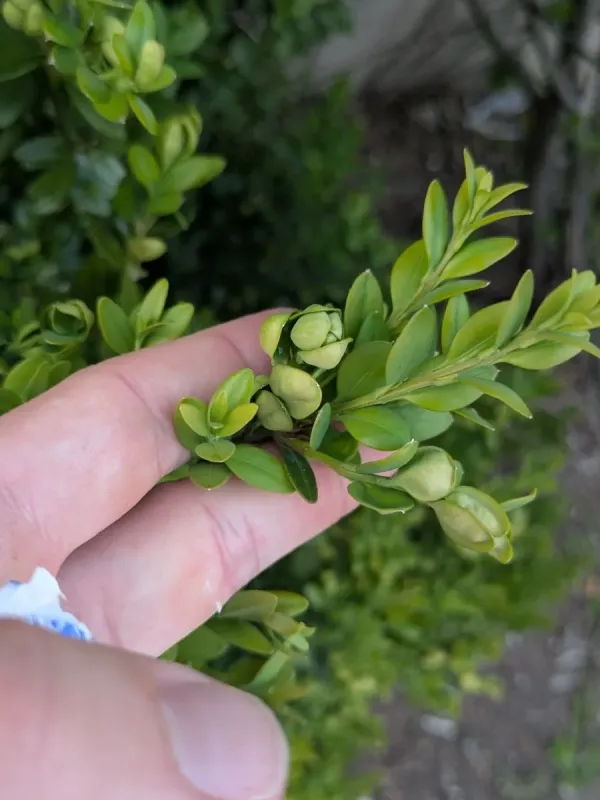
The hallmark sign of a boxwood psyllid infestation is the characteristic cupping or curling of new leaves at the tips of the branches, creating a small shelter for the nymphs.
When the cupped leaves are pried open, the white, waxy secretions of the nymphs are clearly visible, confirming the presence of the pest.
In addition to leaf cupping, infested plants often exhibit stunted shoots, which can make the overall appearance of the boxwood hedge look distorted or uneven.
Like many other sap-sucking insects, they excrete honeydew, which can lead to the growth of sooty mold, appearing as a black, dusty coating on the foliage.
- Distinctive cupping of young leaves.
- White, woolly-like wax covering nymphs.
- Stunted or deformed shoot growth.
- Presence of sticky honeydew.
- Black sooty mold on leaves.
Control measures
The most practical non-chemical control method is the pruning of infested shoot tips during the spring before the adults emerge, which helps remove a large portion of the population.
If chemical intervention is necessary, systemic insecticides are highly effective as they are absorbed by the plant and kill the nymphs as they feed on the sap.
Applications should be timed correctly in early spring, precisely when the nymphs begin to hatch and emerge from their protective bud scales before the leaves curl significantly.
The use of horticultural oils can be effective against the nymphs, but it requires thorough coverage to penetrate the waxy protective coating that the insects produce.
Maintaining vigorous plant growth through proper irrigation and balanced fertilization helps the boxwood tolerate and recover more effectively from pest feeding.
Taxonomy
- Latin name
- Psylla buxi
- Order
- Hemiptera (bugs, aphids, leafhoppers)
- Family
- Psyllidae
- EPPO code
- PSYLBU
Discussion
No discussions yet — be the first.