
Alder psyllid
Psylla alni
Description
How to identify
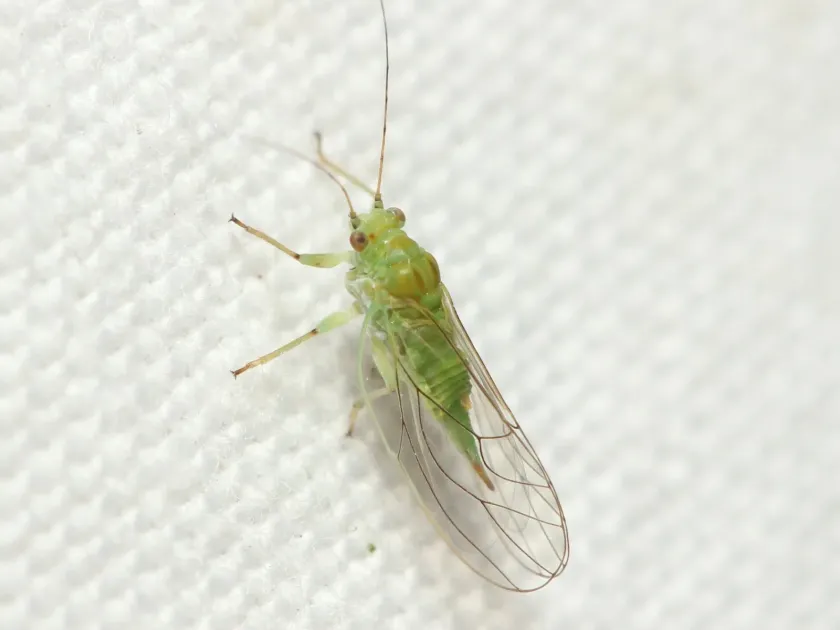
The alder psyllid (lat. Psylla alni) is a small insect belonging to the order Hemiptera and the family Psyllidae. Adults are characterized by powerful hind legs adapted for jumping and transparent wings that fold tent-like over the body.
The appearance of the adults can vary from green to brownish, which provides excellent camouflage against the alder foliage. Their body length typically ranges between 3 and 4 millimeters, with a broad head and prominent complex eyes.
This species is a specialized pest closely associated with alder trees. The nymphs have a flattened body shape and are often covered in waxy secretions, which serve as a protective layer against environmental stress and predators.
The development cycle follows hemimetabolous metamorphosis. The life cycle is intricately synchronized with the phenology of its host plant, ensuring high survival rates within its natural habitat.
These insects are highly mobile; when disturbed, adults perform rapid jumps, which often makes their detection and population monitoring challenging for forestry professionals.
What it damages
The primary host plants for this pest are alders (Alnus species, particularly black and grey alder). They are found throughout the range of these trees, causing significant damage in both natural forests and urban landscapes.
The insect feeds by piercing plant tissues and sucking cell sap from young leaves and shoots, which disrupts the host plant's metabolism. High population densities can cause substantial weakening of young saplings.
Damage is systemic, as large colonies feeding on the canopy deplete the tree's growth potential. Severely weakened trees become increasingly susceptible to secondary infections, such as fungal pathogens or bark beetles.
In forest nurseries, high activity of alder psyllids can significantly slow down the growth of young trees, reducing the quality of seedlings and necessitating additional protective measures.
While mature, healthy trees often tolerate the infestation, mass outbreaks significantly decrease the aesthetic value of alder stands in public parks and ornamental plantings.
When it appears
The activity of the alder psyllid begins in the spring as soon as sap flow commences and buds start to burst. Adults emerge from overwintering sites to begin the mating process.
Egg-laying typically occurs on young leaves and developing buds. Nymphs hatch in late spring or early summer, starting to feed on plant sap, coinciding with the period of most intensive leaf growth.
Several generations can develop during the summer, leading to a rapid buildup of the population. Peak infestation often occurs in June and July when climatic conditions are most favorable for the insects.
As autumn approaches, adults migrate to overwintering sites, often hiding under tree bark or in leaf litter. They remain in a state of diapause throughout the winter months until the next season begins.
Regular monitoring of pest levels should be carried out throughout the first half of the growing season, as early detection is key to preventing large-scale canopy damage.
Signs of infestation
One of the primary indicators of infestation is the curling and deformation of young leaves. The leaves may show chlorosis, lose their natural sheen, and drop prematurely, which is easily visible.
Sticky honeydew secretions are often found on the underside of leaves or on stems. This substance is a byproduct of the insect's feeding and serves as an ideal growth medium for sooty mold fungi.
The appearance of a black sooty mold film on leaves is a critical sign of a severe infestation. This significantly impairs photosynthesis, further stressing the tree and reducing its overall health.
Upon closer inspection, nymphs can be identified by the waxy, cotton-like fluff they produce. Observing these colonies on branches or leaves is a reliable indicator of the pest's presence.
- sticky honeydew residue on foliage;
- leaf curling and deformation;
- presence of black sooty mold;
- jumping insects present when branches are shaken;
- premature leaf yellowing and drop.
Control measures
For early control of alder psyllids, mechanical measures such as pruning and removing heavily infested branches can be effective. In ornamental gardens, washing the canopy with a strong water jet can help dislodge nymphs.
In cases of mass infestation, systemic insecticides are applied. Products based on neonicotinoids or pyrethroids show high efficacy against both adults and nymphal stages, provided they are applied correctly.
Biological control methods involve promoting natural enemies, such as ladybugs, lacewings, and predatory bugs. Protecting these beneficial insects in forest ecosystems is essential for long-term population regulation.
Agrotechnical management includes selecting high-quality, resistant seedlings and maintaining tree vigor through proper care and sanitation. Healthy trees are significantly more resilient to pest attacks.
It is important to avoid indiscriminate use of broad-spectrum pesticides, as this can harm natural predators and lead to secondary outbreaks of other pests, upsetting the ecological balance.
Taxonomy
- Latin name
- Psylla alni
- Order
- Hemiptera (bugs, aphids, leafhoppers)
- Family
- Psyllidae
- EPPO code
- PSYLAL
Discussion
No discussions yet — be the first.