
Red-winged grasshopper
Psophus
Description
How to identify
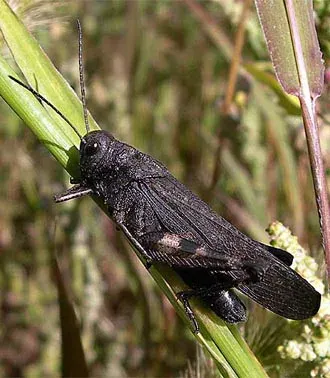
The Red-winged grasshopper, scientifically known as Psophus stridulus, is a member of the Acrididae family. Adult specimens are relatively large, with females typically measuring between 25 and 40 mm in length, while males are slightly smaller.
The most distinctive feature of this species is the brilliant red or orange coloration of the hind wings, which become highly visible during flight. The body is typically mottled with brown, grey, or dark earth tones, providing excellent camouflage against soil and dried vegetation.
The species earns its name from the sharp, rattling sound produced by the males while in flight, generated by rapid wing movements. This acoustic signaling is essential for mating rituals and territory identification.
The grasshopper possesses a powerful chewing mouthpart, designed for consuming fibrous plant material. Its well-developed compound eyes allow for excellent field of vision, aiding in predator avoidance and food source location.
Nymphs resemble smaller, wingless versions of the adults. Throughout their development, they undergo several molts, progressively increasing in size until they reach the adult stage.
What it damages
The Red-winged grasshopper is a polyphagous pest, capable of consuming a wide variety of plant species. It causes significant damage to cereal crops, legumes, pastures, and hayfields, directly competing with livestock for resources.
During years of high population density, the pest can severely reduce crop yields by feeding on leaves, stems, and young ears of grain. This defoliation reduces the plant's photosynthetic capacity, leading to stunted growth.
The pest poses a particular threat to young seedlings during dry seasons when wild forage becomes scarce. In such conditions, grasshoppers migrate to cultivated fields in search of succulent plant material.
Heavy feeding pressure not only destroys plant tissue but also leaves crops susceptible to secondary infections, such as fungal pathogens and bacterial spots, which further degrade crop health.
In addition to direct consumption, the presence of the insect renders forage less palatable to livestock due to the accumulation of frass and the destruction of the vegetative structure.
When it appears
The life cycle of the Red-winged grasshopper follows the typical progression for Acrididae: egg, nymph, and adult. The species overwinters in the egg stage, deposited in soil clutches known as pods.
Nymph hatching generally occurs in late spring, usually May, coinciding with the warming of the topsoil. This is the optimal window for early-season scouting and population monitoring.
The nymphal stage lasts throughout the summer, passing through five instars. Active feeding by adults reaches its peak during July and August, when the insects are most mobile and numerous.
Mating occurs in late summer, followed by oviposition. Females deposit their egg pods in compacted, firm soil, often selecting field margins, roadsides, and uncultivated slopes for their nesting sites.
High temperatures and dry conditions significantly accelerate the development of the grasshoppers and increase nymphal survival rates, which can lead to population outbreaks in subsequent seasons.
Signs of infestation
A primary indicator of their presence is the characteristic rattling noise heard when approaching an infested area. The insects are skittish and will readily take flight, exposing their vibrant red wings.
On crop leaves, the damage presents as irregular, jagged holes along the edges, or complete consumption of the leaf tissue down to the midrib, leaving a skeletonized appearance.
During soil inspections of uncultivated perimeters, one may find egg pods, which appear as small, soil-encrusted cylindrical capsules just beneath the surface.
The accumulation of small, dark, granular frass at the base of plants or near field edges is a clear sign of persistent and active feeding behavior by the population.
Observing fields during the cooler hours of the morning or evening often reveals increased insect activity as they move across the vegetation to feed.
Control measures
Managing the Red-winged grasshopper requires an integrated approach that targets multiple stages of the insect’s development and prevents population buildup.
- Deep autumn plowing of fields, which disturbs and destroys overwintering egg pods embedded in the soil.
- Rigorous management of weeds along field margins and roadsides to eliminate preferred egg-laying sites.
- Preservation of beneficial predator habitats, such as natural vegetation strips, to support bird and insect populations that consume grasshoppers.
- Application of appropriate insecticides on field borders if population thresholds are exceeded, targeting nymphs before they disperse into the main crop.
- Consistent monitoring using visual surveys or sticky traps to ensure timely and effective control measures are implemented.
Taxonomy
- Latin name
- Psophus
- Order
- Orthoptera (locusts)
- Family
- Acrididae
- EPPO code
- PSOHSP
Discussion
No discussions yet — be the first.