
Stone moroko
Pseudorasbora
Description
How to identify
The Stone moroko (Pseudorasbora parva) is a small fish belonging to the Cyprinidae family. It is widely recognized as one of the most successful invasive fish species globally.
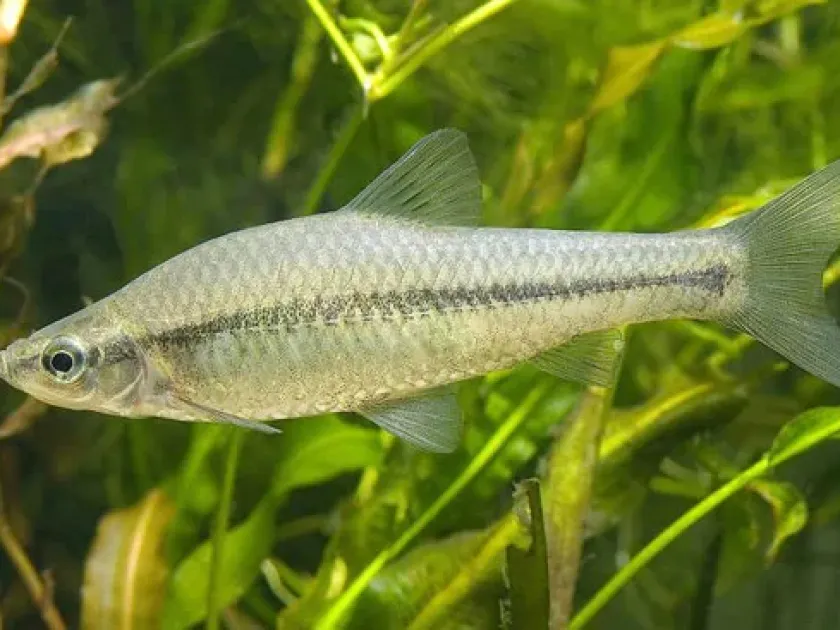
It typically grows to a length of about 8–10 cm and possesses a streamlined body covered with relatively large, silvery-grey scales.
The species is distinguished by the lack of barbels around the mouth and a dark stripe running horizontally along the entire side of its body.
The Stone moroko is highly adaptable, thriving in a wide range of aquatic environments, including stagnant ponds, rivers, and man-made reservoirs.
Its ability to tolerate low oxygen levels and significant temperature fluctuations makes it extremely difficult to eradicate once it invades a body of water.
What it damages
The primary damage caused by Stone moroko in aquaculture is direct competition for food resources with valuable fish species such as carp.
They are prolific breeders and voracious eaters, often depleting zooplankton and other natural food sources required by commercially raised fry.
Stone moroko are known to prey upon the eggs and larvae of other fish species, severely impacting the recruitment and reproductive success of native or stocked populations.
The species is a known carrier of the parasite Sphaerothecum destruens, which can cause severe health crises and mass mortalities in other fish species.
By overpopulating ponds, they significantly reduce the overall productivity and economic output of fish farming enterprises.
When it appears
Activity levels of Stone moroko peak during spring and summer months when water temperatures rise above 15 degrees Celsius.
The spawning period is remarkably long, allowing the fish to reproduce multiple times in a single season, leading to exponential population growth.
Males demonstrate parental care, aggressively guarding the nests of eggs placed on submerged rocks or vegetation, which results in high fry survival rates.
As water temperatures drop during autumn, they move to deeper, warmer layers of the pond, maintaining some feeding activity throughout the colder months.
The peak impact on commercial fisheries occurs during the juvenile stage of the cultured fish, where the moroko effectively outcompetes them for nutrients.
Signs of infestation
A major indicator of infestation is a noticeable decline in the growth rates of cultured fish despite proper feed distribution and management.
Visual observation of shorelines often reveals large, dense schools of small, slender fish with the characteristic dark side stripe.
A significant reduction in the expected number of fry after spawning seasons often points to predation by Stone moroko on newly laid eggs.
Frequent occurrences of parasitic skin or gill diseases in cultured fish often trace back to the Stone moroko acting as a reservoir for pathogens.
The presence of unmarketable, small fish in high density within a production pond is a clear sign that an invasion has occurred.
Control measures
Complete drainage and thorough liming of pond beds during the off-season remain the most effective methods to eliminate established populations.
Installing high-quality mesh filters on water intake structures is crucial to prevent the accidental introduction of eggs or larvae from natural water bodies.
Biological control methods include stocking predatory fish, such as pike or perch, which naturally prey on small fish like the Stone moroko.
- Drainage and disinfection of pond bottoms.
- Installation of fine-mesh filters on water inlets.
- Biological control using native predators.
- Regular culling using fine-mesh seine nets.
- Strict quarantine protocols for all new stock.
Taxonomy
- Latin name
- Pseudorasbora
- Family
- Cyprinidae
- EPPO code
- QRASSP
Discussion
No discussions yet — be the first.