
Meadow Grasshopper
Pseudochorthippus montanus
Description
How to identify
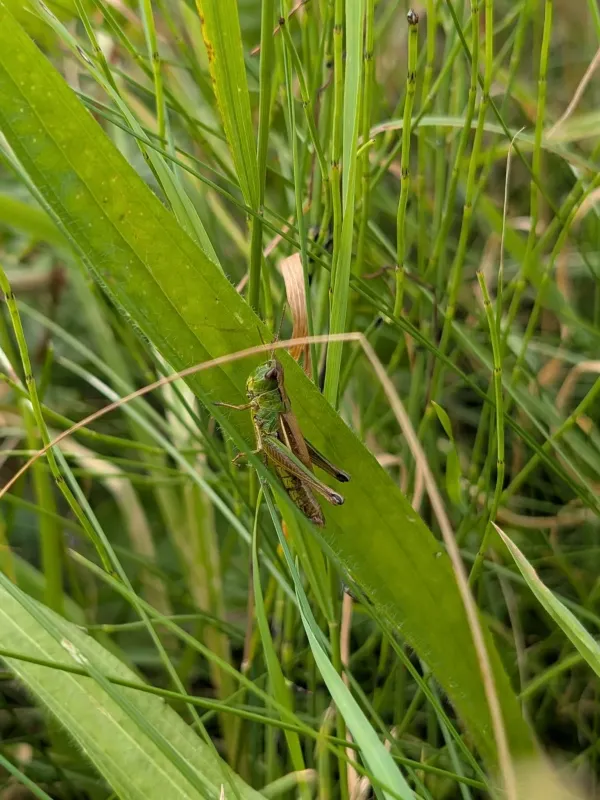
The meadow grasshopper (Pseudochorthippus montanus) is a species of orthopteran insect belonging to the family Acrididae, subfamily Gomphocerinae. It is a common inhabitant of wetlands, damp grasslands, and meadows, where it thrives in lush, moisture-rich environments.
Adult individuals typically measure between 14 and 23 mm in length. Their coloration ranges from green to brown or grayish-brown, providing excellent camouflage among the grasses. A key diagnostic feature is the shape of the pronotal keels, which are slightly curved.
The nymphs go through five developmental stages (instars) before reaching maturity. During these stages, they look like smaller, wingless versions of the adults and remain localized in their hatching sites, relying on dense vegetation for protection and food.
This species is highly hygrophilous, meaning it prefers humid habitats. Populations tend to fluctuate significantly depending on annual rainfall, with wetter seasons often leading to higher densities of the insect in meadows and nearby agricultural fields.
The life cycle involves an egg stage that serves as the overwintering phase. Eggs are laid in clusters called egg pods, deposited either in the soil or within the root zone of dense grasses, which protects them from extreme winter temperatures.
What it damages
The meadow grasshopper is a polyphagous pest that feeds primarily on graminaceous plants. While they naturally occupy wild grasslands, they can become a significant agricultural pest when their population densities spike, leading to crop damage.
Commonly attacked plants include various meadow grasses like Timothy-grass, couch grass, bluegrass, and fescue. When these sources are depleted or during mass outbreaks, the grasshoppers move to cultivated grain fields such as wheat, barley, and oats.
Damage is caused by both adults and late-stage nymphs feeding on leaves. They chew the leaf blades, significantly reducing the surface area available for photosynthesis, which stunts plant growth and reduces the overall yield of the crop.
In pastures and hay meadows, the economic impact is substantial due to the reduction of biomass. Heavy infestations can lead to the near-total loss of high-quality forage, as the insects prefer the most succulent and nutrient-rich parts of the plants.
The vulnerability of crops is highest during the early stages of grain development. Early-season feeding can result in thinning stands, leading to secondary weed infestations and long-term damage to the productivity of the affected field.
When it appears
Nymphs typically emerge from overwintered eggs in late spring, usually May or early June, depending on soil temperatures. Warmer springs lead to faster and more synchronous emergence, which can increase the immediate threat to young crops.
Adults (imagos) generally appear by mid-summer, starting in July. This is the period when the population is most active, as mature individuals feed intensively, mate, and begin their dispersal flights to colonize new areas.
August usually marks the peak of seasonal activity. During this time, the grasshoppers are most mobile and can quickly migrate from drying wild grasses to lush, irrigated, or well-maintained agricultural crop fields.
Oviposition occurs in late summer and early autumn. Females carefully select sites for egg-laying, often preferring dense turf or undisturbed soil patches where the eggs will remain insulated throughout the winter months.
The species is univoltine, completing one generation per year. However, the high fecundity of females ensures that if the environment remains suitable, populations can recover rapidly from one year to the next.
Control measures
Effective management begins with sound agricultural practices. Autumn tillage, such as plowing or deep disking, is highly effective at destroying egg pods, exposing them to predators and harsh winter elements that prevent successful hatching.
Maintaining clean field margins and eliminating patches of tall weeds around the edges of agricultural plots can drastically reduce the number of potential breeding sites and hinder the buildup of local grasshopper populations.
Chemical control should be implemented only when scouting reports indicate that population densities have exceeded the economic injury level. Applications are most effective when targeted at the nymphal stages, as they lack wings and are confined to smaller areas.
Biological control using entomopathogenic fungi is a viable strategy, particularly in the moist microclimates preferred by this species. These biological agents can suppress populations without the broad environmental impact of conventional insecticides.
- Perform deep autumn plowing to disturb egg sites.
- Mow field edges and borders regularly.
- Monitor nymph populations from late spring onwards.
- Apply localized insecticides to suppress high-density outbreaks.
- Encourage natural predators like birds and parasitic wasps.
Taxonomy
- Latin name
- Pseudochorthippus montanus
- Order
- Orthoptera (locusts)
- Family
- Acrididae
- EPPO code
- CHOHMN
Discussion
No discussions yet — be the first.