
Meadow grasshopper
Pseudochorthippus
Description
How to identify
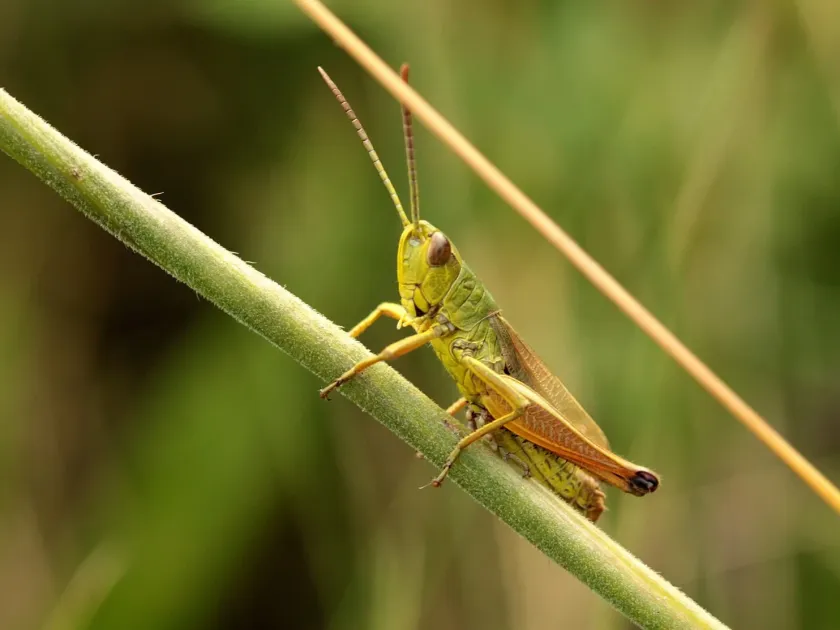
The meadow grasshopper (genus Pseudochorthippus) belongs to the order Orthoptera and the family Acrididae. These are small, jumping insects frequently found in grasslands and agricultural fields.
They are characterized by a slender body, usually measuring 15–25 mm in length. Their coloration, ranging from green to brown, provides excellent camouflage among vegetation.
A distinctive feature is the shape of the pronotum, which has prominent lateral keels that are typically slightly curved or nearly straight, aiding in species identification.
The head is conical, with thread-like antennae that are often thickened at the tips in males. Well-developed wings allow adults to travel significant distances in search of food.
Females are generally larger than males and possess a robust ovipositor, enabling them to lay eggs into the soil or inside plant stems.
What it damages
While these insects are polyphagous, they cause the most significant damage to cereal crops such as wheat, barley, and oats.
High population densities can lead to damage in corn, perennial grasses like alfalfa and clover, and various vegetable crops adjacent to meadow areas.
Both larvae and adults cause damage by actively feeding on the vegetative parts of plants throughout their lifecycle.
Feeding at the seedling stage is particularly hazardous, as it can result in the destruction of young stems and subsequent loss of crop stands.
During the heading and grain-filling stages, they feed on reproductive organs, which leads to reduced yields and lower grain quality.
When it appears
The meadow grasshopper completes one generation per year, overwintering in the egg stage within the soil or ground litter.
Mass hatching of larvae typically begins in the spring, once the average daily soil temperature reaches +15…+18 °C.
Larvae pass through five nymphal stages, feeding intensively for 30–45 days before transitioning into adult insects.
Adult activity peaks between June and August, coinciding with the rapid growth and development phases of most agricultural crops.
Following mating and oviposition in late summer and autumn, the adults die, completing the cycle until the following spring.
Signs of infestation
The primary symptom of infestation is irregular, ragged feeding on the margins of leaves, which reduces the plant's photosynthetic capacity.
Under high pressure, heavy feeding may lead to skeletonization, where only the tough leaf veins remain, severely weakening the crop.
In large fields, localized patches of heavily damaged vegetation become visible, indicating high insect density in those specific areas.
Insects are easily spotted during field inspections as they jump and take short flights when disturbed by movement.
The presence of cylindrical, dark-colored excrement at the base of the plants is a clear indicator of active feeding by the pest.
Control measures
Deep autumn plowing is a crucial agrotechnical method, as it brings egg pods to the surface, exposing them to freezing temperatures and natural predators.
Maintaining clean field margins and controlling weeds are essential, as these areas often serve as initial breeding grounds for the population.
When infestation levels exceed the economic threshold (typically 2–5 individuals per square meter), chemical control via insecticides is necessary.
Contact-stomach insecticides, including pyrethroids or organophosphates, are effective when applied according to local agricultural guidelines.
- Regular spring population monitoring
- Crop rotation practices
- Biological control using natural enemies
Taxonomy
- Latin name
- Pseudochorthippus
- Order
- Orthoptera (locusts)
- Family
- Acrididae
- EPPO code
- PSCRSP
Discussion
No discussions yet — be the first.