
Crawford's humpbacked fly
Pseudacteon crawfordi
Description
How to identify
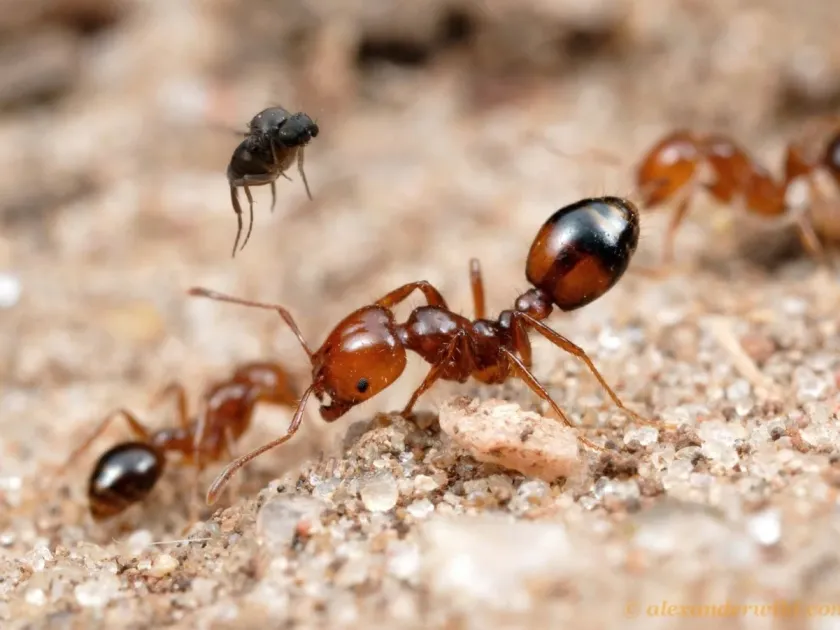
The Crawford's humpbacked fly (Pseudacteon crawfordi) belongs to the Phoridae family, order Diptera. This small insect is primarily known as a parasite of certain ant species, particularly fire ants, but in agricultural settings, it can become a serious pest damaging a wide range of produce.
Adults exhibit a characteristic humpbacked profile of the thorax, which gives the family its name. The wings have a specific venation, and the body is known for its high mobility and ability to move quickly across various substrates.
The larvae go through several developmental stages, increasing in size as they mature. They are conical in shape and adapted to living within organic substrates, making them difficult to detect in the early stages of infestation.
The life cycle is closely linked to the availability of organic matter, decaying debris, or living hosts, depending on the ecological niche of the specific population. Development speed depends directly on the temperature and humidity of the environment.
Identification is complicated by the small size of the adults, so monitoring of storage facilities or fields is most often carried out using traps with attractants that respond to the species' specific pheromones.
What it damages
The main damage is caused by larvae that feed on decaying organic matter but can also penetrate healthy tissues of plants, fruits, and vegetables, causing rot and spoilage. Produce with high sugar and moisture content is particularly vulnerable.
In greenhouse conditions, the humpbacked fly can damage seedlings by entering the root collar or stems, leading to rapid wilting and the death of young plants. This poses a serious threat to the market quality of the produce.
The pest is a vector for various pathogenic microorganisms, including bacteria and fungal spores, which accelerate the rotting of damaged tissues. Consequently, the damage is often greater than the direct mechanical harm caused by the larvae.
Stored fruits and vegetables are at particular risk if phytosanitary storage standards are not followed. One contaminated spot in a crate can become a focal point for the rapid spread of larvae throughout the entire shipment.
Beyond direct crop loss, the presence of the humpbacked fly causes economic losses due to the reduced market appearance of products and the necessity for quarantine measures at the facility.
Signs of infestation
The first sign of infestation is the appearance of small holes on the surface of fruits or plant stems, often surrounded by softened tissue areas. A characteristic unpleasant odor of rot is frequently observed in affected areas.
Visual inspection allows for the detection of small, whitish larvae on the substrate surface or within internodes. With severe infestation, plants become limp, lose turgor, and their root systems can be completely destroyed.
In storage facilities, the presence of adults flying in small groups above crates of vegetables or fruits is a sign of infestation. Their movement is often jerky, resembling short runs.
A specific film on the fruit, caused by larval excrement, serves as indirect confirmation of active pest breeding. This is often accompanied by darkening of the fruit peel.
The presence of the fly can also be detected using sticky traps placed in storage areas. The capture of specific specimens with a humped thorax requires immediate sanitation procedures.
Control measures
The foundation of protection is strict adherence to sanitary and hygienic conditions in warehouses and greenhouses. Any plant debris that could serve as a food source for larval development must be removed in a timely manner.
An important element of prevention is air humidity control. Excessive moisture promotes pest breeding, so maintaining optimal storage conditions acts as a significant deterrent.
Application of pyrethroid-based insecticides can be effective against adults, but controlling larvae inside produce is extremely difficult. Therefore, the focus must be shifted towards preventive protection measures.
Biological control methods include the use of natural entomophagous insects or entomopathogenic nematodes that can destroy humpbacked fly larvae in soil and substrates. This method is considered the most environmentally friendly.
- Regular disinfection of facilities.
- Use of fine-mesh screens on ventilation openings.
- Sorting of produce before storage.
- Monitoring using pheromone and sticky traps.
Taxonomy
- Latin name
- Pseudacteon crawfordi
- Order
- Diptera (flies)
- Family
- Phoridae
- EPPO code
- PSTNCR
Discussion
No discussions yet — be the first.