
Mushroom phorid
Megaselia bovista
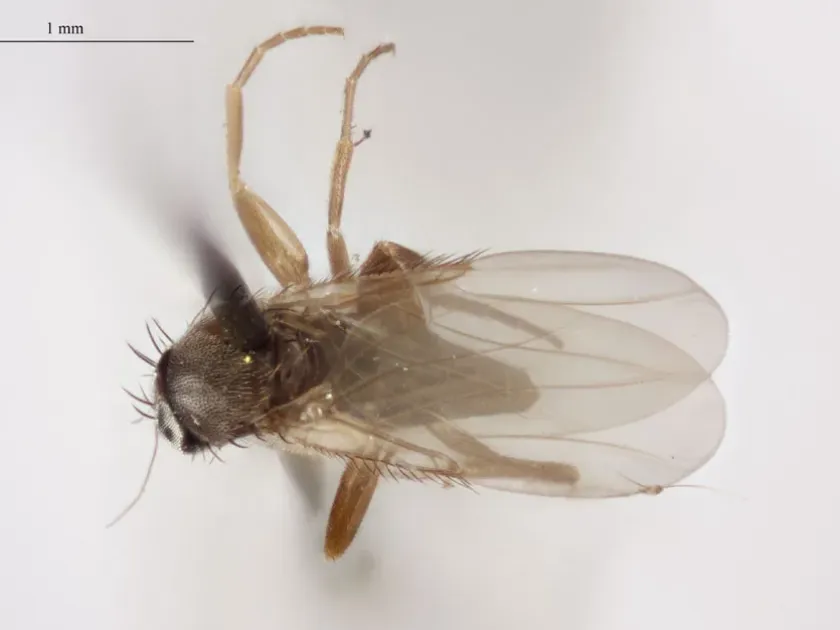
Description
How to identify
The mushroom phorid fly (Megaselia bovista) belongs to the Phoridae family within the order Diptera. These small flies typically measure about 2–3 mm in length and are distinguished by a prominent, hump-backed thorax.
Adult flies exhibit a unique behavior: rather than flying constantly, they frequently run rapidly across surfaces or substrate, often making sudden, jerky movements.
Their coloration varies from yellowish-brown to dark black, allowing them to blend into the dark environments typical of mushroom growing rooms.
The biology of this species is tied to decaying organic matter, making them highly attracted to moist environments containing mycelium and compost.
The life cycle involves egg, larva, pupa, and adult stages, with development being quite rapid, often completing within two weeks under warm conditions.
What it damages
The primary hosts of the mushroom phorid fly are cultivated mushrooms, especially Agaricus (button mushrooms) and Pleurotus (oyster mushrooms).
Larvae are generalist feeders that consume both the fungal mycelium and the fruiting bodies, leading to the destruction of the substrate and crop losses.
In greenhouses, these larvae can occasionally attack the roots of weakened plants, leading to rot and secondary pathogen entry.
High infestation rates result in severe crop damage, as larvae riddle the mushroom caps and stalks with tunnels, rendering the product unmarketable.
Beyond direct feeding damage, phorid flies act as vectors for fungal spores, bacteria, and viruses, introducing diseases into the mushroom crop.
Signs of infestation
The most common sign of an infestation is the presence of small flies darting across the surface of the mushroom beds or along the walls of the growing room.
Fruiting bodies may show irregular tunnels or cavities where larvae have been feeding, causing the mushroom to feel soft or spongy.
In advanced cases, the internal tissue of the mushrooms shows signs of rapid decay, often accompanied by a foul odor caused by larval activity.
Infested beds may show uneven growth or stunted development of mushrooms due to mycelial damage beneath the surface.
- Presence of adult flies on yellow sticky cards.
- Visible larval tunnels in harvested mushrooms.
- General decline in crop yield and quality.
Control measures
Strict hygiene and sanitation are the cornerstones of phorid fly management, including the regular disinfection of all growing rooms and equipment.
Installing fine-mesh insect screens on all ventilation systems is critical to prevent adult flies from migrating into the growing areas from outside.
Effective substrate pasteurization is essential to eliminate eggs and larvae, ensuring a clean start for the mushroom spawn.
Yellow sticky traps should be used systematically to monitor adult fly populations and reduce their numbers early in the infestation cycle.
Chemical control should only be used as a last resort, strictly adhering to product labels, as mushroom crops are highly sensitive to insecticide residues.
Taxonomy
- Latin name
- Megaselia bovista
- Order
- Diptera (flies)
- Family
- Phoridae
- EPPO code
- MGASBO
Discussion
No discussions yet — be the first.