
Pryeria sinica
Pryeria sinica
Description
How to identify
Pryeria sinica, commonly known as the Euonymus moth, is a moth species belonging to the Zygaenidae family. The adult moth has a wingspan of approximately 30–35 mm, featuring translucent wings with distinct dark venation.
The body of the adult is covered in dense hairs, and the abdomen often displays bright orange or yellow markings. This mimicry resembles certain wasp species, serving as a defensive mechanism against predators.
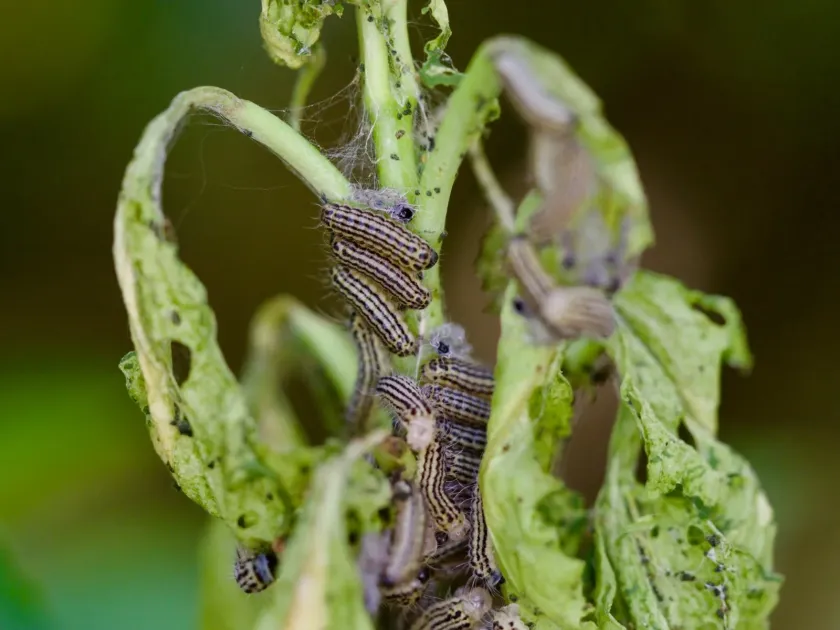
The larvae, or caterpillars, are visually striking, characterized by a pale, grayish-white body marked with longitudinal black stripes and spots, topped with a bright orange head.
Females deposit their eggs in dense clusters on the stems of host plants. These clusters are covered with hair-like scales from the female's abdomen, protecting the eggs during the winter months.
Pupation occurs within firm, spindle-shaped cocoons that are off-white or yellowish. These are typically attached in groups to the crotches of twigs, making them identifiable during dormancy.
What it damages
The primary hosts for Pryeria sinica are shrubs in the Euonymus genus, particularly Euonymus japonicus and Euonymus alatus. These plants are often used in ornamental landscaping.
Young larvae initially skeletonize the leaves, consuming the soft tissues while leaving the veins intact. This early damage can quickly progress to complete defoliation of the entire shrub.
As the larvae grow, their feeding capacity increases, leading to the total destruction of the foliage. Heavy infestations can leave the plant bare in just a matter of weeks during the spring.
Defoliation severely hampers the plant's ability to photosynthesize, weakening its overall health. If damage occurs repeatedly over several seasons, it often leads to branch dieback or total plant death.
Weakened plants are significantly more susceptible to secondary infections, such as fungal pathogens, and show reduced tolerance to environmental stressors like frost or drought.
When it appears
The life cycle of this pest is univoltine, meaning there is only one generation per year. The overwintering stage is the egg, which remains dormant on the bark of young twigs.
Larval emergence coincides with the budding of Euonymus plants in early spring. This ensures that the newly hatched caterpillars have immediate access to fresh food sources.
Pupation typically occurs in late spring or early summer. During this phase, the insect remains stationary within its cocoon attached to the host plant's branches.
Adult moths emerge in late autumn, typically in October or November. This late-season flight is a unique biological trait compared to many other moth species that are active in summer.
After mating, the females lay the eggs that will remain on the twigs throughout the winter, resetting the cycle for the following year.
Signs of infestation
The most visible spring sign is the presence of gregarious young larvae feeding on the developing leaves of the host plant. They are usually found in clusters on the foliage.
Skeletonized leaves, appearing as a delicate network of veins, indicate the presence of early-stage larvae. This is often the first visible symptom of an infestation.
The presence of spindle-shaped cocoons in the forks of branches during winter or early spring is a clear indicator that the plant has been colonized by the pest previously.
The accumulation of frass (caterpillar excrement) on the ground underneath the shrub is another sign of active feeding. These small, dark pellets often pile up as the larvae mature.
Old egg clusters, which look like small, fuzzy patches on the twigs, can be inspected during the winter dormancy period to predict potential infestation levels for the coming season.
Control measures
Manual removal of branches containing egg clusters or cocoons during the winter is the most effective preventative measure. Once collected, these materials should be destroyed by burning.
For active infestations in spring, biological control agents such as Bacillus thuringiensis (Bt) are highly recommended. These provide effective control while remaining safe for the environment.
In cases of severe infestation, systemic insecticides can be applied. Treatment should be timed to coincide with the early larval stage to stop the pest before significant foliage loss occurs.
Maintaining plant vigor through proper watering and balanced fertilization is crucial. A healthy shrub is far more resilient to caterpillar feeding than a stressed or neglected one.
Promoting local biodiversity by encouraging natural predators, such as birds and parasitic wasps, can help manage Pryeria sinica populations naturally over the long term.
Taxonomy
- Latin name
- Pryeria sinica
- Order
- Lepidoptera (butterflies)
- Family
- Zygaenidae
- EPPO code
- PRYESI
Discussion
No discussions yet — be the first.