
Pryeria
Pryeria
Description
How to identify
Pryeria (Pryeria sinica) belongs to the Zygaenidae family of moths. It is recognized as a significant defoliating pest that specifically targets certain species of ornamental shrubs in the Euonymus genus.
Adult moths have a wingspan of approximately 25–30 mm. Their wings are notably transparent due to sparse scaling, giving them a distinct, delicate appearance compared to other common garden moths.
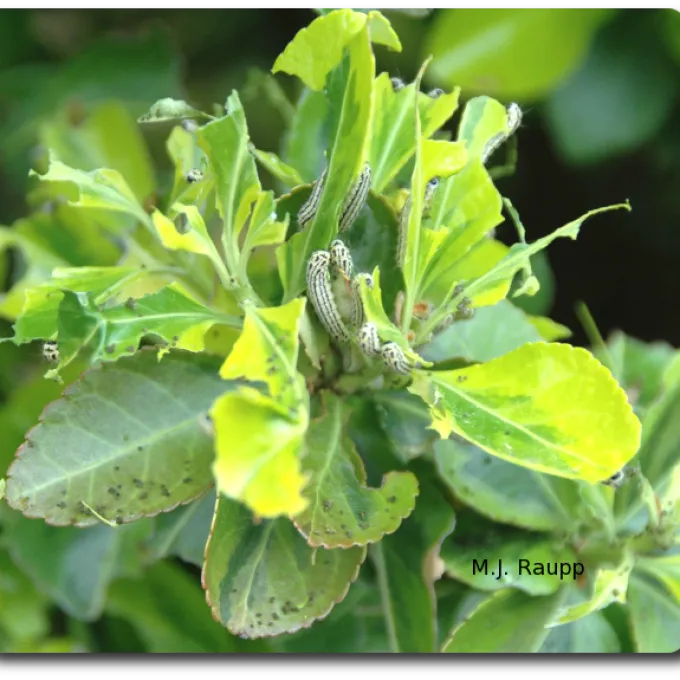
The larvae are distinct in their appearance, typically displaying bold patterns and setae. They exhibit gregarious behavior, meaning they feed and live in groups, which is a major diagnostic feature.
Pupation occurs in net-like, whitish or yellowish cocoons. These cocoons are typically attached to the stems or branches of the host plant, serving as a protective structure during the transition stage.
The species is univoltine, completing one generation per year. A unique biological trait of Pryeria sinica is that adult emergence primarily takes place in late autumn.
What it damages
The primary host plants for this pest are species of Euonymus, including the common spindle tree and various evergreen varieties widely used in landscaping.
Larvae consume the leaf tissue, often starting from the margins. As they grow, they skeletonize the leaves, leaving only the primary veins intact, which drastically reduces the plant's photosynthetic capacity.
Heavy infestations can lead to total defoliation of the shrubs. This loss of foliage is not only unsightly but also severely stresses the plant, weakening its overall health and resilience.
Stressed Euonymus plants become more susceptible to secondary environmental threats, including winter kill, drought stress, and opportunistic fungal pathogens that thrive on damaged tissue.
In urban landscapes and nurseries, Pryeria can cause significant economic loss by ruining the aesthetic appeal of ornamental hedges and shrubs, necessitating costly removal or remedial care.
When it appears
The life cycle begins with eggs deposited on twigs during the late autumn. These eggs serve as the overwintering stage, showing high tolerance to harsh winter temperatures.
Larval emergence occurs in early spring, synchronized with the bud break of the host plant. This timing ensures that young larvae have immediate access to nutritious new growth.
By early summer, the larvae finish their development and enter the pupal stage. They weave their cocoons on the branches, where they remain through the warmer months.
The pupal stage involves a period of summer diapause, waiting for the specific environmental cues of autumn to trigger the emergence of the adult moths for mating.
Understanding this seasonal synchronization is vital for timing control measures. Targeting the early larval stage in spring is the most effective window for intervention.
Signs of infestation
The first sign of an infestation is the presence of small, clustered larvae on the developing leaves of Euonymus during early spring. They are often found in groups.
Leaf skeletonization is the most prominent visual symptom. When a large portion of the canopy shows a lacy, veined appearance, it confirms active feeding by the pest.
Visible silk cocoons on the twigs are clear indicators of the pest's presence in previous seasons or the transition phase of the current population.
The sight of adult moths flying in the vicinity of host plants during autumn nights indicates a breeding population that will produce eggs for the following year's cycle.
Accumulation of larval excrement (frass) under the shrubs is another practical indicator that larvae are feeding in the canopy above, warranting immediate inspection.
Control measures
Effective management of Pryeria sinica requires an integrated approach to suppress populations without harming the wider garden ecosystem.
- Manual removal and destruction of cocoons found on branches during late summer.
- Pruning and disposing of branches with high larval density in the spring.
- Application of Bacillus thuringiensis (Bt) based bio-insecticides when larvae are small.
- Use of systemic insecticides as a last resort if local populations reach outbreak levels.
- Encouraging natural predators and parasitoids that target moth larvae in the garden.
It is important to time chemical applications to avoid impacting pollinators and beneficial insects. Early morning or late evening spraying can reduce non-target exposure.
Maintaining good plant health through proper irrigation and fertilization helps the host plants recover more quickly from potential damage and resist secondary infestations.
Taxonomy
- Latin name
- Pryeria
- Order
- Lepidoptera (butterflies)
- Family
- Zygaenidae
- EPPO code
- PRYESP
Discussion
No discussions yet — be the first.