
Raccoon
Procyon lotor
Description
How to identify
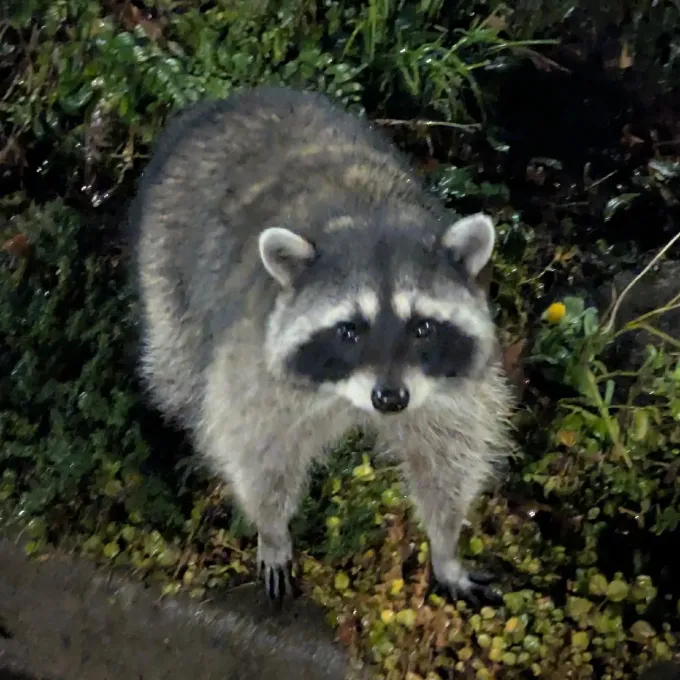
The raccoon (Procyon lotor) belongs to the order Carnivora and the family Procyonidae. It is a medium-sized mammal characterized by its black "mask" facial markings and a bushy tail with dark rings.
Raccoons have a stout build with short, highly dexterous front paws, which they use to climb trees and manipulate various objects, including farm gates or crop stalks.
Adult individuals can grow up to 60-70 cm in length. They possess excellent night vision and highly sensitive touch receptors in their paws, often used to inspect food items in water.
Known for their high intelligence, raccoons are adaptive pests capable of quickly learning how to circumvent human-made obstacles, traps, and deterrent systems.
Their biology favors a sedentary lifestyle near water sources, though they may migrate significant distances to reach fertile foraging grounds when food is abundant.
What it damages
Raccoons are omnivorous, but in agricultural settings, they are notorious for causing heavy damage to sweet corn crops, especially during the milk stage of maturity.
Beyond cereals, their diet includes various garden crops such as berries, grapes, watermelons, melons, and vegetables like tomatoes and cucumbers.
The pest does not only consume parts of the harvest but also spoils large areas by breaking stalks and trampling beds, which facilitates the spread of fungal diseases.
Raccoons can also raid poultry coops, killing chickens and consuming eggs, which leads to significant economic losses for small-scale farming operations.
The presence of raccoons in agroecosystems is also a public health risk, as they are known vectors for dangerous diseases, including rabies and leptospirosis.
When it appears
Raccoon activity peaks from early spring through late autumn, a period during which they must accumulate significant body mass before the winter season.
Being primarily nocturnal, they are most active during the night, which makes monitoring and managing their population difficult without night-vision technology.
During the summer months, as garden crops ripen, the frequency of raccoon incursions into fields and gardens increases dramatically due to the easy availability of nutritious food.
In the spring, during the breeding season, raccoons become more aggressive and persistent in their search for high-calorie food to support the survival of their offspring.
As winter approaches, they enter a state of dormancy; however, if a food source remains stable and shelter is accessible, they may remain active well into the colder months.
Signs of infestation
The most common sign of a raccoon's presence is the distinct, hand-like footprint left in damp soil, which is easily recognizable by its five elongated "fingers."
In corn fields, evidence of their presence includes broken stalks, stripped husks, and partially eaten ears, often resulting in cobs left behind after being stripped clean.
Other indicators include damage to fruit crops, presence of scat containing undigested food remains, and damage to fencing or garden entry points.
If water sources like ponds or troughs exist on the property, tracks around the edges and cloudy water are frequent signs of their food-washing behavior.
Frequent distress among backyard poultry or livestock at night is another reliable indicator that a raccoon is frequenting the premises.
Control measures
The first line of defense is robust physical fencing, such as high-tensile mesh or electric fencing with low-voltage strands placed at the top and bottom.
Ultrasonic deterrents and motion-activated floodlights are effective tools for creating an inhospitable environment that discourages nocturnal animals from lingering.
- Utilize live-catch traps to relocate the animals, ensuring compliance with local wildlife regulations.
- Regularly clear fallen fruits, secure pet food, and manage waste bins to remove potential attractants.
- Install protective netting or cages over high-value crops to prevent direct physical contact with the fruit.
Repellents based on strong odors or tastes can be used, although their effectiveness is often short-lived and requires frequent reapplication.
Always exercise caution when dealing with raccoons due to the risk of zoonotic diseases; protective gear should be worn if handling any area where they have nested.
Taxonomy
- Latin name
- Procyon lotor
- Family
- Procyonidae
- EPPO code
- PROYLO
Discussion
No discussions yet — be the first.