
Ringtail
Bassariscus astutus
Description
How to identify
The Ringtail (Bassariscus astutus) is a carnivorous mammal belonging to the Procyonidae family. Despite its cute appearance, it acts as a significant pest in agricultural settings.
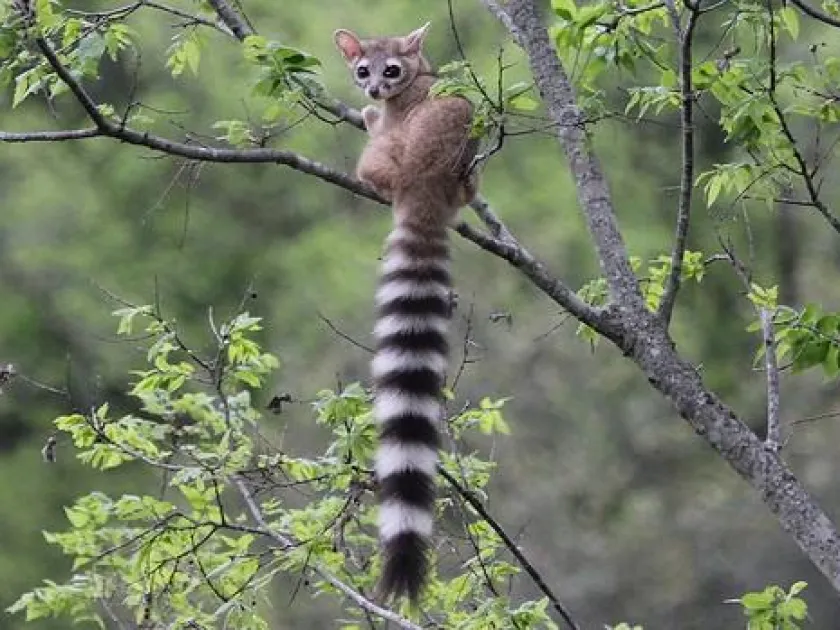
Physically, it is characterized by a long, bushy tail with alternating black and white rings, large dark eyes, and a pointed snout. It is a highly agile and nocturnal creature.
Its slender body allows it to squeeze through narrow crevices in structures or climb vertically on tree trunks, making it difficult to exclude from orchards.
Adults are similar in size to a domestic cat. Their fur color ranges from buff to dark brown, which provides excellent camouflage during night-time raids on fruit crops.
As a highly territorial animal, it often establishes dens in agricultural outbuildings, sheds, or piles of firewood located near fruit-bearing trees.
What it damages
The Ringtail causes direct economic losses by feeding on various fruits, including grapes, figs, peaches, and citrus. It has a high preference for sweet, succulent crops.
Beyond crop consumption, the species causes structural damage by tearing apart bird netting and plastic covers intended to protect the harvest from other pests.
They also gnaw on the bark of young fruit trees, which can stress the tree and provide entry points for pathogens and wood-boring insects.
In stored grain and feed areas, their presence is problematic due to the contamination of products with droppings and urine, leading to health risks.
Their nocturnal foraging habits often result in a large portion of the crop being damaged or wasted before the grower can intervene in the morning.
When it appears
The peak activity period for Ringtails in gardens corresponds with the ripening of fruits, generally from late summer through the autumn months.
During spring and early summer, while rearing young, the animals are more stationary and may become a nuisance in farmhouses or barns due to their increased food demands.
As winter approaches, they increase their foraging range, which may bring them into closer contact with orchards and stored winter feed supplies.
Being strictly nocturnal, the animals follow a consistent schedule, being most active shortly after sunset and before sunrise, which complicates visual detection.
Regional climate plays a role in their year-round activity; in warmer regions, they remain active throughout the winter, requiring constant monitoring.
Signs of infestation
The most reliable sign of a Ringtail presence is the observation of partially eaten fruits with jagged edges and distinct tooth marks, left behind in the canopy.
Droppings are a clear indicator of their activity; they are often found in clusters and frequently contain undigested seeds and bits of insect exoskeletons.
Scratch marks on wooden fences, walls of storage sheds, or the bark of trees are common signs of their physical movement across the landscape.
Audible evidence, such as scratching, scuttling, or chattering sounds coming from attics or storage areas at night, indicates their nesting or foraging activities.
- Jagged tooth marks on fruit
- Seed-filled fecal matter
- Scratch marks on trees and walls
- Torn agricultural protective netting
- Nighttime noises in outbuildings
Control measures
Physical exclusion is the best management strategy. Install metal flashing or smooth barriers on tree trunks to prevent the animal from climbing into the fruit canopy.
Seal all potential access points to buildings, including vents and holes in roofs, using hardware cloth or steel mesh to keep the animals out of structures.
Remove potential habitats like debris, woodpiles, and thick brush near the orchard to make the area less attractive for nesting and hiding.
Implement motion-activated lighting or sonic repellents, which can discourage the Ringtail from frequenting specific areas of the property during the night.
Where permitted, utilize humane live traps to relocate the animals, ensuring that the release site is far away from vulnerable agricultural areas.
Taxonomy
- Latin name
- Bassariscus astutus
- Family
- Procyonidae
- EPPO code
- BASSAS
Discussion
No discussions yet — be the first.