
South American coati
Nasua nasua
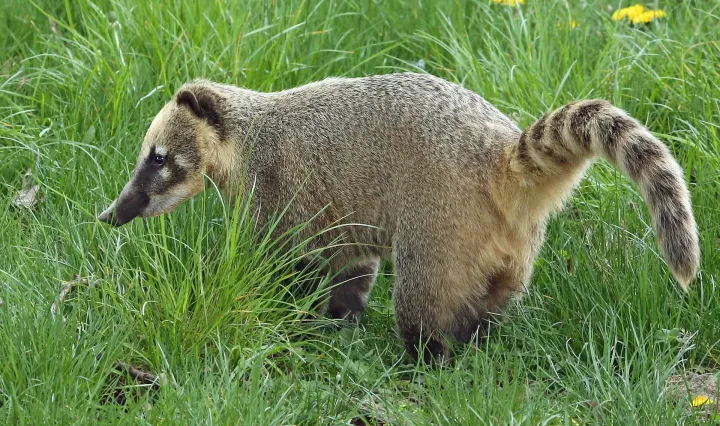
Description
How to identify
The South American coati (Nasua nasua) is a member of the Procyonidae family, recognizable by its slender, flexible snout and long, ringed tail.
These animals are equipped with strong limbs and sharp, non-retractable claws that allow them to be both agile climbers and proficient diggers.
Typically measuring between 40 to 70 cm in body length, they are highly social creatures that often forage in large groups, amplifying their impact on agricultural land.
Their coat ranges from brown to reddish, providing excellent camouflage in wooded environments adjacent to farmlands.
Highly intelligent and curious, coatis are known for their ability to learn and adapt to the presence of human-made obstacles in their environment.
What it damages
Coatis are opportunistic omnivores that frequently target cultivated crops when natural food sources become scarce or less accessible.
Major damage is reported in plantations of bananas, citrus fruits, corn, and sugar cane, where they consume ripening crops and cause physical breakage.
Beyond feeding on fruits, they cause significant damage to soil and root systems by digging extensively to locate insects and tubers.
Their foraging behavior often results in the trampling of row crops, leading to substantial yield losses across the affected sections of a field.
Secondary damage includes structural harm to young trees and shrubbery, which can negatively affect long-term plantation health.
When it appears
Feeding activity often peaks during the ripening stages of agricultural produce, as these crops offer high-energy rewards.
In tropical and subtropical regions, activity remains high year-round, but pressure on crops intensifies significantly during dry seasons.
The rearing of young offspring increases the caloric requirements of the group, driving them to raid agricultural areas with greater frequency.
Farmers should be particularly vigilant during the weeks leading up to the harvest, when the sugar content of the fruit is at its peak.
Being diurnal, these pests are most active during the day, making them easier to spot but harder to deter once they have identified a food source.
Signs of infestation
Indications of coati presence include distinct tracks with visible claw marks found in moist soil or near irrigation points.
Field inspections often reveal discarded fruit peels, partially eaten crops, and broken stalks scattered across the perimeter.
Large patches of disturbed, dug-up soil around the bases of trees and crops are clear indicators of extensive foraging activities.
Audible vocalizations, such as chirps and grunts used for group communication, can alert farmers to the arrival of a foraging troop.
Signs of scratching on tree bark and broken branches at lower levels further confirm their presence in orchard environments.
Control measures
Effective management requires a combination of physical barriers, such as fencing that is buried underground to prevent digging.
Motion-activated deterrents, including lights and acoustic devices, can be useful in disrupting their foraging routines during the day.
- Installing high-quality chain-link fencing around crop perimeters.
- Implementing motion-sensor lighting to deter diurnal incursions.
- Maintaining clean fields by promptly removing all harvest waste.
- Using non-toxic, commercially available wildlife repellents.
- Employing active surveillance or guard animals for larger plantations.
A proactive and integrated pest management strategy is essential to minimize financial loss and maintain high crop productivity.
Taxonomy
- Latin name
- Nasua nasua
- Family
- Procyonidae
- EPPO code
- NASANA
Discussion
No discussions yet — be the first.