
Olive moth
Prays endolemma
Description
How to identify
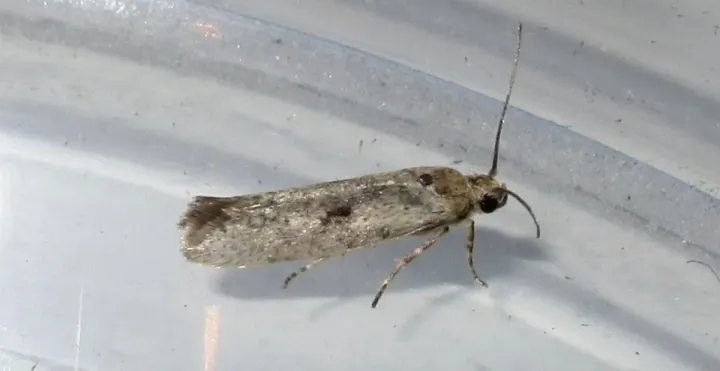
The olive moth (lat. Prays oleae) belongs to the order Lepidoptera, family Yponomeutidae. It is a small insect with a wingspan of up to 14 mm. The forewings are grayish with dark spots, while the hindwings are lighter and fringed.
The pest's life cycle consists of three generations: the phyllophagous (leaf-feeding), anthophagous (flower-feeding), and carpophagous (fruit-feeding) generations. This cycle allows the insect to exploit all available resources of the olive tree at different stages of vegetation.
The moth's eggs are oval and laid singly. Larvae pass through several instars, changing color from light yellow to greenish-brown, which allows them to camouflage effectively on different parts of the plant.
Pupae develop in loose white cocoons, which the pest spins in feeding sites or bark crevices. The rate of development depends directly on the temperature and humidity levels within the olive orchard.
Adults are nocturnal and crepuscular, making them difficult to detect visually without pheromone traps. Imagos cause minimal direct harm; the primary damage is caused by larvae at different stages.
What it damages
The main host plant is the olive tree (Olea europaea). The moth affects both wild and cultivated varieties, causing significant economic losses to agricultural enterprises.
The anthophagous generation damages buds and flowers, feeding on their contents, which leads to mass flower drop and a significant reduction in fruit set percentages.
The carpophagous generation is the most dangerous, as larvae bore directly into developing olives. Inside the fruit, the larva feeds on the seed, causing premature fruit drop and significant harvest loss.
The phyllophagous generation feeds on leaves, creating tunnels known as mines. This reduces photosynthesis, weakens the tree, and decreases its overall resistance to other diseases and pests.
During periods of high population density, yields can be reduced by 50% to 80%, making the control of this insect crucial for the profitability of olive production.
When it appears
The spring generation (anthophagous) emerges during the olive flowering period, when larvae begin to feed actively on unopened buds and blossoms.
The summer generation (carpophagous) coincides with the period of intense fruit growth and maturation. During this time, larvae penetrate the ovaries, typically during the summer months.
The autumn-winter generation (phyllophagous) develops on leaves, where larvae remain until favorable conditions for pupation of the next cycle occur.
Adult emergence dynamics are closely related to the sum of active temperatures. In the Mediterranean region, activity peaks are observed in spring, early summer, and autumn.
To monitor the seasonal arrival of the pest, agronomists use specialized pheromone traps placed in tree canopies 2–3 weeks before the expected flight of the moths.
Signs of infestation
In the early stages of blossom damage, the inflorescences become tangled in silken webbing spun by the larvae. Flowers dry out and drop, leaving empty flower stalks.
On leaves, characteristic winding tunnels (mines) are visible, which can be easily observed when holding the leaf up to the light. Necrotic spots may appear where larvae exit the mines.
When fruit is damaged, entrance holes surrounded by larval excrement can be observed. Infested olives often lose turgor, turn dark, and drop to the ground prematurely.
The presence of white cocoons in leaf axils or under bark scales indicates a mass population outbreak and the need for immediate control measures.
Mass emergence of adults can be confirmed by inspecting trees in the evening or by analyzing trap data, where a sharp increase in the number of captured moths is noted.
Control measures
Chemical control includes the application of systemic and contact insecticides during critical phases of the pest's development, specifically before flowering or at the start of fruit formation.
Biological control methods, such as the use of Bacillus thuringiensis-based products, effectively reduce larval populations while preserving beneficial entomophages.
Agrotechnical measures focus on maintaining tree health: proper pruning improves canopy ventilation, creating conditions less favorable for moth development.
- Installation of pheromone traps to disrupt mating.
- Encouraging natural predators such as ichneumonid wasps and lacewings.
- Timely sanitary pruning and destruction of crop residues.
- Adherence to quarantine measures when importing seedlings from infested areas.
- Population monitoring using light traps.
An Integrated Pest Management (IPM) system should combine monitoring with selective chemical application to minimize the environmental impact on the olive orchard ecosystem.
Taxonomy
- Latin name
- Prays endolemma
- Order
- Lepidoptera (butterflies)
- Family
- Yponomeutidae
- EPPO code
- PRAYED
Discussion
No discussions yet — be the first.