
Prays moths
Prays
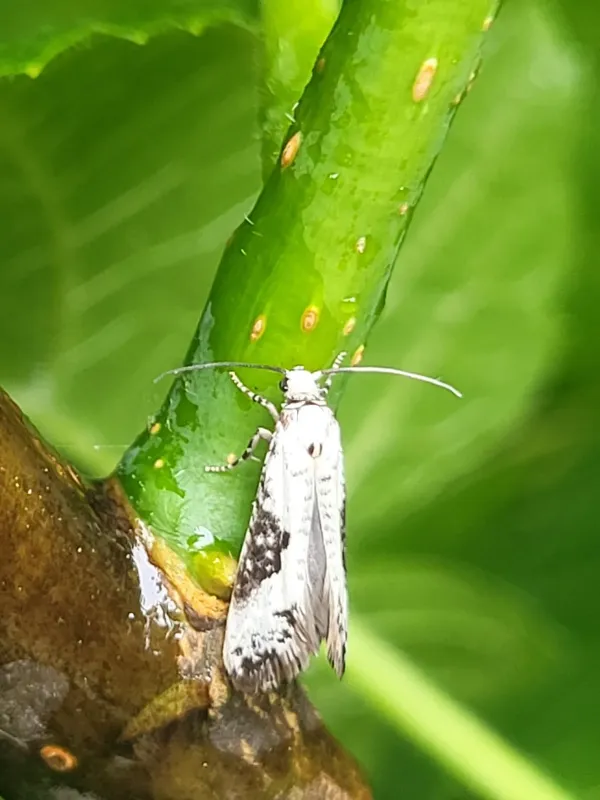
Description
How to identify
The genus Prays belongs to the Yponomeutidae family, within the order Lepidoptera. These are small moths with slender wings, typically having a wingspan of only 12–15 millimeters.
The adult appearance is inconspicuous, with wing patterns varying from greyish to silvery-brown tones, often decorated with dark spots. When at rest, their wings are held closely against the body, creating a distinct, elongated cylindrical profile.
The larvae, or caterpillars, are morphologically typical, with elongated bodies reaching 8–10 mm in length. They range from light green to yellowish-brown and possess well-developed heads and thoracic legs. Their cryptic behavior makes them difficult to spot during early infestation stages.
The life cycle undergoes complete metamorphosis, including egg, larva, pupa, and adult stages. These pests commonly overwinter as first or second-instar larvae, sheltered within leaf mines or beneath the bark of host trees.
Depending on the region and climatic conditions, the genus can complete between two and four generations per growing season. The high fecundity of females allows populations to recover rapidly after periods of environmental stress.
What it damages
The most prominent member of this group is the olive moth (Prays oleae), which causes significant economic losses to olive plantations globally. It attacks all parts of the tree, including leaves, flower buds, and developing fruit.
The first generation of larvae feeds on flower buds and blossoms, leading to mass shedding of inflorescences and a substantial reduction in total yield potential.
The second generation (carpophagous form) bores directly into the fruit. The larva consumes the internal tissues, often damaging the stone, which causes the premature drop of young fruitlets.
The third generation primarily feeds on the leaf parenchyma, creating characteristic serpentine mines. In cases of severe outbreaks, this leads to significant physiological stress in the tree and premature leaf drop.
Economic damage stems from direct crop destruction and the impairment of plant vigor, which renders the trees more susceptible to secondary fungal and bacterial infections.
When it appears
Pest activity typically commences in early spring when mean daily temperatures consistently exceed 10-12 degrees Celsius.
The first generation of adults emerges during the onset of the tree's flowering period. This is a critical window for monitoring, as the level of floral damage is determined during this phase.
The summer generation develops while the fruit is actively growing. During this time, the pest is highly elusive, as larvae remain inside the berries, protected from external environmental factors and pesticide applications.
The autumn generation is most active during periods of moderate temperatures and sufficient humidity. This phase involves intensive feeding as larvae prepare for overwintering and eventual diapause.
Agronomists utilize pheromone traps to track flight patterns, allowing for the precise timing of insecticide applications to coincide with the start of peak adult moth activity.
Signs of infestation
Visible symptoms include narrow, winding tunnels (mines) on the leaf surface, created by the feeding larvae. Careful inspection of the end of these mines often reveals either the larva itself or an exit hole.
Damaged floral clusters appear dried out and enveloped in fine, silken webbing. Frequently, flowers fall from the tree before they even open, which is a clear indicator of larval presence.
Infested fruit exhibit small entry holes, sometimes accompanied by visible frass (excrement) around the puncture site. Affected berries often discolor and abscise prematurely.
During peak activity, tree crowns may show signs of leaf curling or partial consumption. Heavy infestations result in significant defoliation, leaving branches exposed and weakened.
The presence of silken webs within inflorescences and frass on foliage are the primary visual cues for initiating integrated pest management strategies.
Control measures
Chemical control involves the application of systemic insecticides during the peak of adult flight and early larval development, targeting the pests before they penetrate deep into plant tissues.
Biological control methods include the use of Bacillus thuringiensis-based products, which are highly effective against younger larval stages and offer a lower impact on beneficial insect populations.
Proper pruning is a vital cultural practice, as it improves canopy ventilation and light penetration. This creates a less hospitable microclimate for the pest and increases the efficacy of spray coverage.
Pheromone traps serve a dual purpose: monitoring population density and, when deployed at high densities, facilitating mating disruption to reduce the overall reproductive output of the moth.
- Application of specialized contact insecticides.
- Release of natural enemies, such as Trichogramma, in infestation hotspots.
- Adherence to rigorous horticultural maintenance and orchard hygiene standards.
Taxonomy
- Latin name
- Prays
- Order
- Lepidoptera (butterflies)
- Family
- Yponomeutidae
- EPPO code
- PRAYSP
Discussion
No discussions yet — be the first.