
Praunus flexuosus
Praunus flexuosus
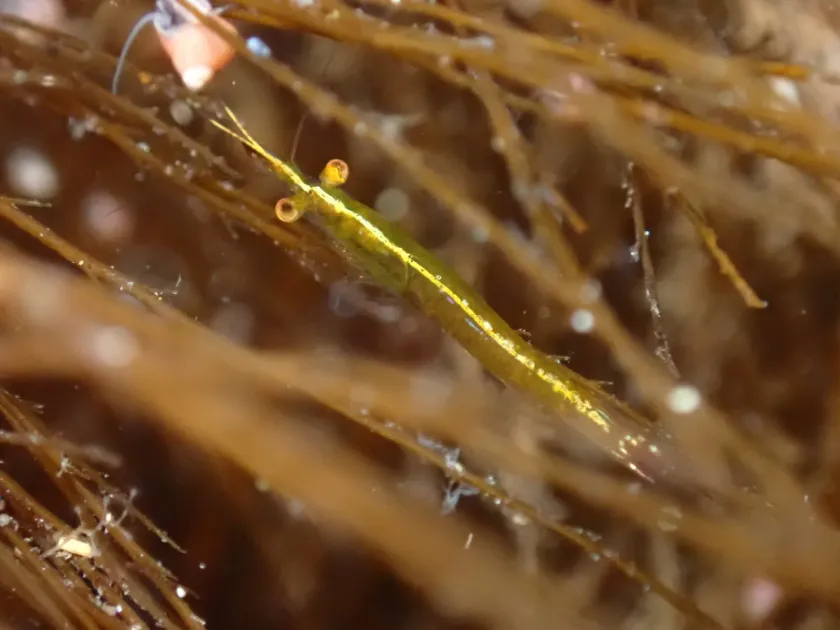
Description
How to identify
Praunus flexuosus belongs to the order Mysida, family Mysidae. It is a small, shrimp-like crustacean typically reaching 15–20 mm in length.
The body is transparent and often exhibits a greenish or brownish hue, providing excellent camouflage within aquatic vegetation.
Key morphological features include a bifurcated telson with distinct spines and long antennules used for sensing the environment in the water column.
These organisms are predominantly pelagic, frequently inhabiting coastal zones where organic detritus and algae are abundant.
Unlike obligate parasites, they are opportunistic omnivores, yet their rapid proliferation poses significant challenges for artificial aquatic ecosystems.
What it damages
The primary economic impact of Praunus flexuosus occurs in fish farms, where they compete for food resources with juvenile fish.
They consume vast amounts of zooplankton, directly depriving fish fry of essential nutrition and leading to reduced growth rates.
Massive infestations can result in mechanical damage to the delicate gill tissues of fish if the crustaceans are ingested accidentally.
These mysids can serve as intermediate hosts for various helminths, facilitating the spread of parasitic diseases among the fish population.
Their intense grazing on phytoplankton and detritus alters the trophic structure of the water body, negatively impacting overall productivity.
When it appears
The peak activity of Praunus flexuosus occurs during the spring and summer months when water temperatures are optimal for reproduction.
Breeding typically takes place from March to August, with females carrying fertilized eggs in a brood pouch located under the thoracic segments.
Offspring are released as fully formed juveniles, allowing the population to expand rapidly throughout the aquatic environment.
Population density typically declines by autumn, though individuals can overwinter in bottom sediments if temperatures remain stable.
Explosions in population density are often correlated with eutrophication, providing an abundance of nutrients that support their rapid growth.
Signs of infestation
The presence of this pest is identified using a fine-mesh net dragged along the margins of dense aquatic vegetation.
A notable sign is a sudden decrease in zooplankton concentration, which cannot be attributed to other environmental factors.
Stunted growth of juvenile fish despite appropriate supplemental feeding indicates high levels of food competition within the pond.
During nighttime, schools of these crustaceans can be observed as small swarms moving rapidly when illuminated by a light source.
Water turbidity changes, caused by the constant filtration of microscopic algae by these mysids, often indicate a high infestation rate.
Control measures
The primary control strategy involves the mechanical removal of aquatic vegetation, which serves as both habitat and breeding ground for the mysids.
Draining and liming ponds between operational cycles is highly recommended to eradicate residual populations in bottom sediments.
Biological control, such as the introduction of predatory fish species, is effective in maintaining the mysid population below economic threshold levels.
Management of nutrient inputs is crucial to prevent eutrophication, as excessive organic matter favors the rapid reproduction of these crustaceans.
- Routine population density monitoring
- Biological control with predatory fish
- Mechanical clearing of pond edges
Taxonomy
- Latin name
- Praunus flexuosus
- Family
- Mysidae
- EPPO code
- PRAUFL
Discussion
No discussions yet — be the first.