
Ararat cochineal
Porphyrophora hamelii
Description
How to identify
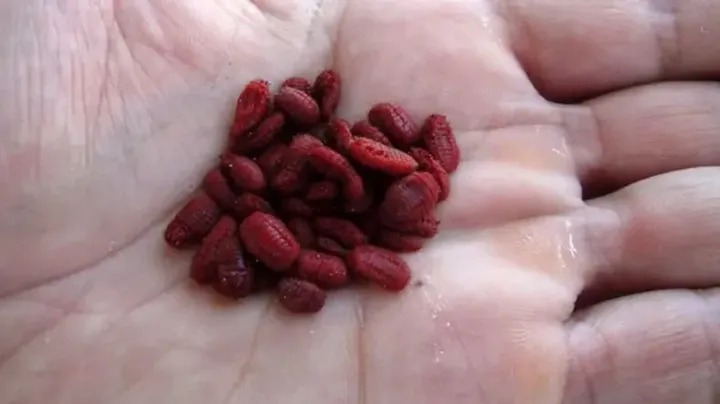
The Ararat cochineal (Porphyrophora hamelii) is a member of the giant scale insect family (Margarodidae). Historically, it was highly valued for the carmine dye extracted from the females, which display a striking, barrel-shaped purple body.
The adult female is flightless, living primarily underground and feeding on the roots of host plants. Their thick, chitinous cuticle allows them to thrive in the saline environments typical of the Ararat plain.
Adult males are quite different: they are winged, significantly smaller, and lack functional mouthparts, as they do not feed during their short adult life, focusing exclusively on mating.
The life cycle involves a dispersal stage known as the "crawler" or first-instar larva. These tiny, mobile individuals emerge from the soil to find suitable host plants to settle on and begin their feeding cycle.
Reproduction is sexual, and after fertilization, the females create soil chambers deep underground to lay their eggs, ensuring the next generation is protected from environmental extremes.
What it damages
The primary hosts for this pest are halophytic plants, most notably the common reed (Phragmites australis) and saltmarsh grass (Aeluropus littoralis). These plants grow in saline soils where the cochineal is naturally present.
By piercing the roots with their stylet-like mouthparts, the cochineals suck sap, causing physiological stress and reducing the vigor of the host plants. In severe cases, this leads to stunted growth and root system decline.
While not a typical pest of standard agricultural crops, the Ararat cochineal can significantly degrade the quality of natural pastures, impacting local ecosystems that rely on these salt-tolerant grasses.
The infestation often goes unnoticed until the host plants show signs of systemic weakening or yellowing, as the damage is entirely localized beneath the soil surface.
The economic importance of the damage is largely measured by the reduction of forage biomass, which affects livestock production in regions where saline soil limits other types of vegetation.
When it appears
The activity of the Ararat cochineal is tightly synced with the climatic conditions of the semi-arid regions it inhabits, with specific phases for movement and feeding.
Crawlers emerge and migrate across the soil surface during late summer, typically August and September, which is the prime time for new infestations to establish on healthy host roots.
Once settled, the larvae transition into a dormant cyst stage, where they remain attached to the roots, surviving through the winter months shielded within the soil environment.
As spring approaches and soil temperatures rise, the larvae resume active feeding, preparing for the final stages of their development and the eventual mating cycle.
The adult phase concludes in the autumn, when females surface briefly to facilitate mating and oviposition, marking the end of the seasonal biological cycle.
Signs of infestation
Detecting an infestation is challenging because the insects are subterranean. The first visible sign is usually the decline in the overall health or density of the halophytic grass cover.
If suspicious patches of dying vegetation are found, examining the root zone by excavation will reveal small, bright purple-to-reddish cysts attached to the root surfaces.
During the peak of the mating season in September, one might observe a subtle reddish tint on the soil surface where high concentrations of adult females have emerged.
Stunted development and thinning of the grass sward in salt-affected areas are strong indicators that a subterranean insect population, such as the cochineal, may be present.
To confirm an active population, agronomists typically collect soil cores at a depth of 15–20 centimeters to identify the insects in their protective cysts on the root system.
Control measures
Effective control is difficult because the insects are protected by cysts and spend most of their life cycle underground, making them largely inaccessible to surface-applied pesticides.
Cultural methods, such as periodic soil cultivation or crop rotation, are considered the most effective strategies to disrupt the insects' soil chambers and reduce their population density.
If chemical intervention is deemed necessary, it must be timed precisely to coincide with the crawler stage, when the larvae are outside their cysts and vulnerable to contact insecticides.
Biological control, focusing on natural predators or soil-dwelling pathogens, is an area of ongoing research aimed at managing these insects while preserving the fragile ecosystem of the salt plains.
Due to the historical and cultural significance of the Ararat cochineal, control measures should be applied carefully to prevent total local extinction while still protecting valuable agricultural land.
Taxonomy
- Latin name
- Porphyrophora hamelii
- Order
- Hemiptera (bugs, aphids, leafhoppers)
- Family
- Margarodidae
- EPPO code
- PORPHA
Discussion
No discussions yet — be the first.