
Southern ground pearl
Dimargarodes meridionalis
Description
How to identify
The southern ground pearl (Dimargarodes meridionalis) is a subterranean insect belonging to the Margarodidae family within the order Hemiptera.
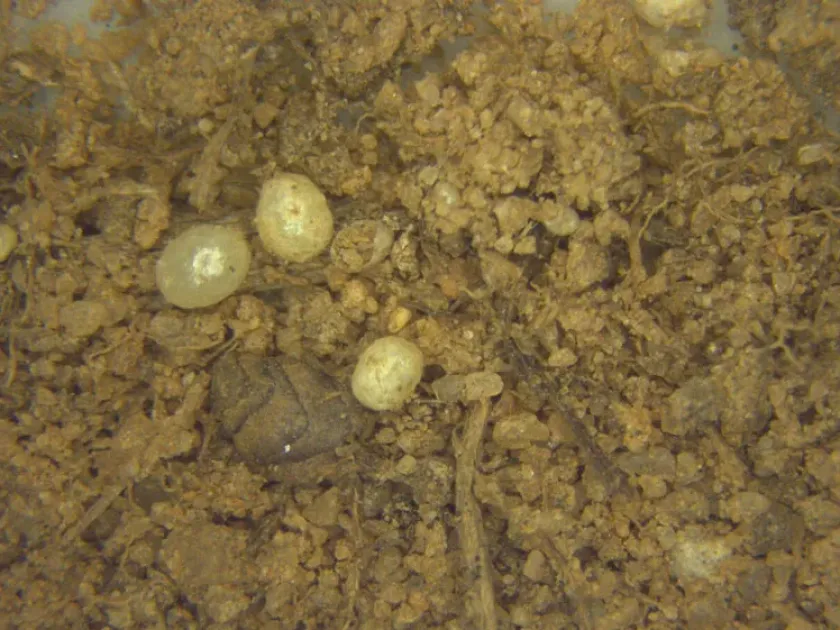
The adult female is flightless and resembles a small, yellowish-white pearl, a characteristic that gives the species its common name.
Adult males are rarely observed, as they are winged and short-lived, focusing primarily on finding females for reproduction.
First-instar nymphs, known as crawlers, are microscopic and spend their time searching for roots to attach to and begin feeding.
Identification often requires careful inspection of soil samples or root systems, as these pests live almost exclusively underground.
What it damages
This pest is a significant threat to warm-season turfgrasses, particularly Bermuda grass (Cynodon dactylon), commonly found on golf courses and sports fields.
They feed on the roots and stolons of the grass, causing plants to lose their vitality due to the extraction of cell sap.
Severe infestations result in thinning turf, yellowing, and eventually the death of grass patches that cannot recover from the root system damage.
The damage often mimics drought stress, which can lead to ineffective management strategies if the true cause is not identified early.
Economic loss is high in professional turf management due to the need for extensive soil treatment and potential sod replacement.
When it appears
The life cycle of Dimargarodes meridionalis is highly synchronized with soil temperature and seasonal changes.
Active crawlers typically emerge in the spring when soil temperatures reach optimal thresholds for development.
During the peak of summer, nymphs often retreat deeper into the soil profile to enter a state of dormancy, effectively escaping contact insecticides.
Females produce waxy cysts to protect their eggs, ensuring survival through harsh soil environments and fluctuating weather conditions.
Depending on the region, the life cycle may be univoltine or multivoltine, requiring precise timing for any chemical control applications.
Signs of infestation
The initial signs of an infestation include the appearance of irregular, yellowing patches in the lawn that do not improve with irrigation.
As the infestation progresses, the grass becomes stunted and easy to pull up, revealing an underdeveloped or damaged root system.
Examining the roots and surrounding soil will reveal the presence of spherical, pearl-like cysts, confirming the pest's identity.
Enlarging dead zones within the turf are characteristic of uncontrolled populations that continue to feed on root tissue.
Visual decline in turf density is often accompanied by an increase in weed colonization as the primary turfgrass species weakens.
Control measures
Controlling the southern ground pearl is challenging because of its subterranean habitat and protective cyst structure.
Systemic insecticides are the preferred method of control, as they can be translocated to the roots where the pests are feeding.
- Monitor soil temperatures to apply control measures during the crawler stage.
- Use professional soil drenching techniques to ensure proper chemical penetration.
- Maintain optimal turf health through balanced fertilization and irrigation.
- Prevent the spread of the pest by cleaning tools and machinery after working in infested areas.
Integrated Pest Management (IPM) practices, including cultural controls, remain the foundation for long-term successful management.
Taxonomy
- Latin name
- Dimargarodes meridionalis
- Order
- Hemiptera (bugs, aphids, leafhoppers)
- Family
- Margarodidae
- EPPO code
- MARGME
Discussion
No discussions yet — be the first.