
Laing's pearl scale
Eumargarodes laingi
Description
How to identify
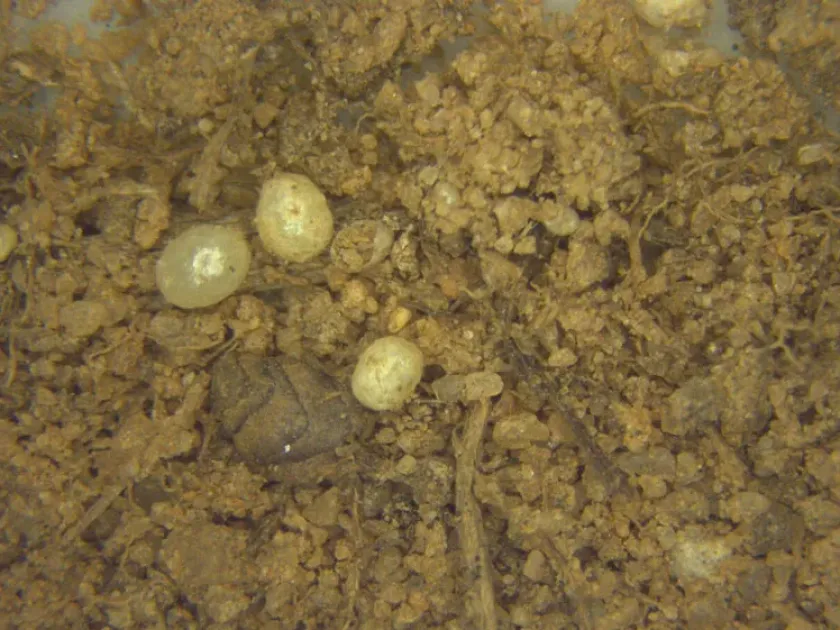
Laing's pearl scale (Eumargarodes laingi) is a member of the Margarodidae family within the order Hemiptera. The common name refers to the distinctive appearance of adult females, which look like small, shiny pearls embedded in the soil or root systems.
The life cycle involves an encysted stage, a biological adaptation that allows the insect to survive in the soil for extended periods, even when food sources are scarce or environmental conditions are harsh.
Adult females are sessile, meaning they remain attached to the roots of their host plants for their entire adult life. Conversely, adult males are winged and free-living, designed specifically for finding females to mate.
First-instar larvae, often referred to as crawlers, are the primary dispersal stage. They migrate through the soil profile to locate suitable host roots, establishing new infestation foci in previously unaffected areas.
Given its subterranean nature, this pest is difficult to detect without systematic soil sampling. Its cuticle is highly resistant, making it less susceptible to various environmental stressors and chemical treatments compared to above-ground scales.
What it damages
Laing's pearl scale primarily infests sugarcane, feeding on the phloem sap of the root system. This feeding behavior drains the plant of essential nutrients and moisture, severely restricting its growth potential.
While sugarcane is the main economic host, the pest can also survive on various wild grasses. These alternative hosts often act as reservoirs, maintaining population levels even when the main crop is harvested.
The removal of sap by large populations of scales leads to a decrease in photosynthetic efficiency and a significant reduction in stalk size and sugar content at harvest time.
Root damage caused by the insects predisposes the crop to secondary root rot pathogens. The punctures made by the scales during feeding provide entry points for soil-borne bacteria and fungi, causing localized decay.
In severe cases of infestation, the root system is decimated, leading to poor anchorage of the plant. This makes crops more susceptible to lodging during periods of high wind or heavy rain.
Signs of infestation
The most visible symptom of an infestation is localized yellowing and stunted growth of sugarcane plants. These areas often appear as irregular patches within the field that fail to respond to irrigation.
Upon careful examination of the root system, one can see the characteristic pearl-like females clinging to the roots. They are typically yellow or brown and possess a smooth, hardened exoskeleton.
The presence of waxy secretions or small cavities around the roots is another diagnostic sign. These secretions are produced by the scales to create a protective environment while they feed.
A reduction in the number of fine root hairs is frequently observed, as the scales compete for sap and physically disrupt root development. This loss prevents the plant from effectively absorbing water.
Stunted internodes and a decrease in the overall diameter of the stalks are clinical signs of long-term infestation, reflecting the plant's inability to maintain its physiological requirements.
Control measures
Crop rotation is the most effective cultural practice for managing Laing's pearl scale. By switching to non-host crops, farmers can starve the scale population and reduce the density in the soil.
Mechanical control, such as deep plowing between crop cycles, disrupts the soil habitat, exposing cysts and larvae to predators, desiccation, and extreme temperatures, which significantly increases mortality rates.
Systemic insecticides can be applied during the period of crawler activity, which is the most vulnerable phase of the life cycle. However, timing and placement are critical for successful suppression.
Maintaining soil health and balanced nutrient availability helps the sugarcane plant compensate for the loss of sap. Improved vigor allows the crop to better withstand the stress induced by root-feeding pests.
- Implementation of strict phytosanitary measures for planting material.
- Monitoring of field edges to prevent expansion of infested zones.
- Encouraging biological control agents, such as specialized predatory mites and parasitic wasps.
Taxonomy
- Latin name
- Eumargarodes laingi
- Order
- Hemiptera (bugs, aphids, leafhoppers)
- Family
- Margarodidae
- EPPO code
- EUMGLA
Discussion
No discussions yet — be the first.