
Porotermes quadricollis
Porotermes quadricollis
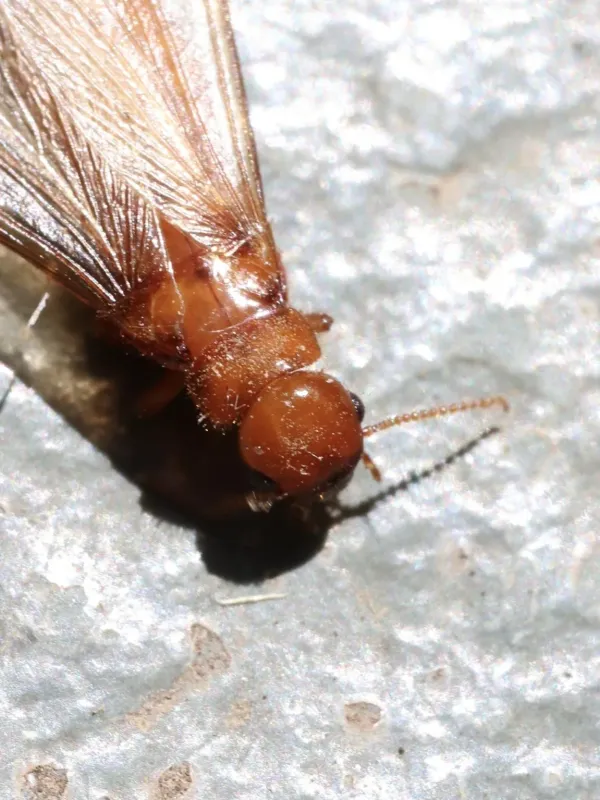
Description
How to identify
Porotermes quadricollis is a species of dampwood termite belonging to the family Termopsidae, order Isoptera. These termites are primarily known for inhabiting and feeding on moist, decaying wood.
The colony structure includes distinct castes: workers, soldiers, and reproductives. Soldiers are distinguished by their enlarged, sclerotized heads equipped with strong mandibles for defense and wood chewing.
Adults typically exhibit a reddish-brown to dark brown coloration. Their body structure is adapted for living in confined tunnels, where they remain sheltered from direct sunlight and predators.
The lifecycle is hemimetabolous, progressing from eggs to nymphs and finally into adults. Unlike subterranean termites, they do not require contact with the soil to maintain their moisture needs.
These termites are social insects that form highly organized colonies, typically located directly within the host timber, which allows them to remain cryptic for extended periods.
What it damages
Porotermes quadricollis attacks both living and dead trees. They prefer wood with high moisture content, often infiltrating trees through wounds, scars, or areas previously compromised by fungal decay.
The primary damage occurs in the heartwood. Termites excavate extensive internal galleries, which weakens the structural integrity of the tree and makes it susceptible to windthrow or breakage.
In forestry and agriculture, this species can cause significant economic losses by degrading timber quality and shortening the lifespan of affected trees in orchards or plantations.
Unlike some wood-boring beetles that leave circular exit holes, termite damage is characterized by hollowed-out chambers filled with a fine mixture of wood particles and fecal pellets.
Over time, the cumulative destruction of internal conductive tissues disrupts the tree's physiological processes, often leading to decline and eventual death of the specimen.
Signs of infestation
The presence of fine, granular frass (termite droppings) pushed out through small holes in the bark or near the tree base is a clear indication of an active infestation.
A hollow or muffled sound when tapping on the trunk is a strong indicator of extensive internal excavation and loss of wood density.
The emergence of winged alates during the swarming season provides evidence of a mature colony and indicates that the termites are actively spreading to nearby trees.
Visible galleries and tunnels hidden beneath the bark layer are typical signs for those inspecting trees for potential termite damage.
Secondary symptoms, such as canopy thinning, chlorosis, or premature leaf drop, often manifest once the internal damage has reached a critical stage.
Control measures
Sanitation is the most effective management practice. Removing deadwood, stumps, and heavily infested trees eliminates the primary reservoirs and nesting sites for the termite population.
Chemical control often involves targeted insecticide injections into the infested galleries to disrupt the colony without requiring extensive foliage spraying.
Biological control methods, focusing on the use of entomopathogenic fungi, are being researched as a sustainable alternative to chemical pesticides.
Preventative measures, such as applying protective coatings to pruning wounds or damage scars, can prevent the initial entry of termites into healthy trees.
- Regular phytosanitary inspections of the forest.
- Prompt removal of infested and dead trees.
- Targeted insecticide injection for localized nests.
- Monitoring swarming activity to predict population spread.
Taxonomy
- Latin name
- Porotermes quadricollis
- Family
- Termopsidae
- EPPO code
- POREQU
Discussion
No discussions yet — be the first.