
Broad-bodied shield bug
Poecilocoris latus
Description
How to identify
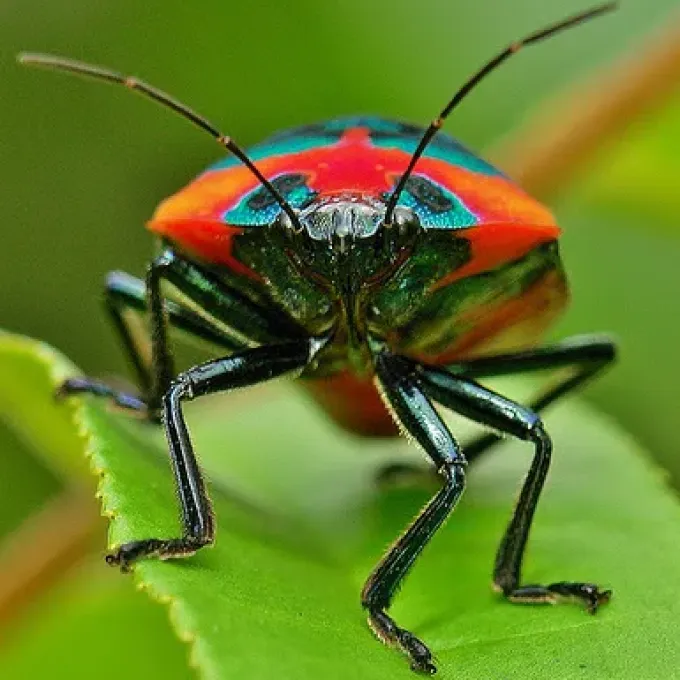
The broad-bodied shield bug (Poecilocoris latus) belongs to the Scutelleridae family, order Hemiptera. The adult insect possesses a characteristic large, shield-like structure that fully covers its abdomen and wings.
The coloration of the bug varies from brownish-red to yellowish-green with a metallic sheen, which provides excellent camouflage among vegetation. Adults typically reach a body length of 10–12 mm.
The nymphs go through several developmental stages, gradually acquiring the appearance of the adult insect. Young nymphs are usually lighter in color and often feature a spotted pattern.
Eggs are typically laid in compact, orderly clusters on the underside of host plant leaves, a behavior common to many species of shield bugs.
These insects overwinter in the adult stage, seeking shelter under plant debris, fallen leaves, or within the top layer of soil until the weather warms up.
What it damages
The broad-bodied shield bug primarily feeds on various agricultural and wild crops, particularly those from the legume and cereal families. The bug uses its piercing-sucking mouthparts to feed on plant juices.
Damage is caused by both adults and nymphs at all developmental stages. By feeding on the sap of young shoots, leaves, and immature seeds, they deplete the plant and significantly reduce yield potential.
The pest is especially dangerous during the formation of reproductive organs, such as inflorescences and fruit sets, as this directly affects crop volume and quality.
In cases of heavy infestation, plants show stunted growth, leaves become yellowed and curled, and in severe cases, seeds may fail to develop or lose their viability entirely.
In addition to direct mechanical damage, puncture marks frequently act as entry points for secondary bacterial and fungal infections, further compromising crop health.
When it appears
The pest activity begins in early spring as soil temperatures rise to 10–15°C. Bugs initially feed on weeds before migrating to cultivated fields as crops emerge and develop.
Population peaks usually coincide with the budding and flowering stages of host plants. Active reproduction occurs throughout the summer before preparations for diapause begin.
Signs of infestation
Visual signs of infestation include yellow or whitish spots on leaves that eventually necrotize. Presence of excrement on the leaf surface is a common indicator of pest activity.
Finding egg clusters on the undersides of leaves is a clear warning to initiate monitoring. Premature fruit drop and deformed, empty seeds are also strong indicators of feeding damage.
Control measures
Agrotechnical control includes maintaining fields free of weeds that serve as alternate hosts. Proper crop rotation is highly recommended to break the life cycle of the pest.
Biological control involves utilizing natural predators and egg parasitoids, such as trichogramma wasps, which can significantly suppress shield bug populations in the field.
When the economic threshold of damage is reached, contact-stomach insecticides should be applied. Treatments are most effective when timed for early morning or evening hours.
Rotating insecticides with different modes of action is essential to prevent the development of pesticide resistance within the shield bug population.
Continuous phytosanitary monitoring of fields is crucial for the early detection of localized outbreaks, allowing for prompt intervention before widespread damage occurs.
Taxonomy
- Latin name
- Poecilocoris latus
- Order
- Hemiptera (bugs, aphids, leafhoppers)
- Family
- Scutelleridae
- EPPO code
- POECLA
Discussion
No discussions yet — be the first.