
Poecilocoris druraei
Poecilocoris druraei
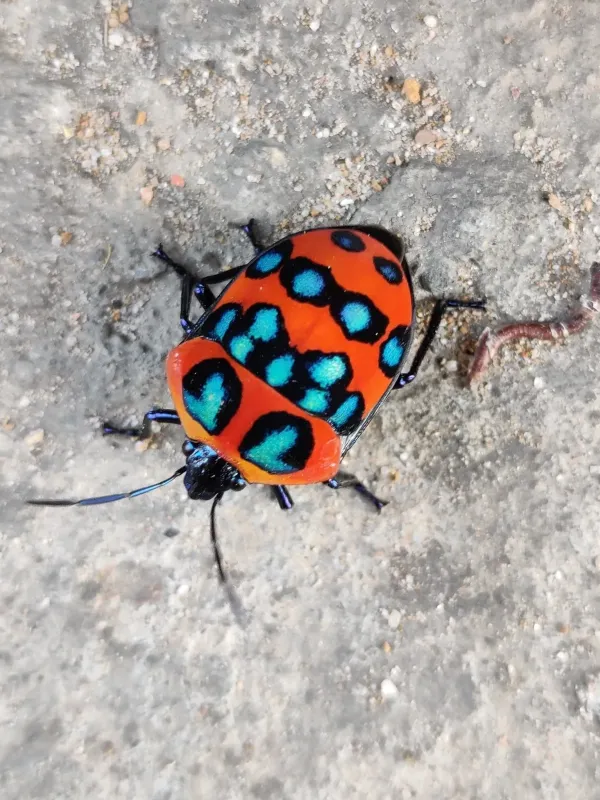
Description
How to identify
The shield bug Poecilocoris druraei belongs to the Scutelleridae family, order Hemiptera. These insects are characterized by a large scutellum that covers the abdomen and wings, giving them a distinct shield-like appearance.
The adults are typically 10–15 mm long and feature striking patterns of orange, yellow, and black. This warning coloration is common among shield bugs and serves as a defense mechanism against predators.
Nymphs resemble smaller, wingless versions of the adults and undergo several molting stages. As they develop, their coloration becomes more distinct, matching the patterns of the mature bugs.
They overwinter as adults in leaf litter, under bark, or within the top layer of soil. As temperatures rise in spring, they emerge to feed on host plants and begin their reproductive cycle.
The life cycle typically includes one generation per year, depending on climatic conditions. Females lay clusters of eggs on the underside of host plant leaves to protect them from environmental stress.
What it damages
This species is a polyphagous pest, known for targeting various agricultural crops, especially oilseeds and legumes. It frequently infests rapeseed and mustard plants, causing significant economic damage.
The bugs use their piercing-sucking mouthparts to feed on plant sap, targeting stems, leaves, and developing seed pods. This feeding process drains the plant of vital nutrients and water.
Heavy infestations result in stunted plant growth, deformed pods, and reduced seed yield. The mechanical damage caused by probing also creates entry points for various bacterial and fungal infections.
Both adults and late-stage nymphs are responsible for the damage. Their feeding behavior is particularly destructive during the critical flowering and pod-filling stages of the host plant.
In hot and dry climates, the impact of Poecilocoris druraei is amplified, as plants lack the turgor pressure necessary to withstand the loss of sap and repair punctures.
Control measures
Crop rotation is the most effective cultural practice to manage populations of this shield bug. By alternating host crops with non-host species, the life cycle of the pest is interrupted.
Good field hygiene, including the removal of weeds and crop residues, reduces overwintering sites. Deep plowing of fields in late autumn helps expose the bugs to harsh winter conditions.
Chemical control involving contact or systemic insecticides may be necessary if infestation levels exceed economic thresholds. Applications should be timed precisely to target the susceptible nymph stages.
Biological control methods, such as encouraging native parasitoid wasps that target the bug's eggs, are essential for sustainable management. These natural enemies can significantly lower pest pressure.
Monitoring using pheromone traps or systematic field scouting allows growers to identify the presence of the pest early, ensuring that interventions are applied before major damage occurs.
Taxonomy
- Latin name
- Poecilocoris druraei
- Order
- Hemiptera (bugs, aphids, leafhoppers)
- Family
- Scutelleridae
- EPPO code
- POECDR
Discussion
No discussions yet — be the first.