
Sunn pest
Poecilocoris
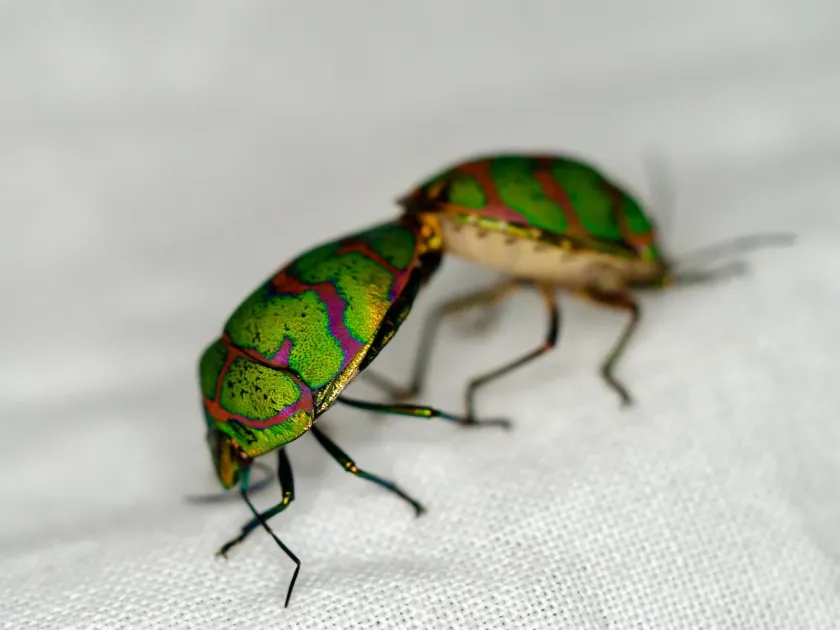
Description
How to identify
The Sunn pest (Eurygaster integriceps) is a species of shield bug that belongs to the order Hemiptera and is recognized as one of the most destructive pests for wheat production.
The adult insect has an oval, shield-like body, reaching about 10–13 mm in length, with coloration varying from light brown to dark gray or even black.
It is characterized by a broad head and a large scutellum that covers the majority of the abdomen and wings, giving it the iconic "turtle" appearance.
Nymphs undergo five developmental stages (instars) before reaching maturity, often mirroring the appearance of adults but without fully developed wings.
Correct identification in the field is vital for agronomists, as large swarms of this pest can migrate into fields rapidly during the spring season.
What it damages
Sunn pests primarily infest cereal grains, with a strong preference for winter and spring wheat, as well as barley, causing extensive crop losses globally.
The insects feed by piercing the plant tissue with their proboscis and injecting saliva, which contains proteolytic enzymes that degrade the gluten in the grain.
Even moderate feeding can lead to significant reductions in flour quality, rendering the grain unsuitable for baking as it loses its bread-making ability.
Mechanical damage caused by the pest includes the wilting of stems, the appearance of white heads, and the production of shriveled, thin grain kernels.
Under high-density infestations, entire fields can suffer from substantial yield losses, impacting both the quantity and the economic value of the harvested crop.
When it appears
The pest spends the winter months in protected locations such as woodlands or under deep leaf litter, where it remains in a state of diapause.
As spring temperatures rise to around 12–15 degrees Celsius, the adults emerge from hibernation and migrate in large numbers to cereal fields to feed and mate.
Egg-laying occurs on the undersides of leaves, typically starting in late spring, and the nymphs emerge to feed on the developing plant tissues.
The entire development cycle is temperature-dependent, with nymph stages being most active during the stem elongation and heading phases of the cereal crop.
After reaching maturity, the new generation of adults feeds briefly on the grain before entering another state of diapause to overwinter, completing the annual cycle.
Signs of infestation
Initial signs of a Sunn pest infestation involve the visual confirmation of adult bugs crawling on the stems and leaves during early spring field surveys.
Small pale spots on leaves are common indicators of feeding punctures, and egg clusters are often found neatly arranged on the undersides of the foliage.
Developing grains often show dark puncture marks, and severely damaged heads may turn white or become brittle as the plant’s health rapidly declines.
Farmers may also notice a characteristic decline in the crop’s vigor, with parts of the stem collapsing where the bugs have been feeding consistently.
- Presence of dead nymphs on the soil or leaf surface.
- Deformed and shriveled grains within the harvested spikes.
- Withered or bleached ears of wheat.
Control measures
Effective management strategies include cultural practices such as crop rotation, selecting resistant wheat varieties, and timing the sowing to avoid peak migration.
Post-harvest stubble management, including deep plowing, is an essential technique for destroying the overwintering habitat and reducing the pest population.
Chemical control involving systemic or contact insecticides is often necessary when the pest density exceeds the economic threshold to prevent irreversible damage.
Biological control agents, such as using egg parasitoids like Trissolcus species, can be integrated to manage pest populations in an environmentally friendly manner.
Regular field monitoring and precise application timing based on economic thresholds remain the most critical components of successful pest mitigation programs.
Taxonomy
- Latin name
- Poecilocoris
- Order
- Hemiptera (bugs, aphids, leafhoppers)
- Family
- Scutelleridae
- EPPO code
- POECSP
Discussion
No discussions yet — be the first.