
Pale Eggar
Poecilocampa populi
Description
How to identify
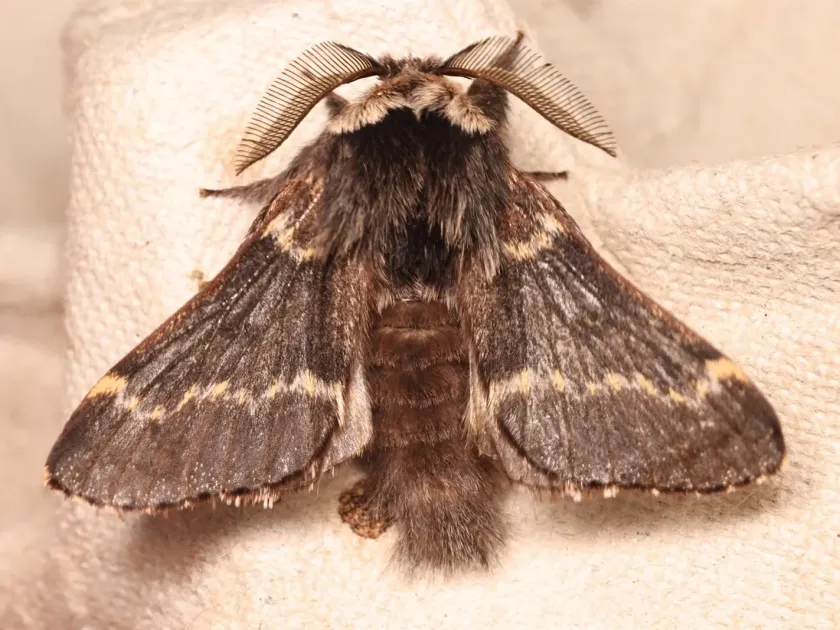
The Pale Eggar (Poecilocampa populi) is a moth belonging to the Lasiocampidae family within the order Lepidoptera. Adult moths typically have a wingspan of 35–50 mm, featuring dark brown or greyish wing patterns that provide excellent camouflage against tree bark.
The larvae, or caterpillars, reach up to 60 mm in length. They are covered in dense hairs and exhibit a mottled pattern of grey, brown, and pale spots, helping them blend in with the texture of branches and twigs where they feed.
Pupation takes place inside a robust, greyish-white silk cocoon. These are often expertly camouflaged with bits of lichen, bark, and debris, making them extremely difficult to locate in the wild.
The species completes one generation per year. A unique biological trait of this moth is that the adults emerge and fly late in the autumn, often persisting into November, which is unusual for most moth species.
Overwintering occurs in the egg stage. Females deposit their eggs directly onto the bark of host trees, where the embryos remain dormant throughout the winter until spring temperatures stimulate hatching.
What it damages
The Pale Eggar affects a wide range of broadleaved trees, including poplar, willow, lime, birch, and alder, as well as common fruit trees like apple and plum.
Damage is primarily caused by the larvae, which hatch in spring and immediately begin feeding on fresh leaves. They initially skeletonize the leaf tissue, later consuming the entire leaf blade except for the major veins.
High population densities can cause severe defoliation, which places significant physiological stress on the tree. This reduced photosynthetic capacity weakens the plant and makes it susceptible to secondary infections.
In orchards and forestry, major outbreaks can lead to significant growth suppression and reduced crop yield due to the energy diverted by the tree for foliage regeneration.
Young saplings are particularly vulnerable; repeated attacks in early spring can lead to branch dieback or even the death of the entire tree if the infestation remains uncontrolled.
When it appears
Adult flight activity occurs late in the season, typically spanning from October through November. This adaptation allows the species to reproduce after many potential predators have decreased in number.
Larval emergence coincides with the bud break of host plants, usually occurring in April or May, ensuring that the young caterpillars have immediate access to high-quality food.
The larvae feed actively throughout late spring and early summer. During this time, they pass through several developmental stages, growing rapidly to prepare for the pupation phase.
The pupal stage occurs in summer and lasts until the autumn, during which time the insect is inactive within its protective cocoon, shielded from high summer temperatures.
Most visible impact on vegetation occurs in late spring, as the larvae grow larger and increase their daily intake of leaf material.
Signs of infestation
Early symptoms include small, irregular holes or "window-pane" effects on the leaves, which quickly progress to complete skeletonization as the caterpillars grow.
Small, bead-like egg clusters attached to the bark of twigs or trunks are a key diagnostic feature that can be identified during dormant winter months.
Caterpillars can often be spotted by inspecting the underside of leaves or along the branches, where they remain motionless during the day to avoid detection.
Accumulated frass (caterpillar droppings) on the ground or on lower branches is a strong indicator of a high infestation density in the canopy above.
The presence of well-hidden, silk-based cocoons attached to bark crevices provides clear evidence of the pest's presence in previous seasons.
Control measures
For ornamental gardens, manual removal of egg clusters during winter pruning is an effective and environmentally friendly method for reducing the next year's population.
Biological control using microbial insecticides based on Bacillus thuringiensis is highly recommended, as it is selective and poses minimal risk to beneficial insects and birds.
If chemical intervention is necessary due to severe infestation levels, contact insecticides should be applied early in the season when the larvae are at their youngest and most vulnerable stage.
- Encourage insectivorous bird populations to nest in the garden.
- Apply grease bands or sticky traps to tree trunks to hinder caterpillar movement.
- Perform selective pruning of heavily infested branches to reduce local population pressure.
- Monitor tree health to ensure rapid recovery after defoliation events.
Maintaining high general tree health through proper fertilization and irrigation helps trees recover more efficiently from the stress caused by caterpillar feeding.
Taxonomy
- Latin name
- Poecilocampa populi
- Order
- Lepidoptera (butterflies)
- Family
- Lasiocampidae
- EPPO code
- POEOPO
Discussion
No discussions yet — be the first.