
Poplar Lappet
Poecilocampa
Description
How to identify
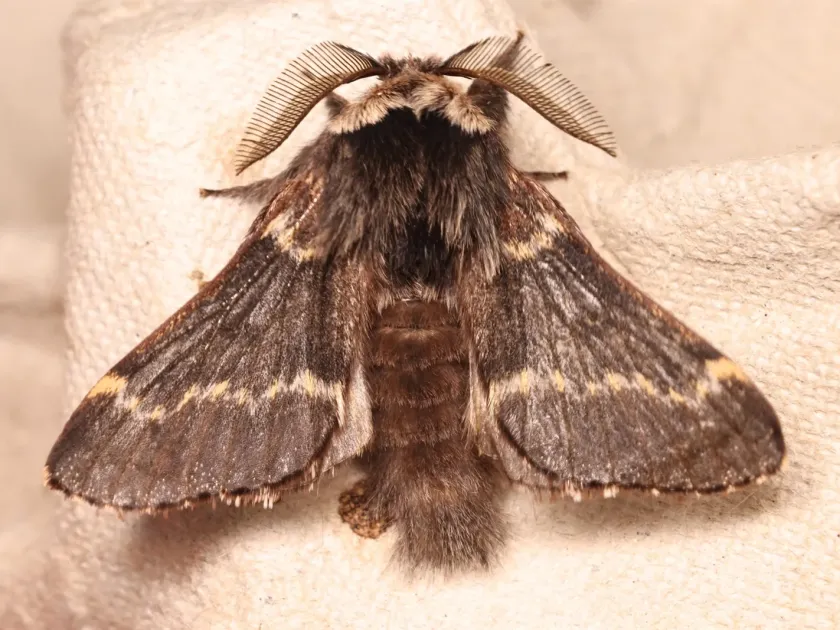
The Poplar Lappet (Latin: Poecilocampa populi) is a nocturnal moth belonging to the Lasiocampidae family. Adult specimens typically have a wingspan ranging from 35 to 50 mm, with dark brown to blackish wings decorated with distinct light-colored crossbands and spots.
The larvae, or caterpillars, reach up to 60 mm in length. Their bodies are densely covered in hair and exhibit a grey-brown or bluish-grey color with bright orange or red lateral spots, providing effective camouflage against tree bark.
The pupae are encased in tough, parchment-like dark brown or black cocoons. These are usually found in crevices of bark, in the soil, or tucked away among fallen leaf litter where they remain protected.
This species is a typical inhabitant of temperate forest ecosystems. A unique biological feature is its late-season adult flight period, which typically occurs during the autumn months, setting it apart from many other similar moth species.
The eggs of the Poplar Lappet are rounded and dark-colored. Females lay them singly or in small clusters primarily on the bark of tree trunks and branches, where they remain throughout the winter until spring.
What it damages
The Poplar Lappet is a polyphagous pest capable of causing significant damage to various deciduous trees and shrubs. It is commonly found in urban parks, orchards, and woodland areas.
The main host plants include:
- Poplar and Aspen
- Willow species
- Fruit trees (Apple, Pear, Cherry, Plum)
- Birch and Lime
- Oak and Elm
Caterpillars feed on developing buds in early spring and subsequently move on to foliage. In cases of high infestation, they can completely skeletonize the leaves, severely affecting the tree's photosynthesis.
Young saplings in nurseries are particularly vulnerable. Heavy feeding leads to stunted growth, loss of annual biomass, and increased susceptibility to secondary diseases and boring insects.
For fruit-bearing trees, the damage includes not only defoliation but also the destruction of flower buds, which leads to a direct reduction in fruit yield and weakens the tree's long-term vitality.
When it appears
The Poplar Lappet follows a univoltine life cycle (one generation per year). The flight of adult moths takes place in late autumn, predominantly during October and November, when temperatures begin to drop.
The insect overwinters in the egg stage. Embryonic development concludes in early spring, synchronized with the bud-bursting phase of the host trees.
Caterpillars typically hatch in April. They are primarily nocturnal feeders, hiding during daylight hours in sheltered spots on branches or within bark cracks to evade predators.
The larval feeding stage lasts until early summer, after which they enter the pupal stage. They spend the entire summer as pupae, waiting for the return of cooler autumn temperatures to emerge as adults.
Adult moths have short lifespans, as their primary biological objective is to mate and lay eggs to ensure the continuation of the species for the following year.
Signs of infestation
The first sign of infestation in spring is the damage to swelling buds. If you notice chewed portions on young shoots, it indicates the beginning of larval activity.
Presence of defoliated leaves, usually starting from the edges of the leaf blades, is a clear indicator of growing caterpillars. Frass (droppings) may also be visible on lower leaves or around the base of the tree.
During spring inspections, look for egg clusters which appear as small, dark, firm bumps securely attached to the smooth bark of branches.
A nighttime inspection using a flashlight is the most effective way to spot the caterpillars themselves, as they actively feed in the dark and are rarely visible during the day.
Finding dark, parchment-like cocoons lodged in bark crevices or in leaf litter during the autumn serves as a strong indicator of a significant pest population in the area.
Control measures
Effective management of the Poplar Lappet requires an integrated approach that combines mechanical, biological, and chemical methods to regulate population density.
Mechanical control involves cleaning tree trunks of loose, dead bark during late autumn or winter, which can expose and remove cocoons or egg clusters. Whitewashing trunks can also deter egg-laying.
For smaller gardens or young trees, manual collection of caterpillars during the early morning hours or at night is effective. Pruning and destroying branches with heavy infestations is also recommended.
Biological control methods include the use of Bacillus thuringiensis-based insecticides. These are effective against early-instar larvae while remaining safe for beneficial insects and the environment.
In cases of severe outbreaks on larger sites, chemical control using pyrethroid or organophosphate insecticides may be necessary, but should be applied during the period of peak caterpillar feeding.
Taxonomy
- Latin name
- Poecilocampa
- Order
- Lepidoptera (butterflies)
- Family
- Lasiocampidae
- EPPO code
- POEOSP
Discussion
No discussions yet — be the first.