
Podisus nigrispinus
Podisus nigrispinus
Description
How to identify
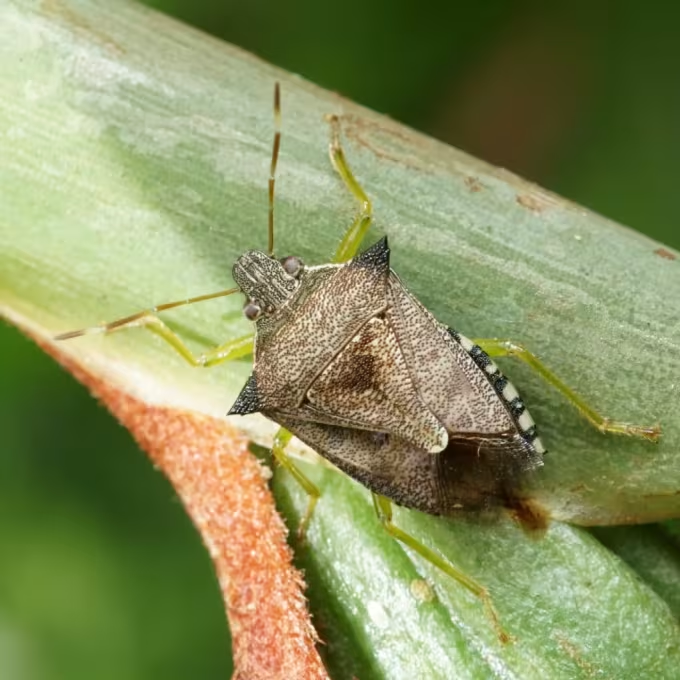
Podisus nigrispinus belongs to the Pentatomidae family, commonly known as stink bugs. Adult insects have a shield-shaped body, typically measuring between 9 and 12 mm, with distinctive sharp shoulder spines that make them easily identifiable in the field.
The coloration of these bugs ranges from grayish-brown to yellowish-tan, which acts as excellent camouflage on stems and bark. This appearance allows them to remain hidden while surveying their surroundings for potential prey or hosts.
The life cycle involves egg, five nymphal stages, and the adult stage. The eggs are laid in neat, organized clusters, typically on the underside of leaves. Each egg has small appendages around the rim, which are characteristic of this species.
Young nymphs are often brighter in color and tend to aggregate in groups. As they progress through their larval stages, they become more independent, eventually dispersing across the plant to hunt or feed.
As a predatory species, it utilizes sophisticated sensory mechanisms to track movement and vibrations. While they are often viewed as biological control agents, their ability to survive on plant tissues during prey scarcity marks them as a potential pest.
What it damages
Though primarily a predator of lepidopteran larvae, Podisus nigrispinus can cause significant damage to crops like soybean, cotton, and tomatoes when natural prey populations are low. They transition to phytophagy to meet their moisture and nutrient needs.
Damage occurs when the insect uses its piercing-sucking mouthparts to penetrate plant tissues. This action drains sap from leaves and young shoots, often leading to necrosis and localized wilting of the affected plant parts.
In fruits and seeds, these punctures create entry points for secondary pathogens, such as fungi and bacteria. This not only impairs the physical appearance of the produce but also reduces its overall quality and shelf life significantly.
When young seedlings are attacked, the damage to the growing point can be catastrophic, leading to stunted development and eventual plant death. This can result in significant yield losses across commercial agricultural fields.
The intensity of the damage is often tied to the local density of the bug population. High-density infestations during sensitive physiological growth stages of the plant can cause irreparable harm to the entire crop stand.
When it appears
The seasonal activity of Podisus nigrispinus is heavily influenced by ambient temperature and humidity. They thrive in warm tropical and subtropical climates, where they can complete multiple generations within a single growing season.
Springtime marks the end of hibernation, as adults emerge to seek hosts for feeding and reproduction. The timing of their migration to fields is often synchronized with the early stages of crop development, making this a critical window for monitoring.
Summer is the period of peak abundance, where generation overlap often leads to high population pressure. Agronomists should focus scouting efforts on this timeframe to identify egg clusters before they hatch into nymphs.
As autumn approaches and temperatures drop, the bugs begin to seek shelter for overwintering. They typically hide in crop residues, leaf litter, or deep within tree bark, making field sanitation a vital practice to reduce the next season's population.
In controlled environments, such as greenhouses, the life cycle may continue without interruption if heating is provided. This necessitates constant vigilance and a consistent integrated pest management (IPM) schedule regardless of the outside climate.
Signs of infestation
One of the most reliable signs of infestation is the presence of egg clusters on the lower surfaces of foliage. These are distinctive and should be the primary focus of any field inspection program to estimate potential outbreaks.
The aggregation of nymphs on stems and leaves is a clear indicator of active colonization. These clusters are often found near damaged plant tissues, which serves as a visual cue for the pest's impact on the crop.
Yellow or brown necrotic spots on leaves, surrounded by small puncture marks, are classic symptoms of feeding. These spots are indicative of the bug having extracted sap and left behind enzymatic residue that kills plant cells locally.
The presence of shed exoskeletons (exuviae) on plant surfaces confirms that the bugs are successfully molting and progressing through their life stages on the site. This is a sign that the population is established and actively growing.
Early morning scouting is the most effective way to detect adults, as they often bask in the sun on the uppermost parts of the plant. Quick identification at this stage allows for targeted interventions before widespread damage occurs.
Control measures
Controlling Podisus nigrispinus requires an integrated approach that prioritizes habitat management and judicious use of chemical inputs. The goal is to suppress population spikes while maintaining ecological balance.
Field sanitation is the foundation of management; removing crop residues and weeds eliminates essential overwintering sites. This simple yet effective measure significantly lowers the starting population for the subsequent season.
- Regular scouting for egg clusters to predict population surges.
- Utilizing selective insecticides only when economic thresholds are exceeded.
- Promoting natural predator-prey dynamics to keep populations in check.
- Implementing crop rotation to disrupt the lifecycle of the bug.
- Applying biological agents, such as fungi, for environmentally friendly suppression.
When chemical control is necessary, choosing products with high selectivity is crucial to protect non-target beneficial insects. This preserves the existing biological control agents already working in the field.
Continuous monitoring and data collection are essential for effective management. By tracking the bug's activity and impact, agronomists can make informed decisions that optimize yield while minimizing the need for harsh chemical treatments.
Taxonomy
- Latin name
- Podisus nigrispinus
- Order
- Hemiptera (bugs, aphids, leafhoppers)
- Family
- Pentatomidae
- EPPO code
- PODINI
Discussion
No discussions yet — be the first.