
Spined soldier bug
Podisus
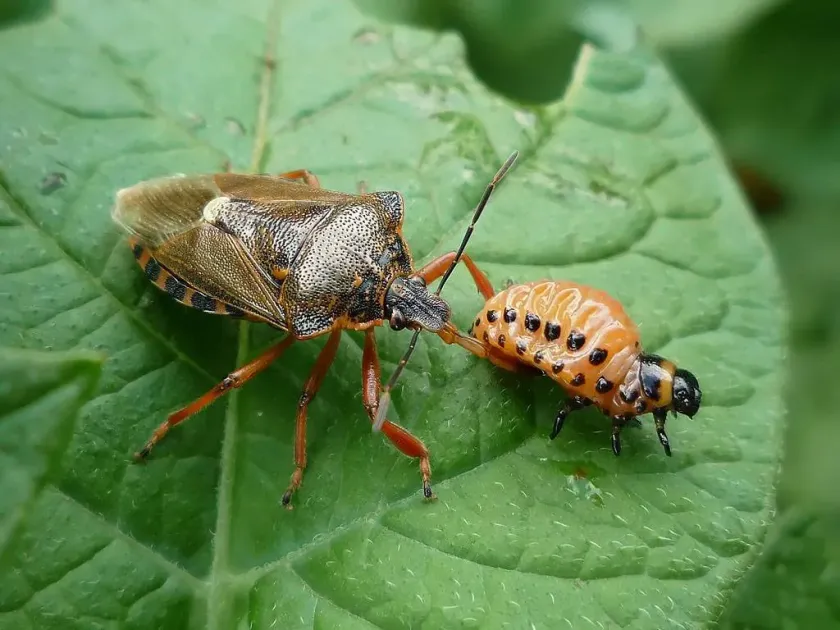
Description
How to identify
The Podisus genus, commonly known as the spined soldier bug, belongs to the Pentatomidae family. These insects are widely recognized as beneficial predators rather than agricultural pests.
Adult bugs typically measure between 8 and 13 mm in length. Their body color ranges from tan to reddish-brown, with a distinct mottled appearance that provides excellent camouflage against leaves and bark.
The most distinctive feature of the genus is the sharp, spine-like projection on the pronotum (the area just behind the head), which gives them their common name and a defensive advantage.
Female bugs lay eggs in clusters on the undersides of leaves. The nymphs pass through five instars before reaching adulthood, with each stage becoming more capable of hunting larger prey.
The mouthparts are structured as a robust piercing-sucking proboscis. This organ is used to puncture prey and inject enzymes, allowing the bug to feed on the internal fluids of its victims.
What it damages
Podisus species are highly valued in agriculture as natural enemies of various crop pests. They are generalist predators, meaning they feed on a wide variety of prey, including larvae of beetles and moths.
They are particularly effective at controlling populations of the Colorado potato beetle, cabbage loopers, and various caterpillars. By reducing these populations, they prevent significant damage to high-value crops.
While extremely rare, some species of Podisus may cause minor damage to plants if prey is scarce, as they may attempt to supplement their water and nutritional intake from succulent plant tissues.
However, this behavior is negligible in terms of economic impact. The benefits gained from their predatory activity far outweigh any superficial markings they might leave on plant foliage.
In modern agricultural practices, these bugs are often encouraged as a part of Integrated Pest Management (IPM) programs to decrease reliance on synthetic chemical insecticides.
When it appears
Spined soldier bugs are most active during the warmer months of the year. They typically emerge from hibernation once temperatures consistently reach favorable levels in the spring.
The peak activity and reproductive cycles coincide with the infestation periods of the pests they hunt. In many climates, they can complete multiple generations within a single growing season.
During the autumn, as days become shorter and temperatures drop, they search for protected locations to overwinter. They often seek refuge in leaf litter, under loose bark, or in sheltered structures.
The success of the overwintering population is crucial for next season's biological control. Providing environmental shelter can significantly boost their density in the following year.
Farmers can monitor their population levels by observing plants infested with prey, as the predators will congregate where the food source is most abundant.
Control measures
As beneficial insects, there is no need to control or eradicate Podisus. Instead, the objective of an agronomist is to implement management strategies that protect and preserve their population.
If chemical pesticides are absolutely necessary for other pests, growers should select narrow-spectrum insecticides that minimize harm to predatory bugs and other non-target beneficial organisms.
Integration of biological control methods and habitat management are the best ways to ensure a high presence of these predators in the field, reducing the long-term need for pesticides.
Avoiding blanket spraying of fields is highly recommended. By creating non-treated buffer zones, you provide a sanctuary where these insects can survive and quickly recolonize treated areas.
- Prioritize selective pesticides over broad-spectrum ones.
- Encourage local biodiversity to support predator survival.
- Monitor predator-to-prey ratios before making management decisions.
- Maintain natural habitats to serve as overwintering sites.
Taxonomy
- Latin name
- Podisus
- Order
- Hemiptera (bugs, aphids, leafhoppers)
- Family
- Pentatomidae
- EPPO code
- PODISP
Discussion
No discussions yet — be the first.