
Mountain wingless grasshopper
Podisma pedestris
Description
How to identify
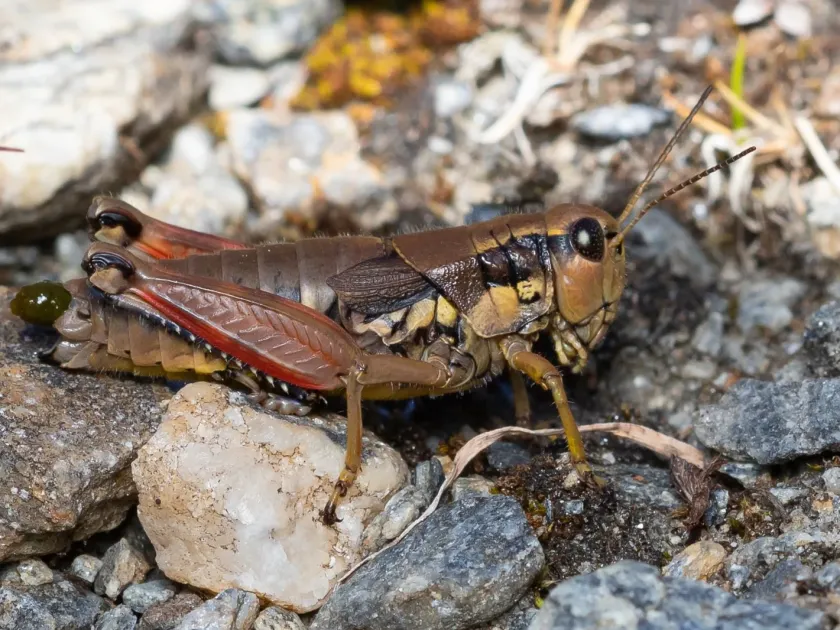
The mountain wingless grasshopper (Podisma pedestris) is a flightless species of grasshopper belonging to the Acrididae family. Adults typically measure between 15 and 30 mm in length and feature a robust body structure.
Their coloration is variable, ranging from brown to olive or greyish-green, often with distinct darker stripes along the sides of the abdomen. This camouflage helps them blend into their natural grassland habitats.
The most distinctive morphological feature of this species is its highly reduced wing structures. These non-functional wings render the insect incapable of flight, restricting its movement to jumping and crawling.
Larvae resemble miniature versions of the adults but lack developed wings and reproductive organs. They undergo several molting stages, gradually increasing in size and developing more adult-like characteristics.
These insects are native to meadows, forest edges, and alpine slopes. While they prefer natural landscapes, they have become significant agricultural pests when their population density spikes in nearby cultivated fields.
What it damages
The mountain wingless grasshopper is a polyphagous pest, meaning it feeds on a wide variety of plant species. It poses a significant threat to cereal crops, legumes, and various vegetables in their early growth stages.
In addition to crops, these insects feed aggressively on grasses and alfalfa. During drought years, they often migrate to industrial crops like sunflowers or flax when natural forage becomes scarce.
Heavy infestations can lead to the total destruction of young seedlings. The pests consume leaves, stems, and reproductive organs, which significantly impedes the development of the affected plants.
Extensive defoliation disrupts photosynthesis, leading to stunted growth or complete loss of the crop. When the growing point of a plant is targeted, the damage is often irreversible, resulting in reduced yields.
In pastures, these grasshoppers compete directly with livestock for food. Their grazing can significantly degrade the quality of forage, reducing the overall biomass and nutritional value of hay fields.
When it appears
The species completes one generation per year. The winter is survived in the egg stage, which the female deposits into the soil at a depth of a few centimeters during the late summer months.
Larval emergence typically begins in late spring, usually May, as temperatures rise. The first nymphs appear on warm, sun-exposed soil patches, road edges, and forest boundaries.
The developmental period for larvae lasts about 40 to 50 days, spanning five distinct instars. During this time, they exhibit voracious appetites, feeding actively on surrounding vegetation.
Adults emerge by mid-summer. This is the period of intense mating and reproduction. The adults remain active and continue to feed on host plants until the first significant autumn frosts occur.
Once the female has completed egg-laying in the soil, the lifecycle of that year's cohort comes to an end. The eggs remain in the ground, entering a state of diapause throughout the winter.
Signs of infestation
Early warning signs of infestation include irregular, shredded leaf margins. Unlike some chewing pests that create holes, these grasshoppers typically feed from the edges inwards, leaving veins behind.
Monitoring is easiest during the cooler parts of the day, such as early morning or late evening, when the insects are most visible on top of the canopy and in open field areas.
The presence of grasshopper frass (excrement) on leaves and the soil surface serves as a strong indicator of their feeding activity. Affected areas often show a patchy distribution of damage.
In high-density scenarios, the vegetation may look severely defoliated. The insects themselves are easily observed by simply moving through the field, which triggers them to jump in all directions.
Proactive field scouting, especially around field margins and weedy borders, is essential. Detecting the nymphs early allows for more targeted and effective control measures before they spread.
Control measures
Cultural control is the most effective preventative measure. Deep autumn plowing is highly recommended as it disrupts the soil, exposing eggs to desiccation, freezing, and predation by birds or insects.
Maintaining clean field borders and eliminating weeds on adjacent land reduces the available refuge and breeding grounds for the grasshoppers. This helps to contain populations before they reach the crop.
Chemical intervention should only be used when economic injury levels are exceeded. Broad-spectrum insecticides, particularly pyrethroids, are effective when applied while the nymphs are in early instars.
Biological control involves supporting natural enemies like predatory birds, beetles, and certain parasitic fungi. Minimizing excessive chemical use helps preserve these beneficial natural regulators.
- Deep plowing to destroy egg pods.
- Weed management on non-cropped areas.
- Chemical control during early nymph stages.
- Regular field monitoring for early detection.
Taxonomy
- Latin name
- Podisma pedestris
- Order
- Orthoptera (locusts)
- Family
- Acrididae
- EPPO code
- PODMPE
Discussion
No discussions yet — be the first.