
Podisma
Podisma
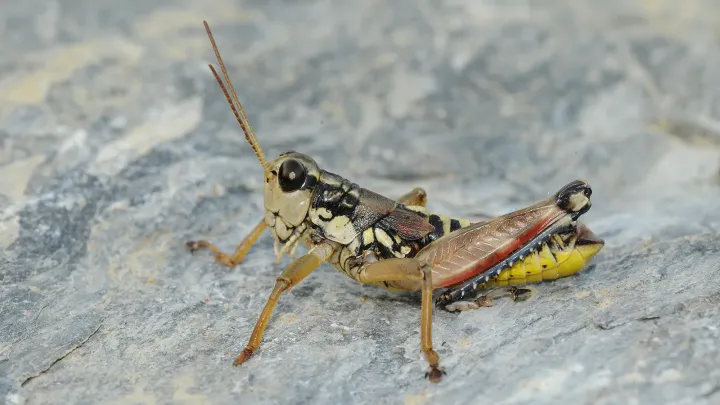
Description
How to identify
Podisma is a genus of grasshoppers belonging to the family Acrididae, notable for its significant impact on various plant species in diverse ecosystems.
These insects are typically flightless or have reduced wings, which keeps them localized within specific habitats such as mountain slopes or meadows.
The morphology of Podisma is characterized by a sturdy, compact body, often exhibiting brownish or greenish camouflage patterns to blend with vegetation.
A key taxonomic feature is the presence of a distinct tubercle on the prosternum, which differentiates this genus from many other grasshopper species.
Adults exhibit sexual dimorphism, with females usually being larger and possessing a well-developed ovipositor for depositing eggs in the soil.
What it damages
Podisma is recognized as a generalist feeder, or polyphage, capable of consuming a wide variety of herbaceous plants, grasses, and legume crops.
The pest causes substantial damage in mountainous regions, often infesting pastures, hayfields, and nearby agricultural cereal plots.
By chewing leaves, stems, and reproductive parts, these insects drastically reduce the photosynthetic capacity and vitality of the infested plants.
In high-density outbreaks, the entire leaf lamina can be consumed, leaving only the veins, which causes significant economic loss to farmers.
Furthermore, feeding injuries create entry points for secondary plant pathogens, further compromising the health and yield quality of the crop.
When it appears
The life cycle of Podisma is univoltine, meaning there is only one generation per year, with the egg stage serving as the overwintering mechanism.
Eggs are laid in batches within the soil or ground litter, where they remain dormant throughout the winter and early spring months.
Hatching occurs in late spring as temperatures rise, leading to the emergence of nymphs that immediately begin to forage for green tissue.
The nymphs undergo several molts, gradually developing into adults by mid-to-late summer, when they reach sexual maturity.
After the mating period in autumn, females oviposit the next generation of eggs to ensure the species' survival through the following winter.
Signs of infestation
The most common indicator of a Podisma infestation is the presence of jagged or scalloped edges on the leaves of host plants.
Field observers may notice characteristic irregular holes in the leaf tissue, often surrounded by small fecal pellets dropped by the feeding insects.
During the day, particularly in sunny weather, nymphs can be spotted jumping or hiding near the base of stems when disturbed.
Significant thinning of the canopy and the destruction of tender terminal shoots are clear signals that the population density is high.
In severe cases, entire sections of a crop may show signs of extensive herbivory, resulting in a stunted or withered appearance of the plants.
Control measures
Effective management of Podisma populations relies on an integrated pest management (IPM) approach that combines cultural and chemical strategies.
Cultural methods, such as deep autumn plowing, are highly effective as they disturb the soil and destroy the overwintering egg pods.
Maintaining clean field borders by eliminating weeds prevents the buildup of initial populations that might otherwise migrate into the main crop.
Chemical control involving approved insecticides is recommended when nymphal populations exceed established economic injury thresholds.
- Regular field scouting to detect early-stage nymphs.
- Application of contact insecticides targeted at younger larval instars.
- Implementation of biological controls using natural predators or pathogens.
Taxonomy
- Latin name
- Podisma
- Order
- Orthoptera (locusts)
- Family
- Acrididae
- EPPO code
- PODMSP
Discussion
No discussions yet — be the first.