
Brown shield bug
Plautia stali
Description
How to identify
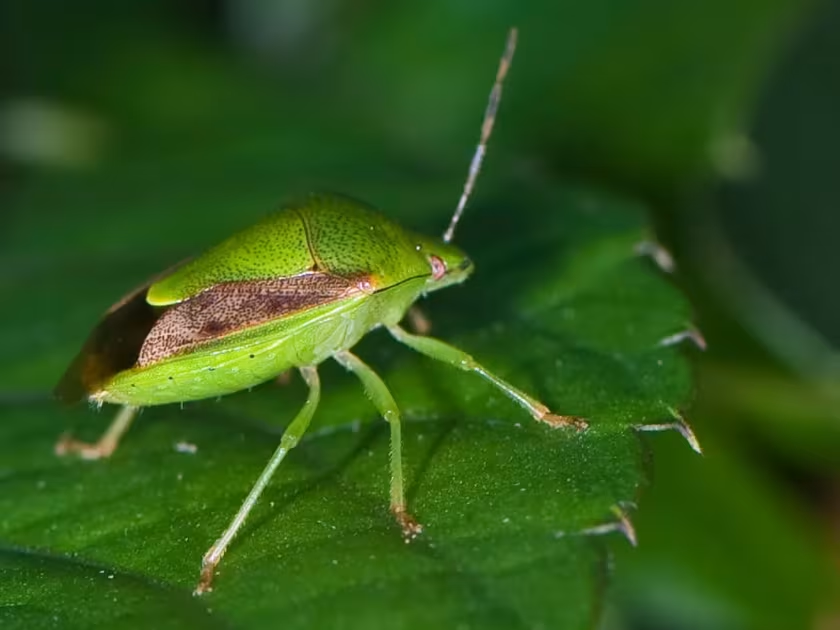
The brown shield bug (Plautia stali) belongs to the order Hemiptera and the family Pentatomidae. Adult insects are characterized by their oval, flattened body shape, typically measuring 10–12 mm in length.
Their coloration ranges from brown to bronze-green, often displaying a distinct metallic sheen. The pronotum and scutellum possess a robust chitinous structure, while the edges of the abdomen often exhibit a contrasting border.
The life cycle includes five nymphal instars. As nymphs mature, they change from a lighter yellow-green to a darker color with distinct patterns on the abdomen, though they lack fully developed wings.
This species is highly adapted to warm climates, thriving in regions with long, favorable growing seasons. In temperate zones, its ability to survive depends heavily on the availability of overwintering sites.
Overwintering adults typically seek shelter in organic debris, leaf litter, under tree bark, or within the dry stalks of weeds, allowing them to remain dormant until spring temperatures rise.
What it damages
As a polyphagous pest, the brown shield bug causes significant damage to a wide variety of agricultural crops, particularly favoring fruit and berry plantations.
In orchards, these bugs target peaches, nectarines, apples, and pears. By piercing the skin and injecting enzymes during feeding, they cause localized cell death, leading to fruit deformation and aesthetic loss.
Berry crops such as grapes and raspberries are also susceptible. Feeding punctures often serve as entry points for secondary fungal pathogens, resulting in premature decay of the fruit.
Vegetable crops, including beans, soybeans, and tomatoes, are frequently attacked. The pest often moves from wild host plants to cultivated crops during the fruit-set and ripening stages.
Severe infestations can lead to substantial yield reductions, making the harvested produce unsuitable for market due to poor quality and damaged internal tissue.
When it appears
The emergence of overwintering adults usually occurs in spring when temperatures consistently rise above the threshold required for insect activity.
During the flowering and early fruit development phases, adults migrate to host plants. They feed intensely on young shoots and buds, causing early-season damage to the plant's structural development.
Summer marks the peak of the pest's activity, characterized by high rates of reproduction and the development of subsequent generations within the crop canopy.
As autumn approaches and temperatures drop, the bugs begin their migration to protected overwintering sites to undergo diapause, ending their period of active damage.
Strategically timing control measures during the peak summer months is essential to target the most vulnerable nymphal stages and prevent the next generation from causing widespread damage.
Signs of infestation
The primary diagnostic sign is the presence of minute, dark puncture marks on the skin of fruit, often surrounded by a chlorotic or necrotic halo.
Internal tissue damage often manifests as hardened, corky, or spongy areas within the fruit, which often develop an unpleasant flavor due to the salivary enzymes injected by the bug.
A noticeable, foul odor in the field is a strong indicator of a high population density of stink bugs, as they release defensive chemicals when disturbed.
Visible presence of bugs, especially on the underside of leaves or directly on ripening fruit during the cooler parts of the day, indicates an ongoing infestation.
Premature fruit drop and the presence of bumpy, deformed fruits are clear field indicators that the crop is being impacted by Plautia stali.
Control measures
Chemical control involving systemic or contact insecticides is often necessary when threshold levels of the pest are reached, particularly targeting early-instar nymphs.
Sanitation practices are crucial for long-term management; removing leaf litter, crop residues, and controlling weeds in adjacent areas eliminates essential overwintering habitats.
Pheromone traps serve as an effective monitoring tool, allowing farmers to detect the arrival of the pest and schedule insecticide applications with higher precision.
Maintaining a weed-free buffer zone around orchards or fields helps discourage the bug from establishing initial populations before moving onto the primary crop.
- Use of natural biological control agents like egg parasitoids (Telenomus species).
- Installation of protective fine-mesh netting for high-value fruit crops.
- Regular inspection of borders and edge rows where the pest first congregates.
Taxonomy
- Latin name
- Plautia stali
- Order
- Hemiptera (bugs, aphids, leafhoppers)
- Family
- Pentatomidae
- EPPO code
- PLAUST
Discussion
No discussions yet — be the first.