
Pirate wolf spider
Pirata piraticus
Description
How to identify
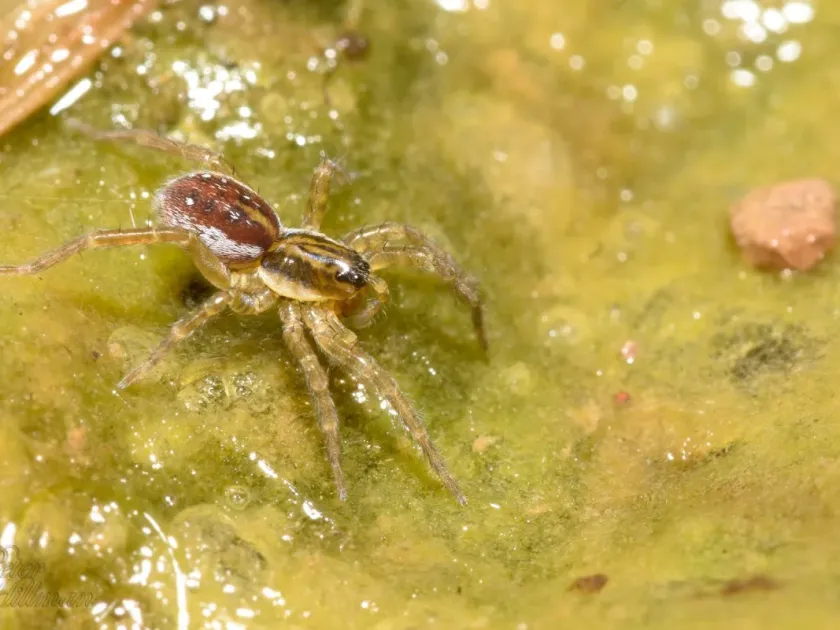
The Pirate wolf spider (Pirata piraticus) is a member of the Lycosidae family, commonly found in moist habitats near water bodies.
Adult specimens typically range in size from 5 to 9 millimeters, featuring a brownish to greyish body color for camouflage.
A key identification mark is the pale longitudinal stripe on the dorsal side of the cephalothorax, tapering towards the rear.
Unlike web-spinning spiders, they hunt actively, relying on their speed and excellent eyesight to capture prey on the ground.
Females are known for carrying their egg sacs attached to their spinnerets, a characteristic behavior of the wolf spider family.
What it damages
Pirata piraticus is not a plant pest; it does not feed on crops, foliage, or roots, and causes no direct injury to agricultural produce.
As an entomophagous predator, this species serves an important ecological function by consuming a variety of small invertebrates.
They act as natural enemies to many agricultural pests, contributing to the biological balance within the field environment.
There is no economic damage threshold for this species, as its presence is generally considered beneficial for crop health.
In high-density populations, their activity is strictly predatory, and they pose no threat to the commercial yield of agricultural crops.
When it appears
The lifecycle begins in early spring as temperatures rise, signaling the emergence of spiders from their winter diapause.
During the summer months, these spiders are highly active, matching the peak availability of prey insects in the fields.
As the season shifts towards autumn, adults look for suitable overwintering sites, such as leaf litter or soil crevices.
Their development is heavily influenced by humidity levels, as they prefer damp soil environments to maintain their physiological needs.
Reproduction typically occurs during the warmer months, ensuring that the next generation is ready for the upcoming season.
Control measures
No specific control measures are necessary for Pirata piraticus because it is not categorized as a crop pest.
Broad-spectrum insecticide applications should be avoided to prevent collateral mortality of these beneficial predatory spiders.
Integrated pest management (IPM) practices should prioritize the conservation of such natural enemies to reduce reliance on chemicals.
In greenhouse settings, if their presence is undesirable, simply adjusting irrigation to reduce localized soil moisture is highly effective.
Maintaining ecological corridors around fields supports stable populations of these helpful arachnids, aiding in natural pest suppression.
Taxonomy
- Latin name
- Pirata piraticus
- Family
- Lycosidae
- EPPO code
- PIRTPI
Discussion
No discussions yet — be the first.