
Radiated wolf spider
Hogna radiata
Description
How to identify
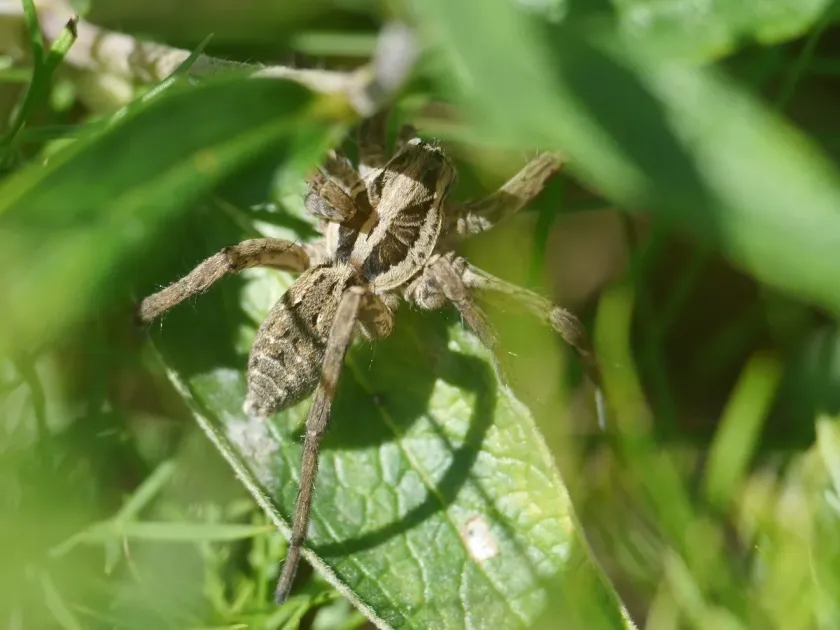
The radiated wolf spider (Hogna radiata) is a member of the Lycosidae family. It is a large, ground-dwelling spider that does not build webs to capture prey but relies on active hunting.
The species is easily recognized by the characteristic radial pattern on its cephalothorax, consisting of dark stripes radiating from the center. Its coloration provides perfect camouflage against the soil and leaf litter.
Females are significantly larger than males, with body lengths reaching up to 3 cm. They are known for their strong maternal instincts, often carrying their egg sacs attached to their spinnerets.
This spider prefers open, dry habitats such as steppes, fields, and edges of agricultural land. It is primarily nocturnal, remaining in hidden spots during the daylight hours.
While their size and appearance may be intimidating, their bite is generally not dangerous to humans, typically causing only minor pain and localized swelling.
What it damages
It is important to clarify that Hogna radiata is not a phytophagous species. It does not feed on plants and does not cause mechanical damage to leaves, fruits, or roots.
Its impact in agro-ecosystems is indirect. By acting as a predator, it consumes various insects, including beneficial ones such as parasitoids and predatory beetles used in integrated pest management (IPM).
In large-scale farming, the presence of these spiders is rarely high enough to interfere significantly with biological control programs, and they are generally considered an insignificant factor in crop loss.
In most cases, these spiders are considered beneficial to farmers, as they actively hunt and control populations of various crop pests, such as beetles, moths, and locusts.
Therefore, labeling them as a primary pest is inaccurate. They are part of the natural balance of the field, providing free biological pest regulation.
When it appears
Activity begins in the spring when soil temperatures rise consistently. This is when individuals emerge from their winter shelters to hunt and mate.
Summer is the peak of their life cycle, coinciding with high insect activity, which provides a steady food supply for the spiders. During this time, female spiders are often seen carrying their young.
As autumn approaches, activity decreases significantly as the spiders prepare for dormancy. They seek deeper soil cracks or rodent burrows to survive the colder months.
The species is well-adapted to surviving winter in temperate climates by entering a state of diapause, hiding in soil layers that remain above freezing temperatures.
With the arrival of the next warm season, the cycle repeats, and the spiders resume their hunting activity across the landscape.
Control measures
Specific control measures for Hogna radiata are rarely necessary, as they are not primary agricultural pests. Management is only required if their presence near houses or storage areas becomes a nuisance.
Agricultural practices such as regular soil cultivation, tilling, and harrowing disrupt the spiders' habitats, making them less likely to establish permanent populations in the fields.
Keeping the area clear of debris, long grass, and stacked materials prevents them from finding suitable hiding spots, forcing them to move away from critical zones.
Indiscriminate use of broad-spectrum insecticides is not recommended, as it harms beneficial insects and natural predators, potentially leading to pest outbreaks.
- Regular weeding and clearing of plant debris.
- Mechanical tilling of the soil in rows.
- Maintaining a clear perimeter around farm buildings.
- Prioritizing biological pest control to maintain a healthy predator balance.
Taxonomy
- Latin name
- Hogna radiata
- Family
- Lycosidae
- EPPO code
- HOGNRA
Discussion
No discussions yet — be the first.