
Gorse shield bug
Piezodorus lituratus
Description
How to identify
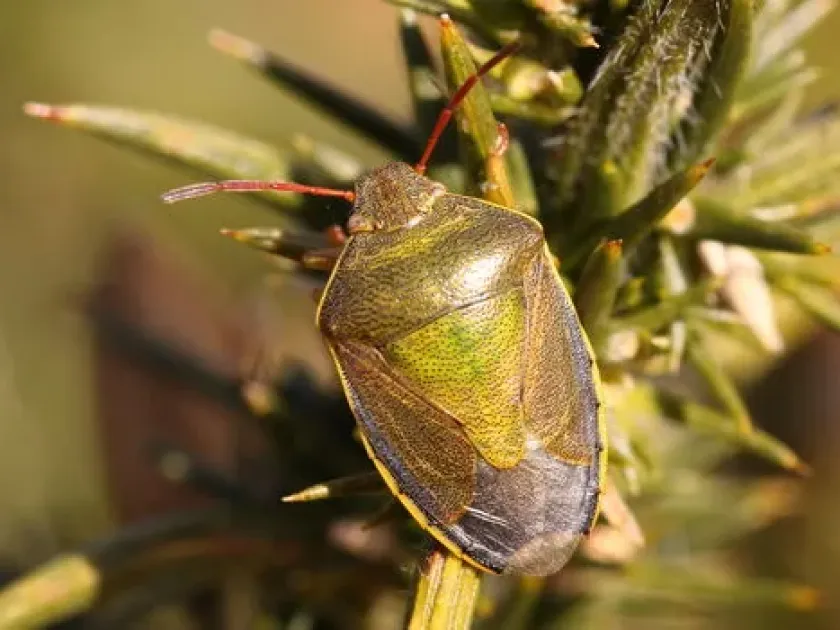
The Gorse shield bug (Piezodorus lituratus) is a member of the order Hemiptera and the family Pentatomidae. Adult bugs typically measure between 10 and 12 mm in length and exhibit a color scheme ranging from green to reddish-brown, often with a striking black pattern on the pronotum.
The insect possesses the classic shield-like body shape typical of its family. A key morphological characteristic distinguishing this species is the transverse pale band across the pronotum, which is bordered by darker spots, making it relatively easy to identify in the field.
The life cycle includes five nymphal instars. During these stages, the appearance of the nymphs changes significantly, shifting from vivid, contrasting patterns to more uniform, brownish or greenish tones as they prepare to transition into adulthood.
These bugs are commonly found in open, sunny habitats such as field margins, meadows, and areas where host plants like gorse or various legumes grow. Eggs are typically laid in small clusters on the underside of host plant leaves.
The species overwinters in the adult stage, seeking shelter in plant debris, leaf litter, or dense vegetation. Once spring temperatures rise, the adults emerge, feed, and begin their reproductive cycle to colonize available host plants.
What it damages
Piezodorus lituratus is primarily a pest of legumes (Fabaceae). In agricultural settings, it frequently infests crops such as alfalfa, clover, vetch, peas, and soybeans, targeting both developing pods and seeds for nourishment.
Both adults and nymphs use their piercing-sucking mouthparts to penetrate pods, extracting juices from the developing seeds inside. This feeding behavior leads to the formation of necrotic spots on the seeds and pods, resulting in shriveled or malformed grains.
Severe infestations can lead to substantial yield losses, particularly in seed production fields. The feeding process not only depletes the nutrients within the seeds but also disrupts the overall development of the fruit, causing premature pod shedding.
The saliva injected by the bug during feeding can cause local tissue death and inhibit plant growth. This can stunt the development of individual branches or entire pods, significantly impacting the aesthetic and commercial quality of the crop.
In years with high bug populations, the damage can escalate rapidly. Because the bugs move from plant to plant, a localized infestation can quickly spread across a field, requiring close monitoring during the pod-filling stages of the crop.
When it appears
The seasonal activity of the Gorse shield bug begins in early spring, usually when temperatures become consistently warm. Adults move from their overwintering sites to early-season host plants to feed and build up energy for mating.
The peak activity period for reproduction and nymph development occurs during the summer months, typically June and July. During this time, the nymphs are most active and voracious, coinciding with the critical pod development stages of many legume crops.
A second generation may occur in warmer climates, leading to a late-summer peak in population numbers. By late summer, the newly emerged adults begin preparing for winter by feeding heavily before seeking out suitable hibernation sites.
As autumn approaches and temperatures drop, the bugs enter a state of diapause. They migrate into forest edges, tall grass, or other protected areas to survive the cold months. The survival rate of the population depends largely on the harshness of the winter.
Monitoring for this pest should be most intense during the late spring and summer months. Early detection is crucial to determining if the bug population has reached a level that necessitates intervention before significant crop damage occurs.
Signs of infestation
Visual identification of infestation often starts with spotting small, dark puncture marks on the surface of the pods. These marks are entry points for the bug's mouthparts and are frequently surrounded by small areas of discoloration or necrosis.
Deformed or twisted pods are another common indicator of the bug's presence. As the bug feeds on the developing seeds within the pod, the uneven extraction of nutrients causes the pod to grow irregularly, leading to the characteristic bumpy or curved appearance.
Field scouting often reveals the insects themselves, especially on sunny days. If disturbed, they may drop to the ground or fly away, so careful observation of the plant foliage, especially around the base of the stems and the underside of leaves, is necessary.
Nymphs are often found clustered on flowers and young pods. Their coloring often mimics the plant tissue, so a closer look at the inflorescences is recommended to identify the presence of juvenile bugs before they reach the adult stage.
A final sign of infestation may be evident during harvest, where a high percentage of small, shriveled, or discolored seeds are found in the sample. This indicates that the pest was present during the seed development stage and successfully fed on the crop.
Control measures
- Implement crop rotation to disrupt the life cycle of the pest by removing host plants from the same field year after year.
- Maintain clean field borders by removing weeds and wild legumes that act as reservoirs for the bug population.
- Utilize early-maturing crop varieties to ensure the pod development phase avoids the peak activity period of the bugs.
- Apply registered insecticides if population counts exceed the economic threshold, targeting early nymphal stages for maximum efficacy.
- Encourage natural predators and parasitoids in the field ecosystem to provide biological control of shield bug populations.
Taxonomy
- Latin name
- Piezodorus lituratus
- Order
- Hemiptera (bugs, aphids, leafhoppers)
- Family
- Pentatomidae
- EPPO code
- PIEZLI
Discussion
No discussions yet — be the first.