
Gorse shield bug
Piezodorus
Description
How to identify
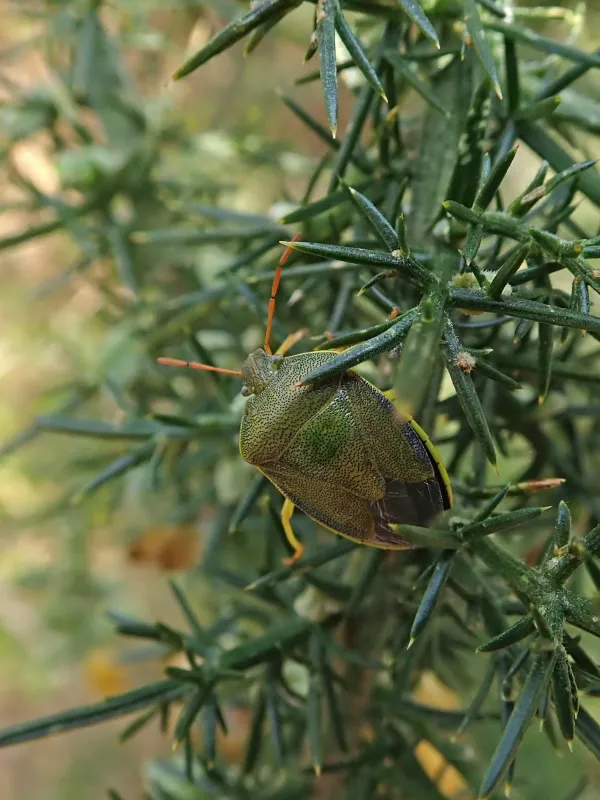
The Gorse shield bug (Latin: Piezodorus lituratus) belongs to the Pentatomidae family, order Hemiptera. Adults are shield-shaped, typically measuring 10–12 mm in length.
The coloration changes from bright green during spring and summer to reddish-brown or yellowish in autumn, providing effective camouflage against foliage.
A distinctive feature of this species is its reddish or yellowish legs, from which it derives its common name. The pronotum has a characteristic protruding front edge and corners.
Eggs are typically laid in double rows on the underside of leaves or on the stems of host plants. Nymphs resemble miniature adults but lack wings and possess a unique pattern on their abdomen.
The life cycle involves incomplete metamorphosis, with nymphs passing through five instars, gradually increasing in size and developing mature characteristics.
What it damages
This species is a polyphage, favoring legumes such as alfalfa, clover, and vetch, as well as various cereal crops.
The pest feeds on plant sap by piercing young shoots, leaves, buds, and developing seeds with its piercing-sucking mouthparts.
The most severe damage occurs during the grain filling and pod formation stages, leading to significant yield losses and reduced seed quality.
Damaged plant tissues turn yellow, become deformed, and develop necrotic spots at the feeding sites, which disrupts the plant's metabolism.
During mass outbreaks, these bugs can cause premature dropping of flowers and ovaries, severely impacting the overall productivity of the agroecosystem.
When it appears
Adults primarily overwinter in leaf litter, dry grass, or plant debris, remaining active until the arrival of persistent cold weather.
Spring activity commences when average daily temperatures exceed 10–12 degrees Celsius, prompting the migration to legume fields.
The peak reproductive phase and egg-laying occur between late May and June, coinciding with the availability of young food sources in the fields.
The summer generation develops rapidly, with population numbers peaking during the flowering and fruiting stages of most crops.
By autumn, insects migrate to overwintering sites, making autumn field maintenance crucial for reducing the population for the following season.
Signs of infestation
The first sign of infestation is the presence of the bugs themselves on the stems or within flower heads, where they often remain hidden.
Leaves may show characteristic light-colored pinpricks, which eventually merge into larger discolored patches of tissue.
Prematurely dropped ovaries and hollow, underdeveloped seeds within legume pods are common indicators of high shield bug activity during the growing season.
Severe infestations lead to stunted plant growth, leaf curling, and the presence of a distinct unpleasant odor released by the bugs when disturbed.
- Yellowing of leaf margins.
- Deformation of pods and seeds.
- Presence of egg clusters on the underside of leaves.
- Excrement deposits on vegetative plant surfaces.
Control measures
Agronomic practices include thorough weeding of fields, as weeds often serve as early-season reservoirs for the pest.
Implementing crop rotation and maintaining spatial isolation between legume crops and perennial grasses significantly reduces the risk of migration.
During periods of high population density, systemic or contact-stomach insecticides registered for specific crops should be applied.
Regular monitoring using an entomological sweep net is essential to make informed decisions based on economic injury thresholds.
Biological control measures, such as preserving natural predators (e.g., parasitic wasps and predatory beetles), help keep populations in check within ecological farming systems.
Taxonomy
- Latin name
- Piezodorus
- Order
- Hemiptera (bugs, aphids, leafhoppers)
- Family
- Pentatomidae
- EPPO code
- PIEZSP
Discussion
No discussions yet — be the first.