
Picromerus bidens
Picromerus bidens
Description
How to identify
Picromerus bidens, known as the spiny shield bug, is a predator within the Pentatomidae family. It is easily recognized by the prominent, sharp spines on its pronotum that point outwards, giving it a distinctive appearance.
Adults typically measure 11–13 mm in length and feature a brown or brownish-grey coloration with dark punctation. Their scutellum is well-developed, covering a significant part of the thorax.
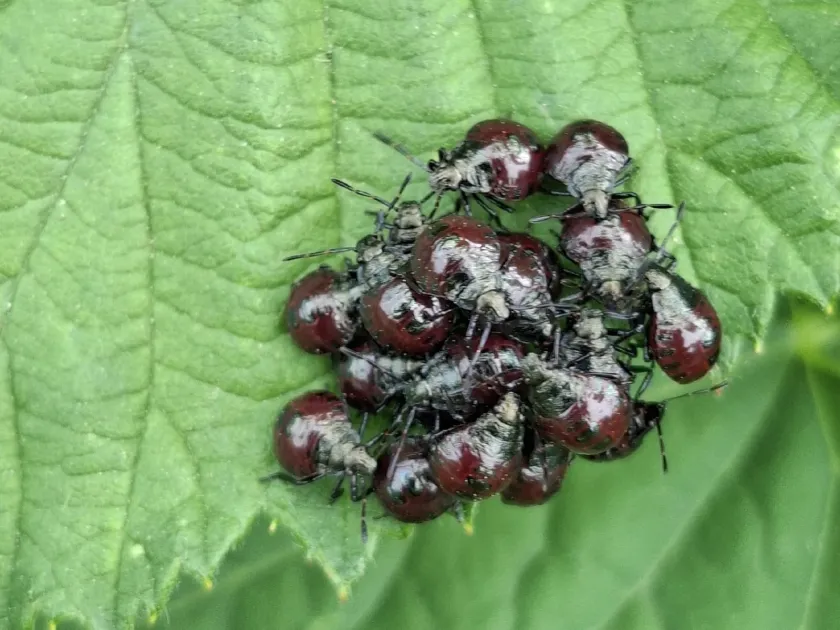
The nymphs go through several instars, with early stages displaying bright red coloration on the abdomen, which darkens to dark brown or black as they mature towards the adult phase.
Their mouthparts are adapted for piercing and sucking fluids from other insects, making them highly efficient predators rather than plant pests.
They are commonly found in gardens, forests, and agricultural fields, often standing motionless on leaves to ambush their prey.
What it damages
Picromerus bidens does not damage crops. It is exclusively predatory, feeding on caterpillars, beetle larvae, and sawfly larvae, which are common agricultural pests.
By consuming these pests, the bug serves as a natural regulator of populations, helping to prevent outbreaks of damaging insects in forests and on farmland.
Because they do not feed on plant tissues, they are considered valuable assets in integrated pest management (IPM) programs.
The role of these bugs is to protect the health of the plants by reducing the number of herbivores that would otherwise destroy foliage or fruits.
Their predatory behavior is highly effective, as they are capable of capturing prey significantly larger than themselves using their specialized rostrum.
When it appears
This species typically produces one generation per year in temperate climates. It overwinters in the egg stage, with eggs laid in clusters on leaves or bark.
Nymphs emerge in the spring and undergo five molts before reaching adulthood. The most active predatory stage occurs during the summer months when pest activity is at its highest.
Adults are present from mid-to-late summer, actively searching for hosts to sustain their energy and eventual reproduction.
Environmental factors such as temperature significantly impact the development speed of nymphs; warmer summers often lead to more synchronized population peaks.
By the time autumn arrives, adults have completed their cycle and laid the eggs that will ensure the continuation of the species through the following winter.
Signs of infestation
Signs of their presence include distinctive egg clusters, usually arranged in regular rows on the underside of foliage. These clusters are quite conspicuous once discovered.
Nymphs are often found in clusters on leaves, which indicates a healthy population growth in the area. Spotting them is a positive indicator of natural pest control.
The presence of adult bugs on stems and leaves, often waiting in a hunting posture, confirms they are actively protecting the vegetation.
Shriveled or dried-up remains of caterpillars on the plants are often the aftermath of a successful hunt by these predators.
A noticeable decrease in pest damage in fields where these bugs are present demonstrates their effectiveness as natural biocontrol agents.
Control measures
There is no need for control measures against Picromerus bidens, as it is a beneficial insect. In fact, farmers are encouraged to promote its presence.
The use of broad-spectrum insecticides should be minimized or avoided during the bugs' active season to ensure the survival of the beneficial predator population.
Maintaining hedgerows, field margins, and floral strips provides essential refuge and alternative food sources for the bugs when primary pests are scarce.
Integrated pest management strategies should prioritize the preservation of these natural enemies over total chemical eradication of all insect populations.
Educating growers on identifying beneficials like the spiny shield bug is key to fostering a balanced ecosystem that relies on natural predation rather than constant chemical use.
Taxonomy
- Latin name
- Picromerus bidens
- Order
- Hemiptera (bugs, aphids, leafhoppers)
- Family
- Pentatomidae
- EPPO code
- PICRBI
Discussion
No discussions yet — be the first.