
Grape phylloxera
Phylloxera perniciosa
Description
How to identify
Grape phylloxera (Daktulosphaira vitifoliae) is a destructive microscopic insect belonging to the family Phylloxeridae. It is native to North America and is a major pest of grapevines worldwide, causing significant economic losses.
The insect exists in two main forms: the root form, which lives underground on the roots, and the leaf form, which creates galls on the foliage. The root form is the primary cause of vine decline and death.
The lifecycle is complex and involves several stages, including wingless asexual females that reproduce parthenogenetically. The insects are small, typically ranging from 0.5 to 1.5 mm in length, and can be difficult to spot without magnification.
Phylloxera populations can multiply rapidly under favorable conditions. A single insect can lead to a massive infestation, making early detection and strict quarantine measures essential for any viticultural enterprise.
Dispersal occurs through human activity, such as moving infested nursery stock, soil attached to machinery, or even through irrigation water runoff from infected vineyards.
What it damages
The primary damage is caused by the root-feeding form, which pierces the roots of European grapevines (Vitis vinifera). The insect's saliva causes the formation of galls (nodosities and tuberosities).
These galls prevent the roots from absorbing water and nutrients effectively. Furthermore, the lesions serve as entry points for soil-borne pathogens, leading to secondary rot and complete root system failure.
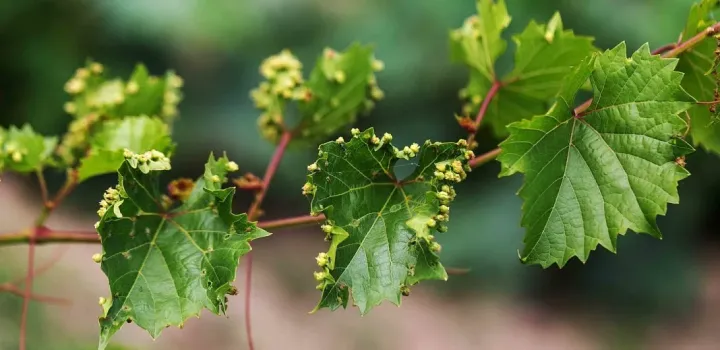
The leaf-feeding form creates galls on the leaves, which can reduce the photosynthetic capacity of the vine. However, this damage is generally considered less severe than the systemic destruction of the root system.
Visible decline of the vine occurs over several years. Initially, growth slows and yields decrease, followed by leaf chlorosis and eventual death of the entire plant as the root system collapses.
Young vineyards are particularly vulnerable, and an infestation can lead to the loss of an entire plantation within a few short years if left unmanaged.
Signs of infestation
Early symptoms are often subtle and can be easily confused with drought stress or nutrient deficiencies. The most reliable signs are uneven growth and stunted vines appearing in localized clusters.
If the foliage is infested, small, bead-like galls appear on the undersides of the leaves. These are easy to identify during the active growing season by performing regular visual inspections of the vine canopy.
During the late season, leaves may show premature yellowing and reddening. The vines will also produce less fruit, and the bunches may remain small and poorly developed compared to healthy specimens.
Below ground, diagnostic signs include the presence of yellow to brownish insects on the roots, as well as distinct galls or swelling on the root tissue that eventually turns black due to necrosis.
Advanced decline is marked by a complete lack of terminal growth, thin canopy, and branches that die back, eventually resulting in the death of the entire grapevine.
Control measures
The most effective strategy for phylloxera management is the use of grafted rootstocks that possess natural resistance to the root-feeding form of the insect. This is the global standard for modern viticulture.
Strict quarantine and biosecurity protocols are crucial to prevent the introduction of the pest into new areas. Nurseries must certify that their stock is free from phylloxera before shipping.
Chemical control is rarely effective for subterranean populations due to the difficulty of reaching the insects in deep soil. In some cases, systemic insecticides may provide temporary suppression, but they are not a long-term solution.
- Planting resistant rootstock cultivars
- Implementing strict quarantine measures
- Sanitation of pruning equipment
- Regular inspection and monitoring of vines
- Removal and destruction of infested vineyard blocks
Integrated Pest Management (IPM) focusing on early detection and prevention remains the best way to safeguard the health of the vineyard against this devastating pest.
Taxonomy
- Latin name
- Phylloxera perniciosa
- Order
- Hemiptera (bugs, aphids, leafhoppers)
- Family
- Phylloxeridae
- EPPO code
- XEROPE
Discussion
No discussions yet — be the first.