
Grape phylloxera intermediate
Phylloxera intermedia
Description
How to identify
Grape phylloxera intermediate Phylloxera intermedia belongs to the Phylloxeridae family, order Hemiptera. This microscopic insect, visually resembling an aphid, leads a hidden lifestyle on the roots or leaves of grapevines.
Adult individuals are about 1 mm long, and their coloration varies from yellowish-green to brown. The insect possesses a specific piercing-sucking mouthpart adapted for feeding on plant sap.
The life cycle of this species is highly complex, involving the alternation of several generations. An important feature of Phylloxera intermedia is the existence of both root-inhabiting and leaf-inhabiting forms of development.
Accurate identification of the pest often requires entomological equipment, as the size of first-instar nymphs does not exceed 0.3 mm, making them almost invisible to the naked eye.
The development of phylloxera occurs in several phases, and the intermediate form demonstrates high adaptability to various soil types and climatic conditions of grape-growing regions.
What it damages
The primary food sources for the pest are cultivated and wild grape species of the Vitis genus. Damage is inflicted on both the root system and the aerial organs of the plant.
The root form of phylloxera causes the appearance of pathological growths known as tuberosities and nodosities. This leads to the disruption of plant metabolism and nutrient intake, inevitably causing the gradual decline of the vineyard.
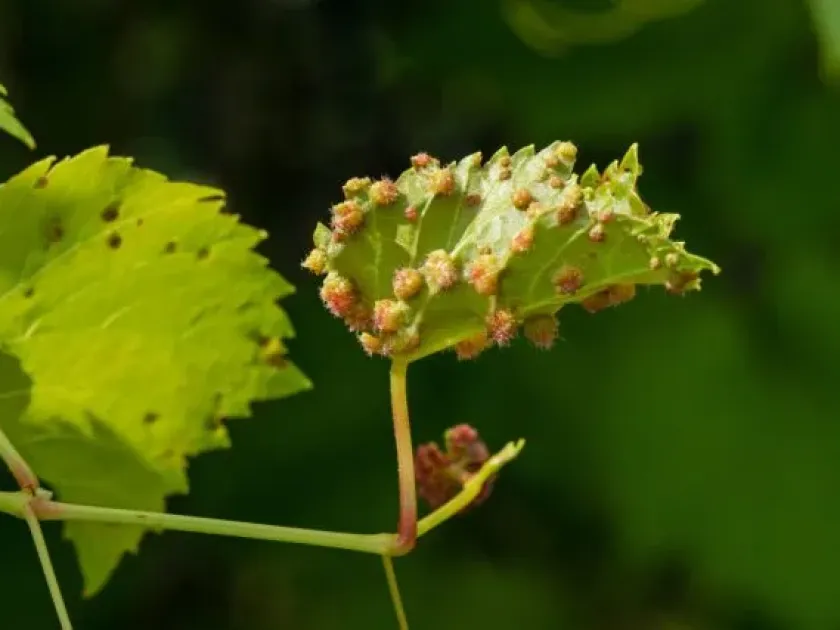
The leaf form triggers the formation of galls, inside which the insect develops and reproduces. Severe infestation leads to curling, deformation, and premature leaf fall.
The harmfulness of Phylloxera intermedia lies not only in direct sap extraction but also in the fact that secondary fungal and bacterial infections enter the puncture sites, causing root decay.
Ultimately, infested grapevines lose productivity, suffer from reduced cold hardiness, and without proper intervention, can perish completely within a few years.
When it appears
Pest activity begins in early spring, immediately after the start of sap flow and bud break, when nymphs move from diapause to active feeding.
Several successive generations develop throughout the summer period. The rate of reproduction depends directly on temperature: values between +20 and +28 degrees Celsius are most favorable.
In the autumn, as average daily temperatures drop, the insects gradually migrate to deeper soil layers or cracks in the bark for overwintering.
Population peaks occur in June and August, coinciding with the phases of most intense shoot growth and grape berry ripening.
The spread of the pest during the season occurs mainly through infested plant material, irrigation water, and is also carried by wind, birds, and agricultural machinery.
Signs of infestation
The first visual sign of infestation is the presence of characteristic galls on the underside of leaves, which appear as small round swellings of bright yellow or reddish color.
Stunted growth and chlorosis of shoots often indicate hidden root damage, which is difficult to detect at initial stages without a thorough inspection of the root system.
Gradual thinning of the vineyard, manifesting as patches of stressed vines, is a classic symptom of the long-term presence of phylloxera colonies.
Inspection of roots can reveal swellings and tissue overgrowth, which eventually darken and decompose, leading to the death of small feeder roots.
Reduced crop yields, smaller clusters, and early yellowing of leaves (not associated with micronutrient deficiencies) can also signal the presence of phylloxera.
Control measures
The most effective method of control is the use of phylloxera-resistant rootstocks, which possess natural resistance to this pest.
Quarantine measures play a critical role in limiting spread: the movement of nursery stock from infested zones is strictly prohibited.
Chemical control methods include the use of contact-systemic insecticides, though targeting the root form is challenging due to the pest's deep subterranean location.
Agronomic techniques, such as flooding vineyards (in regions where feasible) or growing grapes in sandy soils, significantly reduce insect survival rates.
- Use of certified pathogen-free nursery stock
- Regular phytosanitary monitoring of the site
- Disinfection of soil-working tools
- Removal and destruction of heavily infested vines
Taxonomy
- Latin name
- Phylloxera intermedia
- Order
- Hemiptera (bugs, aphids, leafhoppers)
- Family
- Phylloxeridae
- EPPO code
- MORZIN
Discussion
No discussions yet — be the first.