
Grape phylloxera
Phylloxera foveola
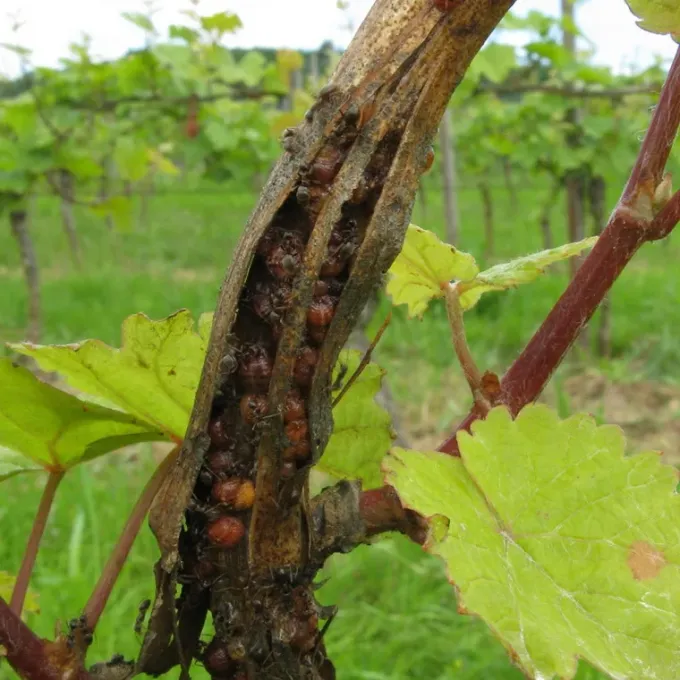
Description
How to identify
Grape phylloxera (Daktulosphaira vitifoliae) is a minute insect belonging to the family Phylloxeridae, order Hemiptera. It is one of the most destructive agricultural pests known, causing severe damage to Vitis vinifera vines worldwide.
The insect is microscopic, which makes early detection in the vineyard extremely difficult. It exists in different forms, including root-feeding, leaf-gall-forming, and winged migratory stages, depending on the season and host type.
Adult females are oval-shaped, varying in color from pale yellow to dark brown. Crawlers (the first instar larvae) are highly active and are primarily responsible for the rapid spread of the pest within and between vineyards.
The life cycle is remarkably complex, involving several generations. In most commercial vineyards, the root-dwelling form is the most critical as it remains underground for the entire season, feeding on the roots.
The leaf form creates specialized structures called galls, where eggs are laid and larvae develop, causing distortion and yellowing of the foliage.
What it damages
The primary host for this pest is the European grapevine (Vitis vinifera). Phylloxera attacks both the roots and, in some cases, the leaves of the host plant.
Root damage manifests as small swellings known as nodosities on new roots and larger, woodier structures called tuberosities on older roots, which eventually lead to root decay.
These feeding lesions impede the vine's ability to transport water and nutrients, resulting in slow decline, reduced fruit production, and eventually vine death.
Leaf-feeding phylloxera causes the formation of small pouch-like galls on the underside of leaves. While less lethal than the root form, heavy infestations weaken the vine significantly.
The economic impact of phylloxera is devastating, historically forcing the entire global wine industry to adopt rootstock grafting to survive.
When it appears
Activity resumes in early spring when temperatures rise, triggering the larvae to begin feeding on the root system after overwintering.
During the growing season, multiple generations overlap, leading to a exponential increase in population size if conditions remain favorable.
Winged forms typically emerge in late summer, usually when temperatures are high, allowing for wind-dispersed migration to new, non-infested vines.
Overwintering occurs primarily in the larval stage, residing within the soil on roots or hiding in the crevices of the vine bark.
Dry and warm climates often accelerate the life cycle, leading to more frequent generations and increased pressure on the vineyard health throughout the summer months.
Signs of infestation
The first indicator of a leaf-form infestation is the presence of numerous small galls on the undersides of leaves during the peak of the growing season.
Root-form presence is harder to spot; it is characterized by stunted vine growth, reduced shoot elongation, and pale, chlorotic leaves despite adequate irrigation.
In advanced stages of decline, the vineyard will show patches of dying vines, often described as 'decline zones' that expand in area year after year.
Direct inspection of the root system often reveals the characteristic galls and decayed, thickened areas of root tissue, which confirm the infestation.
Professional diagnostic monitoring using laboratory techniques for root analysis is the gold standard for confirming the presence of this pest in a new area.
Control measures
The use of phylloxera-resistant rootstocks is the most effective and widely adopted solution in modern viticulture to maintain healthy vineyards.
Strict quarantine measures are essential to prevent the transportation of contaminated vines and soil from infested to non-infested areas.
Cultural methods, such as planting vineyards in sandy soils, can limit the mobility of the larvae, effectively preventing them from reaching the roots.
Chemical control methods are generally limited to specific containment scenarios and are rarely successful for total eradication once established.
- Use certified pest-free rootstocks for new plantings.
- Implement rigorous cleaning protocols for vineyard equipment.
- Regularly monitor vines for signs of stunting and foliage symptoms.
- Remove and destroy infested vines promptly to prevent further spreading.
Taxonomy
- Latin name
- Phylloxera foveola
- Order
- Hemiptera (bugs, aphids, leafhoppers)
- Family
- Phylloxeridae
- EPPO code
- XEROFO
Discussion
No discussions yet — be the first.