
Oak leaf phylloxera
Phylloxera coccinea
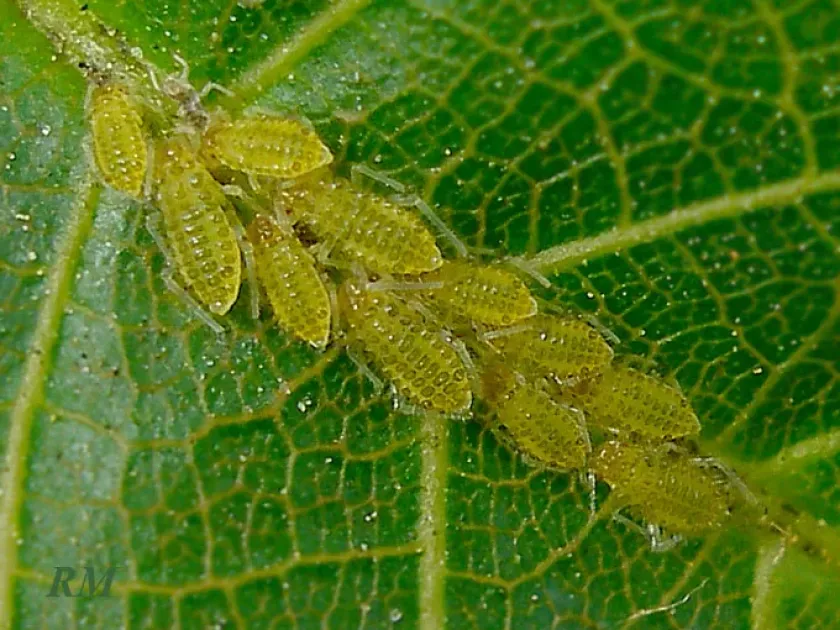
Description
How to identify
The oak leaf phylloxera (Phylloxera coccinea) belongs to the order Hemiptera and the family Phylloxeridae. These small insects are closely related to aphids and exhibit complex life cycles with alternating generations.
Adult individuals are microscopic, typically measuring 1 to 1.5 mm in length. Their bodies are oval and vary in color from yellowish-green to brownish, providing excellent camouflage on the surface of oak leaves.
The life cycle is characterized by polymorphism, meaning the species can produce both winged and wingless forms depending on the developmental stage and environmental cues.
These insects develop in direct contact with the host plant, feeding on sap. Understanding their morphology and habit of living in colonies is essential for early detection in oak stands.
The population can expand rapidly under favorable conditions, making this pest a significant threat to oak nurseries and ornamental tree landscapes.
What it damages
The primary host for this pest is the oak (Quercus). It specializes in damaging the foliage by piercing plant tissues and extracting essential sap required for tree growth.
The damage causes physiological stress to the tree, which is particularly detrimental to young seedlings and trees subjected to urban environmental stressors.
Infestation typically results in leaf curling, yellowing, and deformation, which impairs the tree's ability to perform photosynthesis efficiently.
The overall aesthetic value of the trees is significantly reduced, making this a critical issue for park management and urban landscaping projects.
Prolonged exposure to the pest weakens the tree's immune system, potentially leading to secondary infections or the susceptibility to other opportunistic pests.
When it appears
The life cycle begins in spring when nymphs emerge from overwintering eggs located in tree bark crevices or near bud scales.
Throughout the growing season, the species undergoes multiple generations, with population growth rates heavily influenced by temperature and humidity levels.
The peak activity period usually occurs during the flush of new foliage in spring and early summer when the sap flow is at its maximum intensity.
As autumn approaches, the insects engage in sexual reproduction, laying overwintering eggs that ensure the species' survival through the cold months.
Environmental fluctuations, such as prolonged heatwaves or late spring frosts, can significantly impact the population dynamics of the pest within a given year.
Signs of infestation
The most visible sign of infestation is the curling and distortion of young leaves, which may appear shriveled despite adequate soil moisture levels.
Closer examination of the underside of the leaves reveals colonies of tiny insects and the presence of sticky honeydew secretions.
The presence of ants, which are attracted to the honeydew produced by the phylloxera, is often a reliable indicator that the tree is infested.
As the damage progresses, chlorotic spots appear on the leaves, which eventually turn into necrotic lesions, leading to premature leaf drop.
- Curling and distortion of leaves.
- Presence of sticky honeydew residue.
- Colonies of tiny insects on the leaf undersides.
- Increased ant activity on branches.
- Premature yellowing and shedding of foliage.
Control measures
The primary method of control involves the application of systemic insecticides that can reach the pest within protected or curled leaf structures.
Maintaining high tree vigor through proper horticultural practices, such as irrigation and fertilization, helps trees recover from damage more effectively.
Integrated pest management in park settings should focus on encouraging natural predators like lady beetles and lacewings to maintain population balance.
Early spring monitoring of oak stands is critical to identify initial infestation spots before the pest spreads across the entire tree crown.
In cases of severe localized damage, mechanical pruning and removal of infested foliage can help reduce the overwintering population and overall pest pressure.
Taxonomy
- Latin name
- Phylloxera coccinea
- Order
- Hemiptera (bugs, aphids, leafhoppers)
- Family
- Phylloxeridae
- EPPO code
- PHYXCO
Discussion
No discussions yet — be the first.