
Pecan leaf phylloxera
Phylloxera caryaesepta
Description
How to identify
The pecan leaf phylloxera is a minute insect belonging to the order Hemiptera and the family Phylloxeridae. Both adults and nymphs live a secretive life, often forming characteristic galls on the foliage.
Due to their microscopic size, they are difficult to spot. The insect has an oval-shaped body, typically yellow or green, adapted to feed on the sap of specific plant species.
Reproduction occurs through both sexual and parthenogenetic cycles, allowing the population to recover rapidly under favorable conditions. Infestation is primarily spread through infested nursery stock or nymphs dispersed by wind.
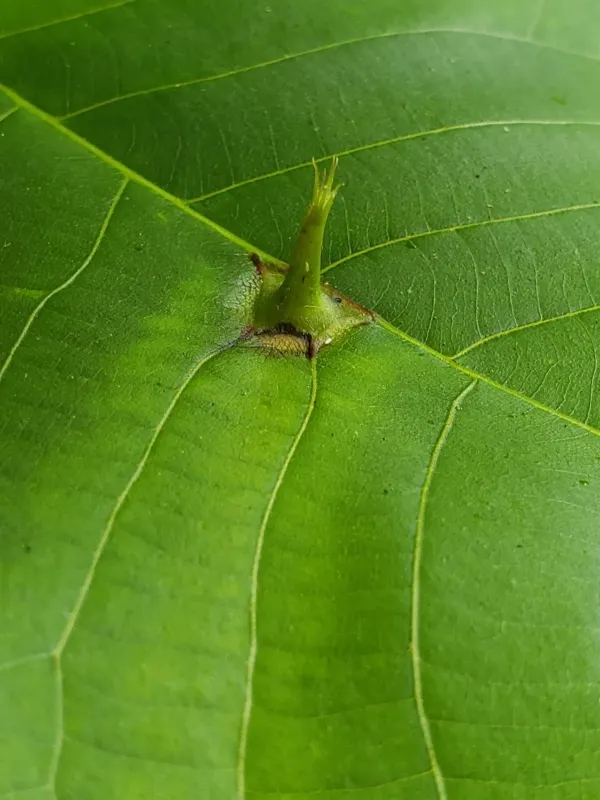
The presence of this pest is visually indicated by pathological growth on leaves, which is often misidentified as a fungal disease. However, the presence of distinct galls remains the primary diagnostic feature.
The insect's development is closely linked to the host plant's phenology, making regular orchard monitoring during the spring and summer essential for accurate identification.
What it damages
The primary host for this species is the genus Carya, most notably the pecan tree (Carya illinoinensis). The pest infests the leaves, significantly reducing their photosynthetic capability.
While feeding, the phylloxera injects specific enzymes into the plant tissue. This triggers uncontrolled cell division in the leaf, leading to the formation of voluminous galls.
Severe infestations cause premature yellowing and leaf drop. This negatively impacts the tree's photosynthesis, which ultimately leads to reduced yields in the nut orchard.
Prolonged pest pressure weakens the tree, making it more susceptible to secondary diseases and abiotic stressors such as drought or extreme cold temperatures.
The economic impact involves both immediate crop loss for the current season and overall stunted growth in young trees, delaying their maturation and fruit-bearing potential.
When it appears
The life cycle begins in early spring when overwintering eggs hatch as buds start to break. This is the most vulnerable period for the pest to be controlled with contact insecticides.
Several generations occur throughout the season. Population peaks often coincide with the period of rapid leaf growth, when the plant provides an abundance of succulent tissues for feeding.
Gall development occurs over several weeks. Inside these structures, nymphs progress through several developmental stages, shielded from external environments by the thick gall walls.
By mid-summer, insect activity may decrease depending on climatic conditions; however, under favorable humidity and temperatures, reproduction continues until autumn.
In autumn, a portion of the population migrates to the tree bark or soil for overwintering. Sanitation measures during this time are critical to reduce the number of individuals entering diapause.
Signs of infestation
The primary sign of infestation is the appearance of small dots or spots on young leaves, which eventually develop into bulging growths known as galls.
Galls may vary in shape and color, ranging from light green to reddish or brown. When these structures are opened, clusters of nymphs or adults can typically be found inside.
Leaf deformation and curling often accompany the gall formation process. If the infestation is widespread, the tree may appear stunted and exhibit an unhealthy chlorotic appearance.
The presence of significant leaf drop during summer, even with adequate irrigation, is an indirect sign of a serious phylloxera infestation.
Early reddening or wilting of individual twigs that were heavily attacked by the pest early in the season is another common indicator of activity.
Control measures
Preventive measures begin with the use of certified healthy nursery stock and strict adherence to quarantine protocols when importing trees from known infested regions.
Chemical control is most effective during the "green tip" stage, when overwintering individuals emerge from diapause. Systemic insecticides capable of penetrating plant tissues are generally recommended.
- Application of contact insecticides during the early spring period.
- Systemic insecticide treatments upon the detection of initial gall symptoms.
- Pruning and destruction of heavily infested shoots to lower the total population.
- Maintaining high-level horticultural practices to improve tree immune response.
Rotating chemical classes is vital to prevent the development of pesticide resistance. Consistent monitoring allows for timely intervention, effectively preventing population explosions.
Taxonomy
- Latin name
- Phylloxera caryaesepta
- Order
- Hemiptera (bugs, aphids, leafhoppers)
- Family
- Phylloxeridae
- EPPO code
- MORZCS
Discussion
No discussions yet — be the first.