
Pecan leaf phylloxera
Phylloxera caryaeglobuli
Description
How to identify
The pecan leaf phylloxera (Phylloxera caryaeglobuli) belongs to the Phylloxeridae family within the Hemiptera order. This tiny insect leads a hidden lifestyle inside pathological plant tissue growths known as galls.
Adult individuals are extremely small, making them difficult to detect with the naked eye without dissecting the affected plant parts. The insect's body is adapted for feeding on plant sap, triggering a specific tissue response.
Reproduction occurs through egg-laying inside the formed gall chamber. The life cycle is closely linked to the host's phenology, ensuring optimal conditions for feeding and protection from environmental factors.
Morphologically, the insect possesses a specialized mouthpart designed to pierce the epidermis and inject substances that stimulate gall formation. This evolutionary adaptation allows the pest to survive even under adverse external conditions.
Species identification requires microscopic analysis, as members of this family look very similar. The primary diagnostic feature is the specific shape and localization of the galls on the leaf lamina.
What it damages
The primary host for this pest is the pecan tree (Carya illinoinensis). The insect prefers young leaves and shoots, which have the most active sap flow required for colony development.
Secondarily, the insect may be found on other Carya species (hickory), where it also forms characteristic spherical structures. The damage affects not only the tree's appearance but also its physiological state.
The severity of the infestation depends on the pest population density in the orchard. Under conditions of mass spread, nearly all leaves on a tree can be involved, severely undermining its vegetative potential.
Prolonged insect activity leads to stunted growth in young trees. Weakened specimens become more susceptible to secondary fungal and bacterial infections, which exacerbates the overall disease picture.
Damaged tissues lose their ability to perform normal photosynthesis, which ultimately reduces yields and fruit quality. The economic impact of the pest is expressed in direct crop losses.
When it appears
The pest's life cycle begins in early spring, as pecan buds break. Overwintering larvae begin feeding, which triggers the development of primary galls on the leaves.
The active breeding phase coincides with the period of intense leaf growth, typically May and June. During this time, new generations develop inside the galls, continuing the cycle.
By mid-summer, gall growth slows, and the insects complete their main cycle, preparing for a dormant state. Temperature regimes directly affect the rate of generations.
By autumn, adult individuals leave the galls in search of overwintering sites. They use cracks in the bark of trunks and thick branches as shelters, where they wait for the next season.
Understanding seasonality is critical for selecting the timing for orchard treatments. Preventive measures are most effective during the phase when larvae emerge from their overwintering sites.
Signs of infestation
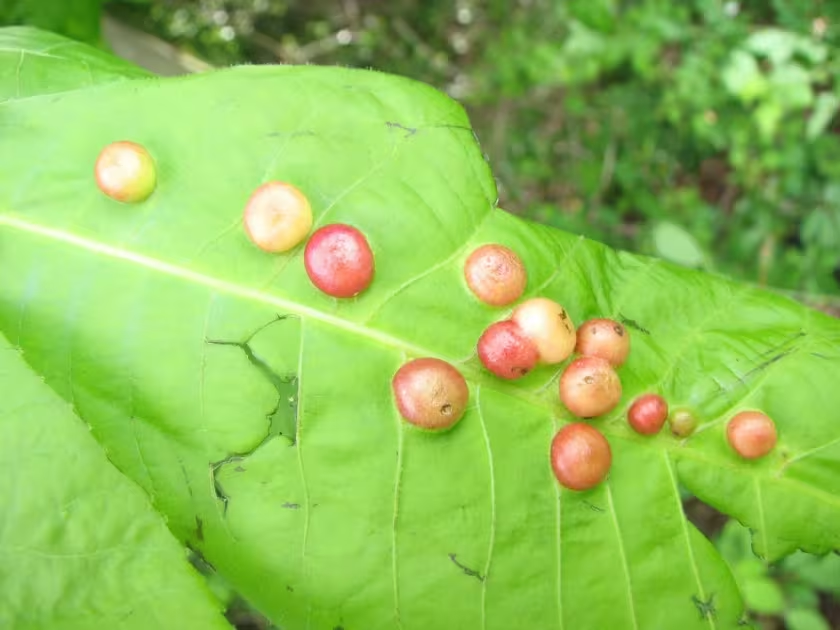
The key sign of infestation is the appearance of specific spherical galls on the surface of leaf laminae. They have a dense structure and are initially green, later turning yellowish or brown.
In early stages, galls may be solitary, but with heavy infestation, they merge, deforming the leaf. Often, one can observe color changes in the leaf tissue surrounding the affected areas.
On the underside of the leaf below the gall, a small hole or indentation is often visible. This is the exit channel through which insects leave their "home" after completing their development cycle.
The internal cavity of the gall is filled with the insect's waste and the individuals themselves at various developmental stages. This is easy to verify by cutting open one of the galls with a knife.
- Presence of spherical swellings on leaves.
- Deformation and curling of leaf laminae.
- Premature yellowing and leaf drop in heavily infested areas.
- Reduced overall shoot growth rate.
Control measures
Chemical control should be timed to the moment when larvae emerge from their overwintering sites, before they have time to form galls. Once the galls have formed, the access of pesticides to the pest is significantly limited.
It is recommended to use broad-spectrum contact and systemic insecticides. It is crucial to perform thorough canopy spraying, especially in areas where bark has cracks and irregularities.
Agrotechnical methods include regular sanitary pruning. Removing and subsequently burning infested branches and fallen leaves can significantly reduce the phylloxera population in the orchard.
Maintaining high tree immunity through balanced fertilization and irrigation helps them cope better with the stress caused by insect activity. A healthy tree is capable of compensating for tissue damage.
Biological control, including the introduction of natural enemies (entomophages), is still under study; however, preserving beneficial insect populations in the orchard is an important element of integrated pest management.
Taxonomy
- Latin name
- Phylloxera caryaeglobuli
- Order
- Hemiptera (bugs, aphids, leafhoppers)
- Family
- Phylloxeridae
- EPPO code
- XEROCL
Discussion
No discussions yet — be the first.