
Black Issid
Phylloscelis atra
Description
How to identify
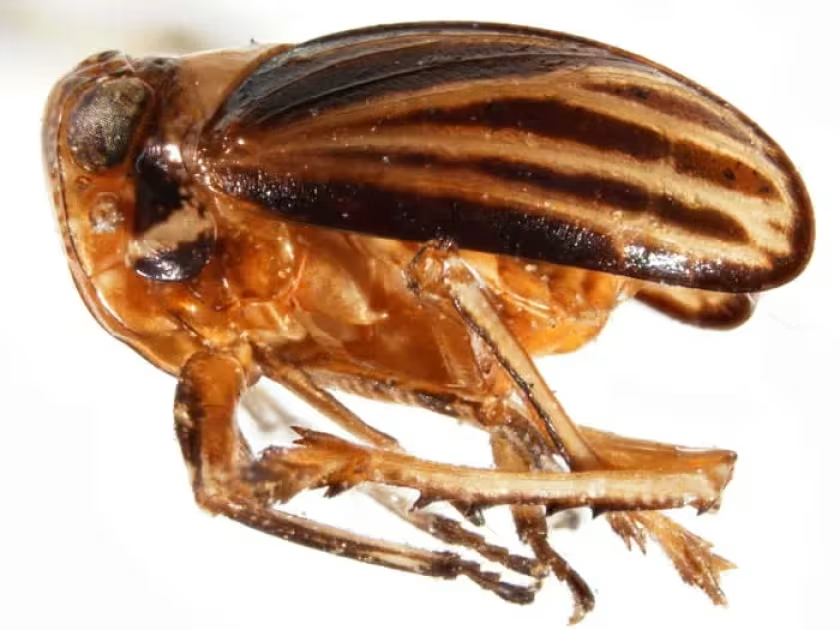
The Black Issid (Phylloscelis atra) belongs to the family Issidae, part of the order Hemiptera. These are small insects, usually measuring between 5 to 6 mm in length.
As the name suggests, the adult insects are characterized by a dark, almost black, color. Their body is somewhat flattened, and the head features a distinctive conical protrusion.
The wings, when at rest, are held in a roof-like position over the body. The surface of the forewings has a complex reticulated texture, providing excellent camouflage against tree bark or dark foliage.
Nymphs are smaller versions of the adults but lack developed wings and often appear in lighter, brownish hues. They are highly active and can jump or crawl quickly when disturbed.
This species is notoriously elusive, often hiding on the underside of leaves, within crevices of stems, or in plant forks, making them easy to overlook during casual monitoring.
What it damages
The Black Issid is a polyphagous insect, meaning it feeds on a wide range of host plants. Both adults and nymphs contribute to the damage by feeding on plant sap.
Common host plants include various ornamental shrubs, berries, and several vegetable crops. By piercing the plant tissue with their mouthparts, they drain essential nutrients.
A major side effect of their feeding is the excretion of "honeydew," a sugary substance that coats the leaves. This serves as a primary growth medium for sooty mold, which ruins the appearance of the plants.
Heavy infestations weaken the plant, causing stunted growth, leaf yellowing, and occasionally leaf drop. In young plants, the loss of vigor is particularly noticeable and harmful.
Additionally, the feeding sites can become entry points for secondary pathogens, further compromising the health of the host plant and reducing overall yield quality.
When it appears
Typically, this species completes one generation per year. They overwinter in the egg stage, with eggs usually deposited in the bark of woody plants or dry stems of perennial herbs.
Nymphs emerge in the spring, coinciding with the beginning of the plant's active growth phase. They begin feeding immediately, targeting tender new shoots and buds.
Throughout the summer, the nymphs pass through several instars. The adult population generally reaches its peak in mid-to-late summer, when they are most conspicuous.
As autumn approaches and temperatures drop, adults search for suitable egg-laying sites. This seasonal cycle ensures the continuity of the population for the following year.
Warm, dry weather conditions tend to be optimal for their development, which can lead to increased pest pressure during drought years when plants are already stressed.
Signs of infestation
One of the earliest signs of Black Issid activity is the curling and yellowing of leaves. The plant may appear wilted despite adequate irrigation and care.
The presence of a sticky, glistening substance on the leaf surface (honeydew) is a hallmark sign of infestation. You may also observe ants tending to these insects to collect the sugary waste.
The development of a black, powdery coating known as sooty mold on the leaves and stems confirms a significant and long-standing population of sap-sucking insects.
On close inspection, the underside of the leaves may reveal tiny necrotic spots or stippling. These are the direct result of the insect's piercing-sucking feeding action.
The insects themselves can be flushed out by gently shaking foliage. They will often react by jumping suddenly or moving to the opposite side of the stem to avoid detection.
Control measures
Effective management begins with good sanitation. Remove weeds and clear plant debris during late autumn to eliminate overwintering sites for the eggs.
For ornamental gardens, yellow sticky traps are highly effective at capturing adults and monitoring population levels without the need for broad-spectrum chemicals.
In cases of severe infestation, targeted application of contact or systemic insecticides may be necessary. Always choose products that minimize impact on beneficial insects.
Encouraging natural predators such as ladybugs, lacewings, and parasitic wasps can help maintain a natural balance and prevent populations from exploding.
- Apply treatments during the early morning or evening.
- Follow safety instructions to protect pollinators.
- Regularly monitor the undersides of leaves during the peak summer months.
Taxonomy
- Latin name
- Phylloscelis atra
- Order
- Hemiptera (bugs, aphids, leafhoppers)
- Family
- Dictyopharidae
- EPPO code
- PYIZAT
Discussion
No discussions yet — be the first.