
Black redstart
Phoenicurus ochruros
Description
How to identify
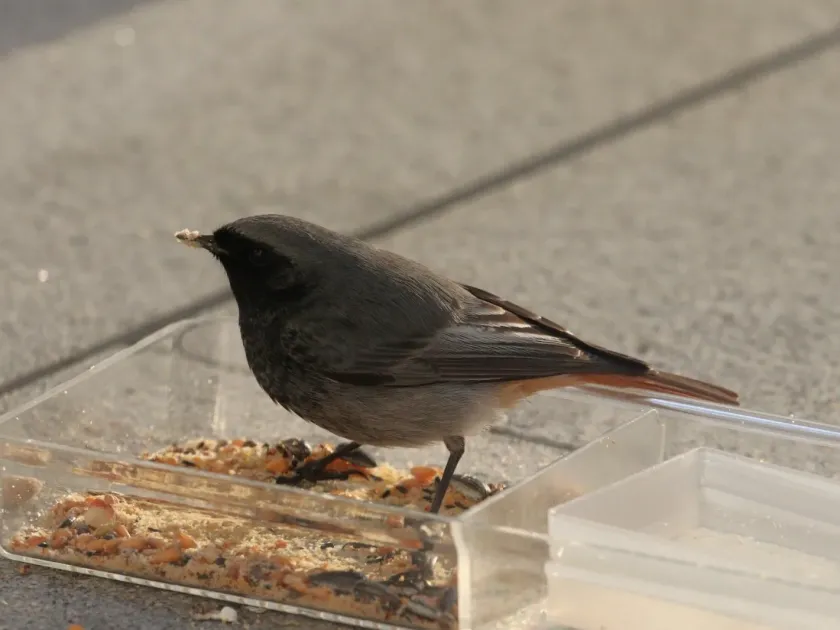
The black redstart (Latin: Phoenicurus ochruros) is a bird species from the Muscicapidae family. It is easily identified by its charcoal-colored plumage in males and a distinctive, continuously twitching tail with a reddish-orange hue.
These birds are well-adapted to urban and suburban environments, frequently nesting in crevices of buildings, sheds, and rocky cliffs. This proximity to human habitats often brings them into close contact with fruit-growing areas.
While often considered beneficial in early spring for insect control, their dietary preferences expand as the season progresses. The black redstart is a highly agile flyer, capable of maneuvering quickly within thick garden foliage.
The breeding biology involves raising multiple broods per season, meaning the birds stay active in the garden throughout the crucial summer months. This prolonged presence increases the risk to ripening garden fruits.
Understanding their behavior is key, as they are not purely "pests" but opportunists. Their presence is a sign of a healthy but potentially vulnerable garden ecosystem during the harvest window.
What it damages
The primary damage caused by the black redstart involves the pecking of ripening berries and stone fruits. They target soft tissues, leaving deep puncture marks that render the fruit visually unappealing and prone to rot.
Favorite crops include raspberries, blackberries, currants, and various types of cherries. A small flock can cause significant cumulative losses by piercing large portions of the harvest before it reaches maturity.
In addition to fruit, they can cause incidental damage to vegetable beds. By foraging for larvae in the soil, they often disturb the root systems of young seedlings, leading to stunted growth or plant death.
Their droppings on foliage and fruit act as a vector for secondary infections. Once a berry is pecked and contaminated with feces, fungal growth occurs almost immediately, turning a healthy fruit into a source of pathogens.
The economic impact on a small-scale or professional garden can be severe, especially when the birds target high-value cultivars that are meant for fresh market consumption.
When it appears
The threat period is strictly seasonal, occurring during the fruit maturation stage. In late spring, they perform a valuable role by feeding on garden insects, which should be encouraged.
The risk escalates sharply from mid-June to late July, coinciding with the peak harvest season for soft fruits. As the young birds fledge, the demand for high-energy food like sugar-rich berries increases.
August can remain a period of concern for late-ripening fruits. If natural food sources like insects are scarce due to dry weather, birds become more persistent in their foraging efforts in orchards.
Climate factors are critical; heatwaves often lead to birds seeking high-moisture fruits for hydration. In such years, the level of crop damage usually spikes significantly compared to cooler, wetter summers.
The migration cycle naturally concludes the damage phase as the birds prepare to depart or move to different habitats, allowing growers to salvage late-season produce.
Signs of infestation
The most reliable sign of a black redstart incursion is the presence of fruit with small, conical holes. The affected fruit often appears bruised or collapsed around the entry point.
Evidence of foraging in vegetable beds is also a indicator. Look for displaced soil, disturbed mulch, and small holes in the ground where the birds have probed for invertebrate prey.
The accumulation of bird droppings on the upper surfaces of leaves and fruit is a clear sign that the birds are using the canopy as a resting or observation point.
Audible cues, such as their characteristic "ticking" call, usually precede foraging activity. Observing this behavior early allows for proactive deployment of deterrent measures before damage begins.
- Distinctive puncture marks on ripening berries.
- Bruised skin on stone fruits like cherries.
- Soil disturbances and displaced mulch under fruit bushes.
- Bird droppings on leaves and fruit surfaces.
Control measures
Physical barriers remain the most effective solution. High-quality fine-mesh netting installed over fruit bushes or trees provides a reliable barrier that excludes birds without harming them.
Visual deterrents, including holographic tapes and moving reflectors, provide a temporary solution. For maximum effectiveness, rotate these objects frequently so the birds do not become habituated.
Cultural practices, such as immediate harvesting of ripe fruit and clearing of fallen produce, remove the incentive for birds to remain in the area. Keeping the orchard floor clean is essential.
Modern acoustic deterrents that emit high-frequency pulses can discourage birds from entering the garden, provided they are tuned correctly to prevent them from becoming accustomed to the sound.
An integrated approach that combines nets for high-value crops with mild deterrents for larger areas provides the best protection for your harvest while respecting the garden's ecological balance.
Taxonomy
- Latin name
- Phoenicurus ochruros
- Family
- Muscicapidae
- EPPO code
- PHNCOC
Discussion
No discussions yet — be the first.