
Common nightingale
Luscinia megarhynchos
Description
How to identify
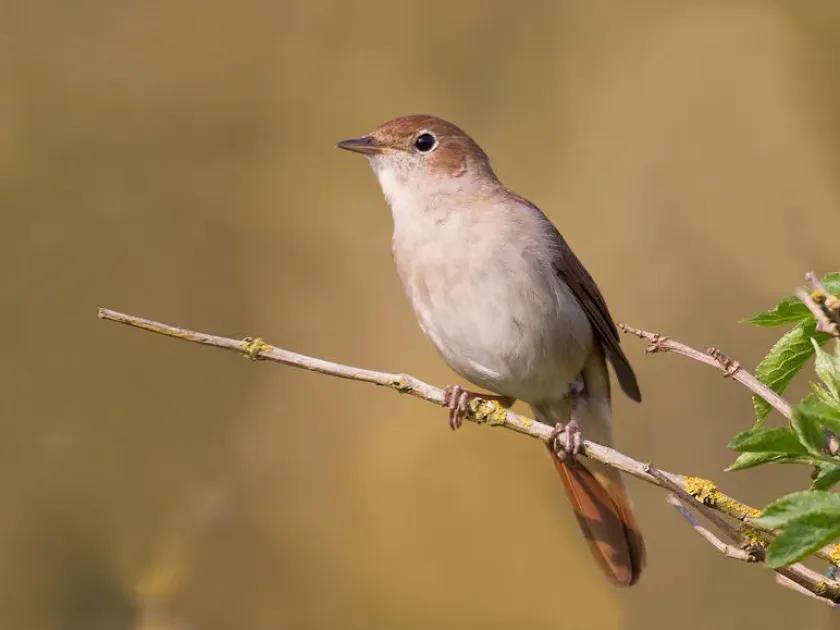
The common nightingale (Luscinia megarhynchos) belongs to the order Passeriformes and the family Muscicapidae. It is a small bird, approximately 16-17 centimeters long, with plain brown plumage and a lighter-colored underside.
The species is best identified by its reddish-brown tail and its elusive behavior. They prefer to inhabit dense shrubs, hedges, and riparian woodlands, making them hard to spot in a garden setting.
In agricultural environments, nightingales frequently establish territories near private gardens and orchards. Despite their famous song, they can become a nuisance when nesting near valuable crops.
Males and females look identical, which makes identifying specific individuals on your property difficult. They are most active during dawn and dusk, when they forage for food near the ground.
Nests are typically built on the ground or at the base of dense bushes. This secretive nesting habit allows the birds to occupy a site for a long time before the owner notices the impact on the crops.
What it damages
The primary damage caused by the common nightingale occurs during the ripening of early berry crops such as strawberries, raspberries, and honeysuckle. Birds peck at ripe fruits, significantly reducing both yield and market value.
In addition to eating berries, nightingales can damage young vegetable seedlings. While foraging for invertebrates in the soil, they often trample or uproot small plants, disrupting uniform crop emergence.
In nursery settings, nightingales may peck at the tender buds of young trees and shrubs in early spring. This can cause deformation and stunt the growth of young plants during a critical vegetative stage.
Bird damage typically intensifies during dry years when natural prey, such as insects, is scarce. During these times, berries serve as a primary source of both nutrients and hydration for the birds.
While nightingales do consume harmful insects, their economic impact in intensive commercial orchards can often exceed the benefit of their presence, necessitating active crop management.
When it appears
The highest level of nightingale activity occurs from late spring through early summer, coinciding with the flowering and fruit-setting phases of many horticultural crops.
May and June are peak nesting months, when the parents require high amounts of food to feed their chicks. This period corresponds with the maximum pressure on garden berries and young vegetables.
By mid-summer, after the fledglings have left the nest, the birds' activity in the garden decreases. They shift their diet toward wild seeds and berries found in non-cultivated areas.
Fall migration occurs relatively early in the season, meaning that garden damage is usually limited to the first half of the summer. Late-season crops remain largely unaffected by this species.
Monitoring for nesting activity should begin as soon as blossoms appear, allowing gardeners to implement protective measures before the fruits become vulnerable.
Signs of infestation
Signs of nightingale presence include missing or partially eaten berries with clear peck marks. Fragments of fruit skin and pulp are often found on the ground beneath the affected bushes.
In vegetable patches, one can observe trampled soil and mechanical damage to leaves, which look like irregular tears or holes caused by the birds foraging for ground-dwelling insects.
The presence of nests at the base of shrubs is a clear indicator that the birds are using the garden as a primary food source for their brood. Birds often return to the same territory annually.
Evening and early morning singing is a reliable indicator that a population has established itself. This should prompt immediate action if the crops are in the ripening stage.
If produce is disappearing despite an absence of traditional insect pests, it is highly likely that Passeriformes activity is the underlying cause.
Control measures
The most effective protective method is the use of fine-mesh netting placed over berry bushes. This physically prevents bird access while remaining safe for the wildlife.
Visual deterrents, such as reflective tapes, old CDs, or hawk silhouettes, can be used for short-term mitigation. These should be moved periodically to prevent the birds from habituating to them.
Regular pruning of dense undergrowth is recommended to remove the habitat features that make the garden attractive for nightingale nesting.
Bioacoustic deterrents, which play back distress calls or predator sounds, can effectively deter birds from a site, though they require regular technical maintenance to remain effective.
- Covering berries with protective netting.
- Using reflective visual deterrents.
- Regular pruning of thick shrubs.
- Employing bioacoustic sound systems.
- Planting alternative food sources on the perimeter.
Taxonomy
- Latin name
- Luscinia megarhynchos
- Family
- Muscicapidae
- EPPO code
- LUSCME
Discussion
No discussions yet — be the first.