
Heuglin's robin-chat
Cossypha heuglini
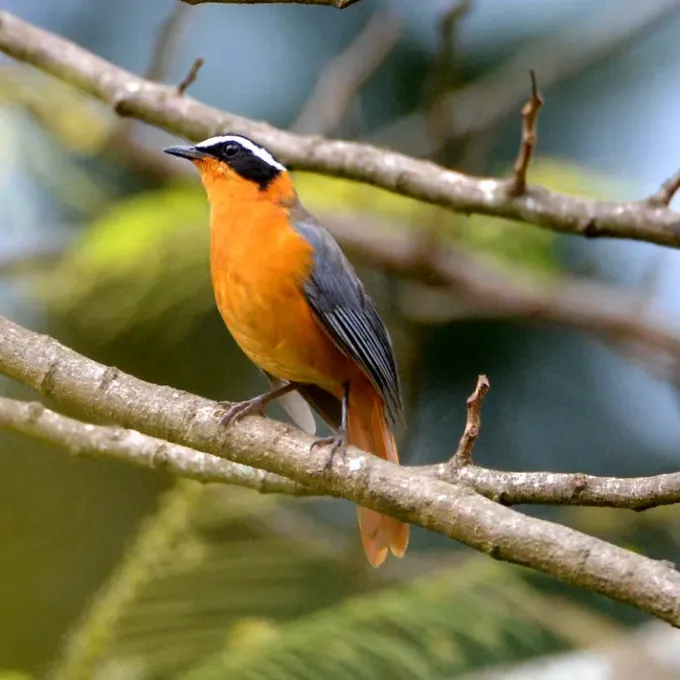
Description
How to identify
Heuglin's robin-chat (Cossypha heuglini) is a distinctive songbird belonging to the Muscicapidae family within the order Passeriformes.
It is easily recognized by its dark brown crown, a bold white supercilium (eyebrow stripe), and a vibrant orange-rufous underbelly and rump.
These birds typically measure around 19 to 20 centimeters in length and possess strong legs suitable for both arboreal movement and foraging on the forest floor.
While often shy and secretive, they are known for their loud and melodious songs, which are frequently heard in dense thickets and gardens.
Taxonomically, they are forest-dwelling insectivores, though they adapt to various habitats including edges of agricultural land and suburban orchards.
What it damages
Although primarily insectivorous, Heuglin's robin-chat can cause damage to soft fruits and berries when traditional food sources become scarce.
The birds use their beaks to pierce the skin of ripe fruits, which directly compromises the marketability of the produce and invites secondary rot.
In addition to physical feeding damage, their presence often leads to the accumulation of droppings on the foliage and produce, raising hygiene concerns.
Heavy infestations, although rare in broad-acre crops, can cause localized but significant losses in small-scale berry plantations or home gardens.
Their habit of moving through branches and foliage can also lead to the bruising of delicate fruit crops, reducing their shelf life and quality.
When it appears
Activity levels tend to peak during the breeding season when the birds are highly active in establishing territories and provisioning for their young.
As a sedentary species, they occupy their range throughout the year, meaning they can potentially impact seasonal crops whenever fruit is available.
The birds are most active during the early morning and late afternoon hours, coinciding with prime foraging periods for nectar and soft fruit.
Seasonal environmental factors, such as prolonged droughts, can drive these birds toward cultivated areas in search of moisture-rich food sources.
During the harvest window, the increased availability of ripening fruit makes orchards particularly attractive to local populations of these birds.
Signs of infestation
Visible V-shaped or irregular punctures on the skin of berries and soft fruits are the most definitive indicators of avian feeding activity.
The presence of scattered droppings in the tree canopy or on the ground beneath feeding sites confirms that birds have been active in the area.
Auditory signs include the specific, complex vocalizations of the species, which often precede or accompany their presence in the fruit trees.
Premature fruit drop and damaged or scarred surfaces on the remaining crop are classic symptoms of bird-related harvest depletion.
Persistent presence of the birds in hedges or vegetation surrounding the fields is a strong signal to implement proactive monitoring measures.
Control measures
Exclusion netting is the most effective way to prevent access to ripening crops, providing a physical barrier that birds cannot penetrate.
Visual deterrents, such as reflective tape, holographic kites, or stationary raptor decoys, can discourage birds from lingering near sensitive areas.
Bioacoustic deterrents, which play recorded distress calls of the species, are useful for protecting larger areas without harming the birds.
Habitat management, specifically the removal of dense cover or thickets near fields, makes the area less attractive for nesting and hiding.
An integrated approach that combines physical barriers with shifting deterrent techniques is recommended to prevent the birds from becoming habituated.
Taxonomy
- Latin name
- Cossypha heuglini
- Family
- Muscicapidae
- EPPO code
- CSSYHE
Discussion
No discussions yet — be the first.