
Drinker moth
Philudoria potatoria
Description
How to identify
The Drinker moth (Philudoria potatoria) is a robust moth belonging to the family Lasiocampidae, within the order Lepidoptera. Adults typically feature a wingspan of 45 to 65 mm, with colors ranging from ochre-yellow to reddish-brown.
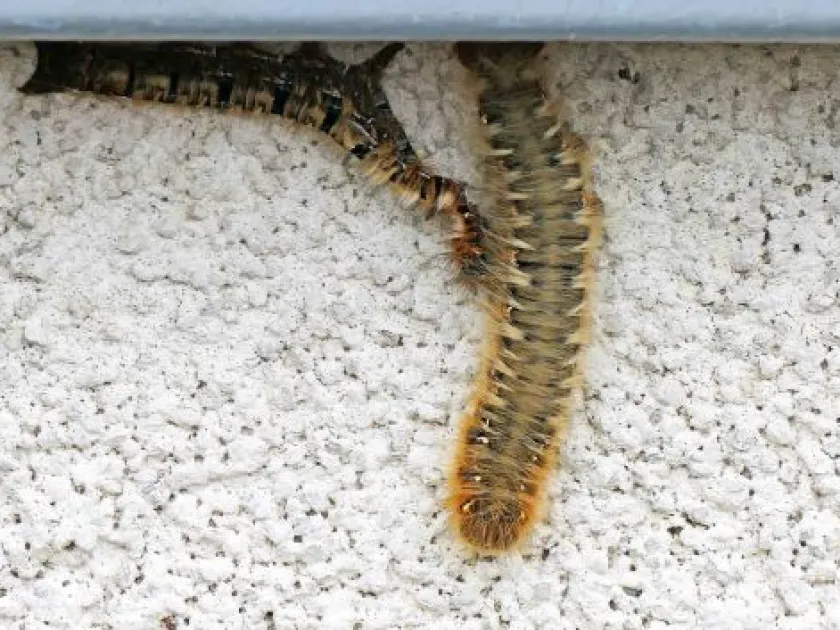
The larvae, or caterpillars, grow up to 70 mm in length and are covered in dense, soft hairs that can cause skin irritation if handled. They are easily recognizable by their unique pattern of black, grey, and bright orange-red markings along their backs.
The pupal stage occurs inside a sturdy, yellow-white, spindle-shaped cocoon, which is often attached to the stems of grasses or berry bushes during the early summer months.
Young larvae overwinter in the leaf litter or near the base of their host plants, resuming activity as soon as spring temperatures start to climb.
This species is native to damp meadows, forest fringes, and overgrown gardens, frequently migrating into cultivated berry patches to feed.
What it damages
The Drinker moth primarily infests raspberry and blackberry bushes, though it also feeds on various grasses, sedges, and reeds found near the plantations.
Damage is exclusively caused by the caterpillars, which begin to feed vigorously in early spring, devouring foliage and often leaving only the main veins behind.
Heavy infestations can lead to severe defoliation, which cripples the plant's photosynthetic ability and significantly depletes its stored energy reserves.
Weakened plants show reduced winter hardiness and suffer from lower fruit yields, which directly impacts the profitability and health of the berry crop.
In young plantations, significant leaf loss can inhibit plant growth and, in extreme cases, contribute to the failure of the entire berry crop season.
When it appears
The Drinker moth completes one generation per year. Adult moths typically emerge for flight during mid-summer, primarily throughout July and August.
Females lay their eggs on the underside of leaves or directly on stems, and larvae hatch in late summer, entering diapause as they grow towards the final larval instar.
Spring feeding begins as temperatures consistently exceed 10 degrees Celsius, coinciding with the early stages of plant growth and bud break.
Larval development concludes in June, at which point the caterpillars construct their characteristic cocoons for pupation.
The pupal phase lasts approximately three to four weeks, marking the end of the annual lifecycle and the preparation for the next generation of adults.
Signs of infestation
Early signs of infestation include jagged edges on leaves and "skeletonized" foliage where the soft tissue has been consumed by the larvae.
Spring scouting of the plantation is essential; look for the distinct yellow spindle-shaped cocoons attached to the lower parts of raspberry stems.
Adult moths are attracted to light, so the use of nocturnal light traps can help monitor the arrival of the breeding population during the summer.
Caterpillars are often visible during the morning hours as they rest on the leaves of the host plants, making visual inspection a very effective monitoring tool.
- Ragged leaf margins and defoliated stems;
- Presence of large, hairy caterpillars;
- Light-colored cocoons on lower stem sections.
Control measures
Effective management begins with good horticultural practice, such as removing weeds and grasses that act as breeding reservoirs for the larvae.
Manual collection of caterpillars and destruction of cocoons is highly recommended for small garden plots, as it is environmentally friendly and precise.
Biological insecticides containing Bacillus thuringiensis are highly effective against young larvae and represent a safe alternative to broad-spectrum chemical sprays.
Chemical intervention should be reserved for major outbreaks and must be managed carefully to ensure compliance with pre-harvest safety intervals.
Encouraging natural predators, such as insectivorous birds and parasitic wasps, helps keep the Drinker moth population naturally regulated within the garden ecosystem.
Taxonomy
- Latin name
- Philudoria potatoria
- Order
- Lepidoptera (butterflies)
- Family
- Lasiocampidae
- EPPO code
- PHIUPO
Discussion
No discussions yet — be the first.