
Phaulacridium
Phaulacridium
Description
How to identify
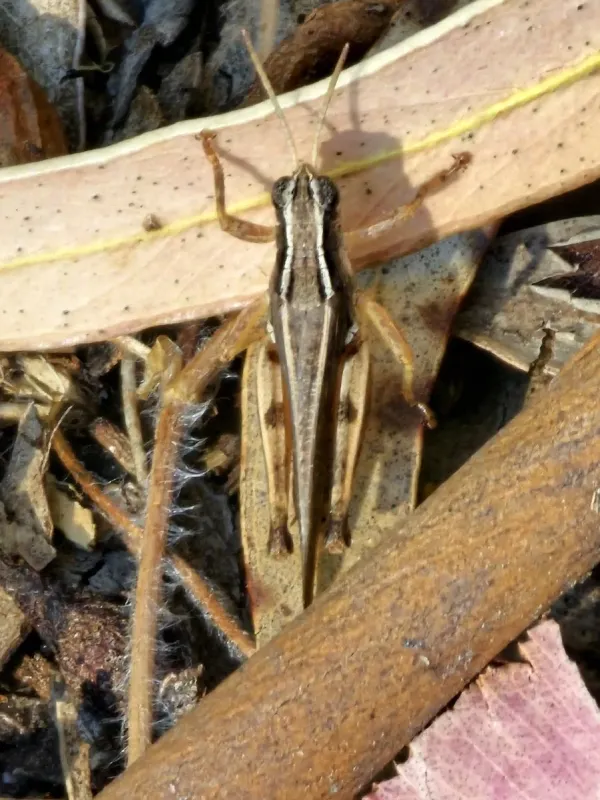
The genus Phaulacridium, commonly associated with the species Phaulacridium vittatum, belongs to the order Orthoptera and the family Acrididae. These are flightless or short-winged grasshoppers often referred to as wingless grasshoppers.
Adults are typically small, ranging from 10 to 20 mm in length. Their body structure is robust, with powerful hind legs for jumping, and they exhibit cryptic coloration, ranging from grey to green, which serves as excellent camouflage.
Unlike migratory locusts, these insects do not travel long distances by flight. Their movement is primarily terrestrial, making them a localized pest that builds up population density in specific favorable areas.
The lifecycle involves a gradual metamorphosis starting from eggs laid in the soil. The nymphs resemble miniature versions of the adults but without fully developed wings.
Population density is highly dependent on environmental variables such as soil temperature and moisture levels, which determine the survival rate of the overwintering eggs.
What it damages
As a polyphagous pest, this insect consumes a wide range of plant species. They are particularly destructive to pastures, where they feed on high-quality clover and native grasses.
In agricultural settings, they can cause significant damage to young crops, including cereals, canola, and vegetables, often stripping foliage and hindering early plant development.
The damage often begins on the edges of fields and progresses inwards as the local food source is exhausted. High populations can cause total loss of young seedlings.
Apart from eating the plant material, they contaminate forage with fecal matter, making pastures unpalatable for livestock and reducing the overall feed value.
The impact is most severe during dry seasons, when the limited natural vegetation forces these grasshoppers to congregate and feed heavily on commercial crops.
When it appears
Egg hatching generally occurs in the spring after the soil receives adequate moisture and warming. The nymphs emerge simultaneously, leading to a sudden increase in local numbers.
The active stage of adults peaks during the summer months. This is when the insects are most aggressive in their feeding and reproductive behaviors.
The insect typically has one generation per year. Most of the lifecycle is spent in the egg stage within the soil, providing protection against seasonal extremes.
Weather patterns, particularly rainfall events in late spring, play a critical role in determining the success of the new generation and the subsequent pest pressure.
By late summer and early autumn, the adults lay eggs in the soil and die off, leaving the diapause-ready eggs to survive the unfavorable conditions of the off-season.
Signs of infestation
The primary symptom of an infestation is irregular defoliation, where the edges of leaves are chewed, resulting in a serrated or jagged appearance.
Observing a sudden jumping activity of numerous small insects when walking through a field is a clear indicator of a significant infestation.
- Visible presence of dark, granular frass (excrement) on the leaves and soil surface around plants.
- Noticeable patches of denuded vegetation in pastures, often resembling bare circles.
- Stunted plant growth due to the loss of leaf surface area, impacting photosynthesis.
In cases of severe infestation, entire stems may be stripped of their leaves, leaving only the central midribs or tougher plant parts behind.
Regular scouting is recommended during early morning or late afternoon when the insects are most actively feeding on the foliage.
Control measures
Insecticide application is the standard chemical control method, applied when population thresholds are exceeded to protect vulnerable crops.
Cultural control strategies include aggressive weed management to eliminate alternative food sources and reduce suitable breeding habitats around field margins.
Tilling the soil in late autumn or early winter can effectively disturb egg beds, leading to high mortality of the overwintering population.
Integrated pest management emphasizes the role of natural predators such as birds and parasitic wasps, which can help maintain population balance if preserved.
Strategic grazing of pastures can also disrupt the habitat, making it less suitable for the grasshoppers to thrive and limiting their ability to colonize nearby crops.
Taxonomy
- Latin name
- Phaulacridium
- Order
- Orthoptera (locusts)
- Family
- Acrididae
- EPPO code
- PHAMSP
Discussion
No discussions yet — be the first.