
Green lynx spider
Peucetia viridans
Description
How to identify
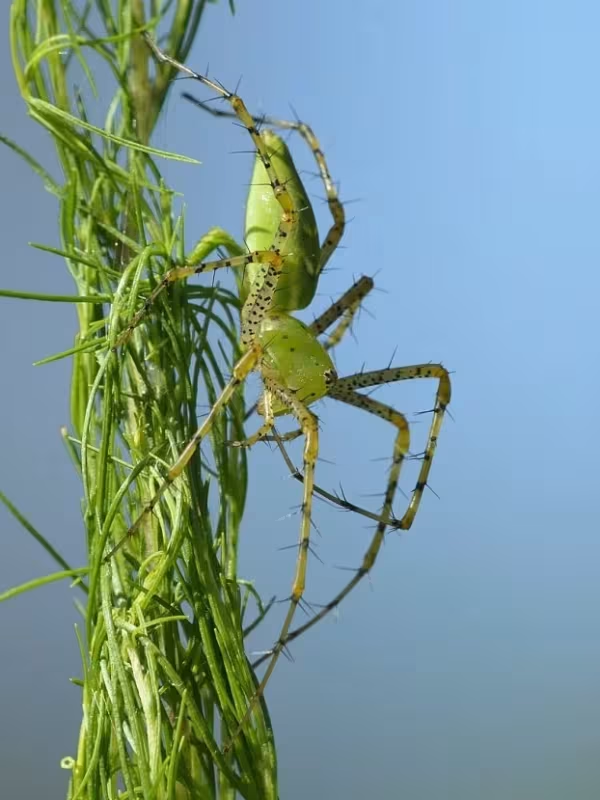
The Green lynx spider (Peucetia viridans) belongs to the Oxyopidae family, often recognized by its vibrant green color which serves as excellent camouflage.
These spiders are characterized by prominent spines on their legs and a slender body structure, allowing them to move rapidly and capture prey with high precision.
Adult females are generally larger than males, typically reaching up to 22 mm, while males remain smaller and more slender to maintain agility during mating.
Unlike web-building spiders, the Green lynx spider is an active hunter, waiting for prey on leaves and flowers before launching a swift attack.
They possess exceptional eyesight and are capable of jumping from plant to plant, which makes them highly effective predators in a garden ecosystem.
What it damages
While often considered beneficial because they consume agricultural pests, their presence can be problematic for certain crops and garden aesthetics.
They frequently prey on beneficial pollinators such as bees, which can inadvertently lead to reduced fruit set in crops that rely heavily on insect pollination.
Physical damage to plants is minimal, but during the nesting period, females may cause slight deformation to flower buds where they secure their egg sacs.
In high concentrations, their aggressive hunting behavior may drive away other beneficial predatory insects, such as ladybugs, potentially creating a pest imbalance.
Gardeners may find them undesirable on ornamental flowers, as their presence can deter people from handling the plants due to the spider's aggressive posture.
When it appears
The life cycle of Peucetia viridans is closely tied to the growing season, with most activity occurring during late spring and summer months.
They emerge from hibernation as temperatures rise, immediately seeking out locations with high insect traffic to begin their hunting season.
Mid-summer is the peak period for reproduction, during which females are most visible as they guard their egg sacs attached to host plants.
By late summer and early autumn, the juvenile spiders hatch and begin to disperse, preparing themselves for the upcoming dormant period.
They survive the colder months by hiding in leaf litter, crevices of tree bark, or other protected areas, remaining inactive until the following spring.
Control measures
Chemical control is rarely recommended for this species because the Green lynx spider acts as a natural pest control agent against aphids and other pests.
If population reduction is necessary, focusing on cultural practices such as clearing garden debris and thinning plant density is the most effective approach.
Reducing the number of preferred nesting sites can naturally limit the spider population without disrupting the overall ecological health of the garden.
Manual removal of egg sacs from ornamental plants is an effective method for small-scale control before the young spiders hatch in the late summer.
- Keep garden areas free of dense, overgrown weeds that harbor spiders.
- Promote biodiversity to balance the predatory pressure in the garden.
- Use water sprays to physically dislodge spiders from sensitive flowers.
Taxonomy
- Latin name
- Peucetia viridans
- Family
- Oxyopidae
- EPPO code
- PEUCVI
Discussion
No discussions yet — be the first.