
Striped lynx spider
Oxyopes salticus
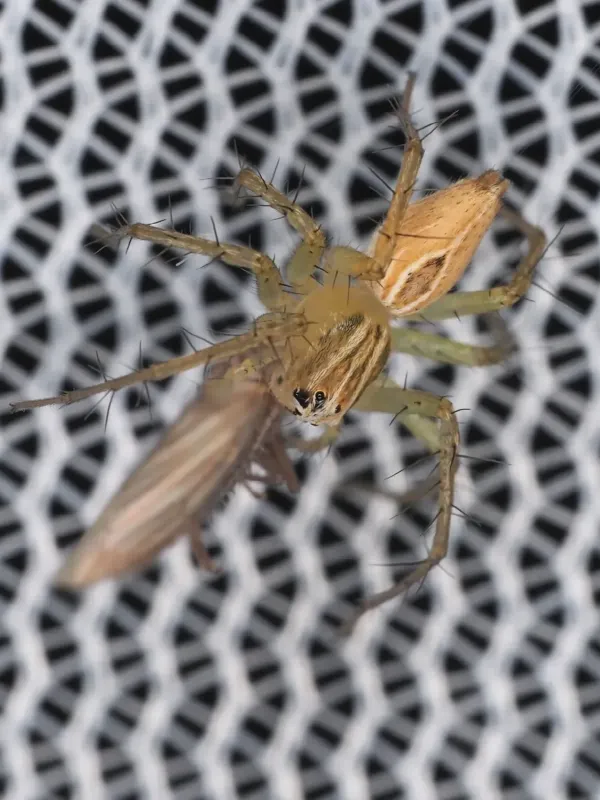
Description
How to identify
The striped lynx spider (Oxyopes salticus) is a member of the Oxyopidae family, commonly known for their unique hunting behavior that relies on agility rather than webs.
These spiders are easily identified by their long, spiky legs and a slender body, which allow them to move rapidly across vegetation to capture their prey.
The coloration of Oxyopes salticus is typically light yellow or brown, featuring distinct longitudinal stripes that provide excellent camouflage on foliage.
They possess an elevated head region with a unique eye arrangement that provides a wide field of vision, essential for spotting prey in complex environments.
Adult females are generally larger than males, usually reaching about 6–8 millimeters in length, though their small size often makes them hard to detect without close inspection.
What it damages
It is important to clarify that the striped lynx spider is not a plant pest; it is a highly beneficial predator that plays a key role in natural pest suppression.
These spiders consume a wide variety of pests, including aphids, leafhoppers, beetle larvae, and various caterpillars that threaten agricultural yields.
They are frequently observed in fields of cotton, soybean, and corn, where they act as effective biological control agents against herbivorous insects.
They cause no damage to the plants themselves, as they do not feed on plant tissues or sap, dedicating their energy entirely to hunting other insects.
Farmers who protect these spiders benefit from reduced pressure from major crop pests, ultimately lowering the need for chemical insecticide applications.
When it appears
The striped lynx spider becomes active in early spring, as temperatures rise to facilitate the metabolic needs of the insect population they prey upon.
Throughout the summer months, their population typically peaks, corresponding with the vigorous growth stages of major agricultural crops.
Reproductive activities occur during the warm season, after which females deposit their egg sacs on leaves or stems, often guarding them until hatching.
As autumn approaches, the spiders prepare for dormancy, seeking refuge from the cold in sheltered areas such as plant debris or soil crevices.
They overwinter as sub-adults or adults, remaining inactive until the environmental conditions become warm enough to trigger the next growth cycle.
Control measures
Since Oxyopes salticus is a beneficial organism, there is no need for control measures to eliminate it; instead, management should focus on its conservation.
Avoiding the use of broad-spectrum insecticides is crucial, as these chemicals can wipe out the spider population and disrupt natural biological control.
Implementing integrated pest management (IPM) practices allows farmers to maintain stable populations of these helpful spiders within their fields.
Preserving non-crop vegetation and field borders provides critical habitats for these predators to survive and thrive throughout the entire growing season.
Regular crop scouting and monitoring are encouraged to recognize the presence of beneficials and ensure that chemical sprays are used only when absolutely necessary.
Taxonomy
- Latin name
- Oxyopes salticus
- Family
- Oxyopidae
- EPPO code
- OXYSSA
Discussion
No discussions yet — be the first.