
Oxyopes javanus
Oxyopes javanus
Description
How to identify
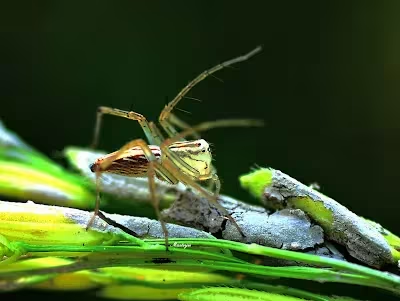
Oxyopes javanus is a species of lynx spider (family Oxyopidae). Unlike web-building spiders, they are active hunters that rely on their speed and agility to capture prey.
These spiders are characterized by long, spiny legs which allow them to navigate effectively across plant stems and leaves, making them highly mobile predators in rice fields.
Their coloration is typically a mix of green, yellow, and brown, providing excellent camouflage against the foliage, which is a key adaptation for their hunting strategy.
The cephalothorax is narrow, and their eye arrangement provides a wide field of vision, allowing them to detect movement in their surroundings instantly.
Females are known for their maternal care, as they guard their egg sacs attached to the leaves of plants, ensuring the survival of their offspring during the vulnerable early stages.
What it damages
While often found in rice cultivation, Oxyopes javanus is primarily a predator that feeds on various insects found within the canopy of the crops.
The "damage" caused is not direct feeding on plant tissue, but rather their ecological impact as predators that may disrupt the natural balance of beneficial insects.
In certain agricultural settings, high densities of these spiders can prey upon pollinators or natural enemies of actual crop pests, complicating integrated pest management.
They can interfere with the biological control of plant-feeding insects by competing with or consuming other parasitic wasps and predatory beetles.
Farmers and agronomists need to assess the density of the spider population to determine if they are acting as beneficial control agents or as factors that hinder local biodiversity.
When it appears
The activity of Oxyopes javanus is closely tied to the cropping cycle of the plants they inhabit, with populations peaking during the rainy season.
Development from egg to adult is highly dependent on environmental humidity and temperature, which facilitate the rapid growth of successive generations.
During the vegetative growth phase of crops, these spiders disperse throughout the field, utilizing the increasing plant density for hunting and reproduction.
Overwintering or periods of low activity occur during dry or cooler seasons, where individuals survive in leaf litter or soil crevices until favorable conditions return.
Systematic scouting should be conducted during the flowering and grain-filling stages to monitor the spider's impact on the local insect community.
Control measures
Management should focus on Integrated Pest Management (IPM) practices that prioritize the conservation of the entire ecosystem's predator-prey balance.
Broad-spectrum insecticides should be avoided as they often kill predatory spiders alongside actual pests, potentially leading to secondary pest outbreaks.
Maintaining clean field borders by managing weeds reduces the sheltered areas where these spiders aggregate, helping to limit their movement into crops.
Proper water management and crop spacing can discourage excessive spider density by altering the microclimate within the crop canopy.
Biological monitoring is recommended before applying any corrective measures, ensuring that decisions are based on the actual population threshold observed in the field.
Taxonomy
- Latin name
- Oxyopes javanus
- Family
- Oxyopidae
- EPPO code
- OXYSJA
Discussion
No discussions yet — be the first.